Advertisements
Advertisements
Give an example of each mixture having the following characteristics. Suggest a suitable method to separate the components of this mixture
Two immiscible liquids.
Concept: undefined >> undefined
When light is passed through water containing a few drops of milk, it shows a bluish tinge. This is due to the ______ of light by milk and the phenomenon is called ______. This indicates that milk is a ______ solution.
Concept: undefined >> undefined
Advertisements
Non-metals are usually poor conductors of heat and electricity. They are non-lustrous, non-sonorous, non-malleable and are coloured.
Name a lustrous non-metal.
Concept: undefined >> undefined
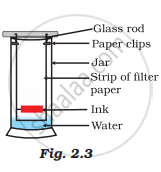
A child wanted to separate the mixture of dyes constituting a sample of ink. He marked a line by the ink on the filter paper and placed the filter paper in a glass containing water as shown in Fig.2.3. The filter paper was removed when the water moved near the top of the filter paper.
(i) What would you expect to see, if the ink contains three different coloured components?
(ii) Name the technique used by the child.
(iii) Suggest one more application of this technique.
Concept: undefined >> undefined
Calculate the mass of sodium sulphate required to prepare its 20% (mass percent) solution in 100g of water?
Concept: undefined >> undefined
How will the equations of motion for an object moving with a uniform velocity change?
Concept: undefined >> undefined
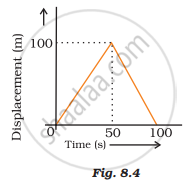
A girl walks along a straight path to drop a letter in the letterbox and comes back to her initial position. Her displacement–time graph is shown in Fig.8.4. Plot a velocity-time graph for the same.
Concept: undefined >> undefined
The velocity-time graph (Fig. 8.5) shows the motion of a cyclist. Find (i) its acceleration (ii) its velocity and (iii) the distance covered by the cyclist in 15 seconds.

Concept: undefined >> undefined
Draw a velocity versus time graph of a stone thrown vertically upwards and then coming downwards after attaining the maximum height.
Concept: undefined >> undefined
An object starting from rest travels 20 m in the first 2 s and 160 m in the next 4 s. What will be the velocity after 7 s from the start?
Concept: undefined >> undefined
An electron moving with a velocity of 5 × 10⁴ ms−1 enters into a uniform electric field and acquires a uniform acceleration of 104 ms–2 in the direction of its initial motion.
(i) Calculate the time in which the electron would acquire a velocity double of its initial velocity.
(ii) How much distance the electron would cover at this time?
Concept: undefined >> undefined
Two stones are thrown vertically upwards simultaneously with their initial velocities u1 and u2 respectively. Prove that the heights reached by them would be in the ratio of `"u"_1^2 : "u"_2^2` (Assume upward acceleration is –g and downward acceleration to be +g)
Concept: undefined >> undefined
A body is falling from a height of h. After it has fallen a height `"h"/2`, it will possess
Concept: undefined >> undefined
Rainfall patterns depend on
Concept: undefined >> undefined
What happens when rain falls on soil without vegetational cover?
Concept: undefined >> undefined
Find out the correct sentence about manure
- Manure contains large quantities of organic matter and small quantities of nutrients.
- It increases the water-holding capacity of sandy soil.
- It helps in draining out an excess of water from clayey soil.
- ts excessive use pollutes the environment because it is made of animal excretory waste.
Concept: undefined >> undefined
Soil supply ______ nutrients to plants.
Concept: undefined >> undefined
______ nutrients are required in large quantity and called as ______.
Concept: undefined >> undefined
Differentiate between compost and vermicompost?
Concept: undefined >> undefined
Differentiate between compost and vermicompost?
Concept: undefined >> undefined
