Please select a subject first
Advertisements
Advertisements
Write the following in decimal form and say what kind of decimal expansion has:
`329/400`
Concept: undefined >> undefined
Express the following in the form `bb(p/q)`, where p and q are integers and q ≠ 0.
`0.4bar7`
Concept: undefined >> undefined
Advertisements
Express the following in the form `bb(p/q)`, where p and q are integers and q ≠ 0.
`0.bar001`
Concept: undefined >> undefined
Study the following statement:
“Two intersecting lines cannot be perpendicular to the same line”.
Check whether it is an equivalent version to the Euclid’s fifth postulate.
[Hint: Identify the two intersecting lines l and m and the line n in the above statement.]
Concept: undefined >> undefined
Two lines are respectively perpendicular to two parallel lines. Show that they are parallel to each other.
Concept: undefined >> undefined
Which of the following is not a criterion for congruence of triangles?
Concept: undefined >> undefined
ABC is an isosceles triangle with AB = AC and BD and CE are its two medians. Show that BD = CE.
Concept: undefined >> undefined
ABC is a right triangle with AB = AC. Bisector of ∠A meets BC at D. Prove that BC = 2AD.
Concept: undefined >> undefined
In which of the following figures, you find two polygons on the same base and between the same parallels?
Concept: undefined >> undefined
Two parallelograms are on equal bases and between the same parallels. The ratio of their areas is ______.
Concept: undefined >> undefined
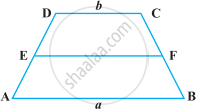
ABCD is a trapezium with parallel sides AB = a cm and DC = b cm (Figure). E and F are the mid-points of the non-parallel sides. The ratio of ar (ABFE) and ar (EFCD) is ______.
Concept: undefined >> undefined
PQRS is a rectangle inscribed in a quadrant of a circle of radius 13 cm. A is any point on PQ. If PS = 5 cm, then ar (PAS) = 30 cm2.
Concept: undefined >> undefined
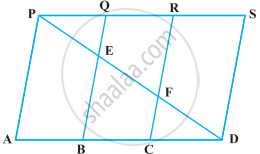
In the following figure, PSDA is a parallelogram. Points Q and R are taken on PS such that PQ = QR = RS and PA || QB || RC. Prove that ar (PQE) = ar (CFD).
Concept: undefined >> undefined
ABCD is a square. E and F are respectively the mid-points of BC and CD. If R is the mid-point of EF (Figure), prove that ar (AER) = ar (AFR)

Concept: undefined >> undefined
ABCD is a parallelogram in which BC is produced to E such that CE = BC (Figure). AE intersects CD at F. If ar (DFB) = 3 cm2, find the area of the parallelogram ABCD.
Concept: undefined >> undefined
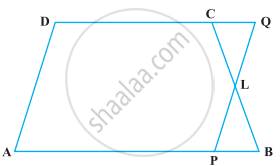
In trapezium ABCD, AB || DC and L is the mid-point of BC. Through L, a line PQ || AD has been drawn which meets AB in P and DC produced in Q (Figure). Prove that ar (ABCD) = ar (APQD)
Concept: undefined >> undefined
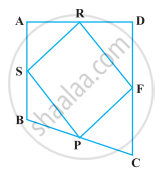
If the mid-points of the sides of a quadrilateral are joined in order, prove that the area of the parallelogram so formed will be half of the area of the given quadrilateral (Figure).
[Hint: Join BD and draw perpendicular from A on BD.]
Concept: undefined >> undefined
The diagonals of a parallelogram ABCD intersect at a point O. Through O, a line is drawn to intersect AD at P and BC at Q. Show that PQ divides the parallelogram into two parts of equal area.
Concept: undefined >> undefined
ABCD is a trapezium in which AB || DC, DC = 30 cm and AB = 50 cm. If X and Y are, respectively the mid-points of AD and BC, prove that ar (DCYX) = `7/9` ar (XYBA)
Concept: undefined >> undefined
In the following figure, ABCD and AEFD are two parallelograms. Prove that ar (PEA) = ar (QFD). [Hint: Join PD].

Concept: undefined >> undefined
