Please select a subject first
Advertisements
Advertisements
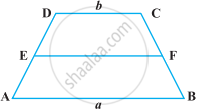
ABCD is a trapezium with parallel sides AB = a cm and DC = b cm (Figure). E and F are the mid-points of the non-parallel sides. The ratio of ar (ABFE) and ar (EFCD) is ______.
Concept: undefined >> undefined
PQRS is a rectangle inscribed in a quadrant of a circle of radius 13 cm. A is any point on PQ. If PS = 5 cm, then ar (PAS) = 30 cm2.
Concept: undefined >> undefined
Advertisements
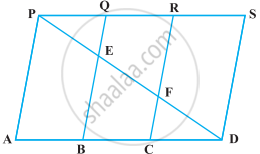
In the following figure, PSDA is a parallelogram. Points Q and R are taken on PS such that PQ = QR = RS and PA || QB || RC. Prove that ar (PQE) = ar (CFD).
Concept: undefined >> undefined
ABCD is a square. E and F are respectively the mid-points of BC and CD. If R is the mid-point of EF (Figure), prove that ar (AER) = ar (AFR)

Concept: undefined >> undefined
ABCD is a parallelogram in which BC is produced to E such that CE = BC (Figure). AE intersects CD at F. If ar (DFB) = 3 cm2, find the area of the parallelogram ABCD.
Concept: undefined >> undefined
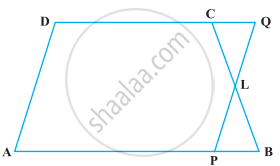
In trapezium ABCD, AB || DC and L is the mid-point of BC. Through L, a line PQ || AD has been drawn which meets AB in P and DC produced in Q (Figure). Prove that ar (ABCD) = ar (APQD)
Concept: undefined >> undefined
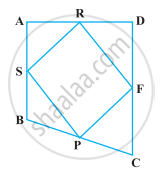
If the mid-points of the sides of a quadrilateral are joined in order, prove that the area of the parallelogram so formed will be half of the area of the given quadrilateral (Figure).
[Hint: Join BD and draw perpendicular from A on BD.]
Concept: undefined >> undefined
The diagonals of a parallelogram ABCD intersect at a point O. Through O, a line is drawn to intersect AD at P and BC at Q. Show that PQ divides the parallelogram into two parts of equal area.
Concept: undefined >> undefined
ABCD is a trapezium in which AB || DC, DC = 30 cm and AB = 50 cm. If X and Y are, respectively the mid-points of AD and BC, prove that ar (DCYX) = `7/9` ar (XYBA)
Concept: undefined >> undefined
In the following figure, ABCD and AEFD are two parallelograms. Prove that ar (PEA) = ar (QFD). [Hint: Join PD].

Concept: undefined >> undefined
If the perpendicular bisector of a chord AB of a circle PXAQBY intersects the circle at P and Q, prove that arc PXA ≅ arc PYB.
Concept: undefined >> undefined
A, B and C are three points on a circle. Prove that the perpendicular bisectors of AB, BC and CA are concurrent.
Concept: undefined >> undefined
If BM and CN are the perpendiculars drawn on the sides AC and AB of the triangle ABC, prove that the points B, C, M and N are concyclic.
Concept: undefined >> undefined
Two circles with centres O and O′ intersect at two points A and B. A line PQ is drawn parallel to OO′ through A(or B) intersecting the circles at P and Q. Prove that PQ = 2 OO′.
Concept: undefined >> undefined
With the help of a ruler and a compass it is not possible to construct an angle of ______.
Concept: undefined >> undefined
The construction of a triangle ABC, given that BC = 6 cm, ∠B = 45° is not possible when difference of AB and AC is equal to ______.
Concept: undefined >> undefined
The construction of a triangle ABC, given that BC = 3 cm, ∠C = 60° is possible when difference of AB and AC is equal to ______.
Concept: undefined >> undefined
An angle of 52.5° can be constructed.
Concept: undefined >> undefined
An angle of 42.5° can be constructed.
Concept: undefined >> undefined
A triangle ABC can be constructed in which AB = 5 cm, ∠A = 45° and BC + AC = 5 cm.
Concept: undefined >> undefined
