Advertisements
Advertisements
Divide as directed.
x(x + 1) (x + 2) (x + 3) ÷ x(x + 1)
Concept: undefined >> undefined
Factorise the expression and divide them as directed.
(y2 + 7y + 10) ÷ (y + 5)
Concept: undefined >> undefined
Advertisements
Factorise the expression and divide them as directed.
(m2 − 14m − 32) ÷ (m + 2)
Concept: undefined >> undefined
Factorise the expression and divide them as directed.
(5p2 − 25p + 20) ÷ (p − 1)
Concept: undefined >> undefined
Factorise the expression and divide them as directed.
4yz(z2 + 6z − 16) ÷ 2y(z + 8)
Concept: undefined >> undefined
Factorise the expression and divide them as directed.
5pq(p2 − q2) ÷ 2p(p + q)
Concept: undefined >> undefined
Factorise the expression and divide them as directed.
12xy(9x2 − 16y2) ÷ 4xy(3x + 4y)
Concept: undefined >> undefined
Factorise the expression and divide them as directed.
39y3(50y2 − 98) ÷ 26y2(5y + 7)
Concept: undefined >> undefined
The following graph shows the temperature of a patient in a hospital, recorded every hour.
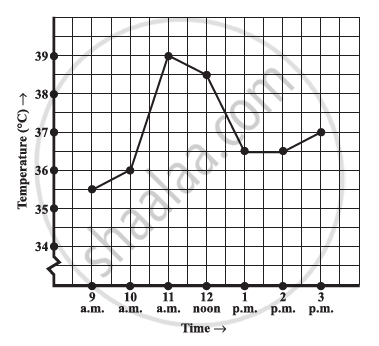
- What was the patient’s temperature at 1 p.m.?
- When was the patient’s temperature 38.5°C?
- The patient’s temperature was the same two times during the period given. What were these two times?
- What was the temperature at 1.30 p.m.? How did you arrive at your answer?
- During which periods did the patients’ temperature showed an upward trend?
Concept: undefined >> undefined
The following line graph shows the yearly sales figures for a manufacturing company.

- What were the sales in (i) 2002 (ii) 2006?
- What were the sales in (i) 2003 (ii) 2005?
- Compute the difference between the sales in 2002 and 2006.
- In which year was there the greatest difference between the sales as compared to its previous year?
Concept: undefined >> undefined
For an experiment in Botany, two different plants, plant A and plant B were grown under similar laboratory conditions. Their heights were measured at the end of each week for 3 weeks. The results are shown by the following graph.

- How high was Plant A after (i) 2 weeks (ii) 3 weeks?
- How high was Plant B after (i) 2 weeks (ii) 3 weeks?
- How much did Plant A grow during the 3rd week?
- How much did Plant B grow from the end of the 2nd week to the end of the 3rd week?
- During which week did Plant A grow most?
- During which week did Plant B grow least?
- Were the two plants of the same height during any week shown here? Specify.
Concept: undefined >> undefined
The following graph shows the temperature forecast and the actual temperature for each day of a week.

- On which days was the forecast temperature the same as the actual temperature?
- What was the maximum forecast temperature during the week?
- What was the minimum actual temperature during the week?
- On which day did the actual temperature differ the most from the forecast temperature?
Concept: undefined >> undefined
Use the tables below to draw linear graphs.
The number of days a hill side city received snow in different years.
| Year | 2003 | 2004 | 2005 | 2006 |
| Days | 8 | 10 | 5 | 12 |
Concept: undefined >> undefined
Use the tables below to draw linear graphs.
Population (in thousands) of men and women in a village in different years.
| Year | 2003 | 2004 | 2005 | 2006 | 2007 |
| Number of men | 12 | 12.5 | 13 | 13.2 | 13.5 |
| Number of women | 11.3 | 11.9 | 13 | 13.6 | 12.8 |
Concept: undefined >> undefined
A courier-person cycles from a town to a neighboring suburban area to deliver a parcel to a merchant. His distance from the town at different times is shown by the following graph.
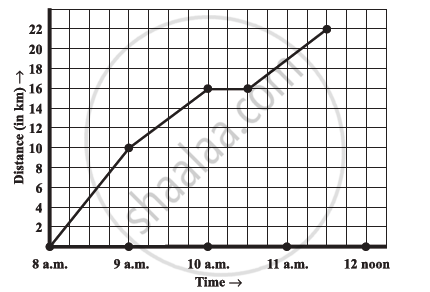
- What is the scale taken for the time axis?
- How much time did the person take for the travel?
- How far is the place of the merchant from the town?
- Did the person stop on his way? Explain.
- During which period did he ride fastest?
Concept: undefined >> undefined
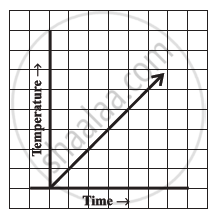
Can there be a time-temperature graph as follows? Justify your answer.
Concept: undefined >> undefined
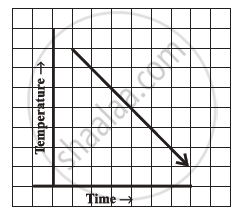
Can there be a time-temperature graph as follows? Justify your answer.
Concept: undefined >> undefined
Can there be a time-temperature graph as follows? Justify your answer.
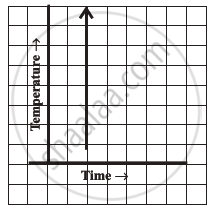
Concept: undefined >> undefined
Can there be a time-temperature graph as follows? Justify your answer.
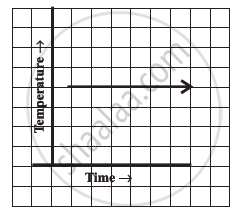
Concept: undefined >> undefined
Find the greatest common factor (GCF/HCF) of the following polynomial:
2x2 and 12x2
Concept: undefined >> undefined
