Advertisements
Advertisements
Draw a labeled diagram of a full wave rectifier circuit. State its working principle. Show the input-output waveforms ?
Concept: undefined >> undefined
A plot of magnetic flux (Φ) versus current (I) is shown in the figure for two inductors A and Β. Which of the two has larger value of self inductance?
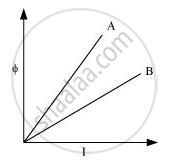
Concept: undefined >> undefined
Advertisements
Draw magnetic field line when a (i) diamagnetic, (ii) paramagnetic substance is placed in an external magnetic field. Which magnetic property distinguishes this behaviour of the field line due to the substances?
Concept: undefined >> undefined
What type of wavefront will emerge from a (i) point source, and (ii) distance light source?
Concept: undefined >> undefined
In a single slit diffraction experiment, when tiny circular obstacle is placed in path of light from a distance source, a bright spot is seen at the centre of the shadow of the obstacle. Explain why?
Concept: undefined >> undefined
State two points of difference between the interference patterns obtained in Young’s double slit experiment and the diffraction pattern due to a single slit.
Concept: undefined >> undefined
Define self inductance. Write its S.I. units.
Concept: undefined >> undefined
Derive an expression for self inductance of a long solenoid of length l, cross-sectional area A having N number of turns.
Concept: undefined >> undefined
Describe briefly, with the help of labelled diagram, working of a step-up transformer.
A step-up transformer converts a low voltage into high voltage. Does it not violate the principle of conservation of energy? Explain.
Concept: undefined >> undefined
Will the diffraction effects from a slit be more or less clearly visible if the slit-width is increased?
Concept: undefined >> undefined
The equation of refraction at a spherical surface is \[\frac{\mu_2}{\nu} - \frac{\mu_1}{\mu} = \frac{\mu_2 - \mu_1}{R}\]
Taking \[R = \infty\] show that this equation leads to the equation
\[\frac{\text{ Real depth }}{\text{ Apparent depth }} = \frac{\mu_2}{\mu_1}\]
for refraction at a plane surface.
Concept: undefined >> undefined
A point source of light is placed at a distance of 2 f from a converging lens of focal length f. The intensity on the other side of the lens is maximum at a distance
Concept: undefined >> undefined
A convex lens has a focal length of 10 cm. Find the location and nature of the image if a point object is placed on the principal axis at a distance of (a) 9.8 cm, (b) 10.2 cm from the lens.
Concept: undefined >> undefined
A slide projector has to project a 35 mm slide (35 mm × 23 mm) on a 2 m × 2 m screen at a distance of 10 m from the lens. What should be the focal length of the lens in the projector?
Concept: undefined >> undefined
A particle executes a simple harmonic motion of amplitude 1.0 cm along the principal axis of a convex lens of focal length 12 cm. The mean position of oscillation is at 20 cm from the lens. Find the amplitude of oscillation of the image of the particle.
Concept: undefined >> undefined
An extended object is placed at a distance of 5.0 cm from a convex lens of focal length 8.0 cm. (a) Draw the ray diagram (to the scale) to locate the image and from this, measure the distance of the image from the lens. (b) Find the position of the image from the lens formula and see how close the drawing is to the correct result.
Concept: undefined >> undefined
A converging lens of focal length 15 cm and a converging mirror of focal length 10 cm are placed 50 cm apart with common principal axis. A point source is placed in between the lens and the mirror at a distance of 40 cm from the lens. Find the locations of the two images formed.
Concept: undefined >> undefined
A converging lens of focal length 15 cm and a converging mirror of focal length 10 cm are placed 50 cm apart. If a pin of length 2.0 cm is placed 30 cm from the lens farther away from the mirror, where will the final image form and what will be the size of the final image?
Concept: undefined >> undefined
A 5 mm high pin is placed at a distance of 15 cm from a convex lens of focal length 10 cm. A second lens of focal length 5 cm is placed 40 cm from the first lens and 55 cm from the pin. Find (a) the position of the final image, (b) its nature and (c) its size.
Concept: undefined >> undefined
A point object is placed at a distance of 15 cm from a convex lens. The image is formed on the other side at a distance of 30 cm from the lens. When a concave lens is placed in contact with the convex lens, the image shifts away further by 30 cm. Calculate the focal lengths of the two lenses.
Concept: undefined >> undefined
