English
Karnataka Board PUCPUC Science Class 11

A Charge of 3.14 × 10⁻⁶ C is Distributed Uniformly Over a Circular Ring of Radius 20.0 Cm. the Ring Rotates About Its Axis with an Angular Velocity of 60.0 Rad S−1. - Physics

Advertisements
Advertisements

Question

A charge of 3.14 × 10⁻⁶ C is distributed uniformly over a circular ring of radius 20.0 cm. The ring rotates about its axis with an angular velocity of 60.0 rad s−1. Find the ratio of the electric field to the magnetic field at a point on the axis at a distance of 5.00 cm from the centre.

Short/Brief Note
Advertisements

Solution
Given:
Magnitude of charges, q =  3.14 × 10⁻⁶ C
Radius of the ring, 

\[r = 20 \text{ cm } = 20 \times {10}^{- 2} \] m
Angular velocity of the ring
\[\omega = 60\]  rad/s
Time for 1 revolution = \[\frac{2\pi}{60}\]
 
\[\therefore \text{ Current, i }= \frac{q}{t} = \frac{3 . 14 \times {10}^{- 6} \times 60}{2\pi}\]
\[ = 30 \times {10}^{- 6} A\]
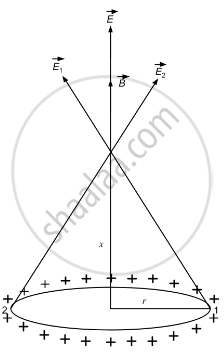
In the figure, E1 and E2 denotes the electric field at a point on the axis at a distance of 5.00 cm from the centre due to small element 1 and 2 of the ring respectively.
E is the resultant electric field due to the entire ring at a point on the axis at a distance of 5.00 cm from the centre.
The electric field at a point on the axis at a distance x from the centre is given by

\[E   =   \frac{xq}{4\pi \epsilon_0 ( x^2 + r^2 )^\frac{3}{2}}\] 

The magnetic field at a point on the axis at a distance x from the centre is given by

\[B = \frac{\mu_0}{2}\frac{i r^2}{( x^2 + r^2 )^{3/2}}\]
\[\frac{E}{B} = \frac{\frac{xq}{4\pi \epsilon_0 ( x^2 + r^2 )^\frac{3}{2}}}{\frac{\mu_0}{2}\frac{i r^2}{( x^2 + r^2 )^{3/2}}}\]
\[ = \frac{9 \times {10}^9 \times 3 . 14 \times {10}^{- 6} \times 2 \times (20 . 6 )^3 \times {10}^{- 6}}{25 \times {10}^{- 4} \times 4\pi \times {10}^{- 14} \times 12}\]
\[ = \frac{9 \times 3 . 14 \times 2 \times (20 . 6 )^3}{25 \times 4\pi \times 12}\]
\[ = 1 . 88 \times {10}^{15} \] m/s
shaalaa.com
  Is there an error in this question or solution?
Chapter 13: Magnetic Field due to a Current - Exercises [Page 252]

APPEARS IN

HC Verma Concepts of Physics Vol. 2 [English] Class 11 and 12
Chapter 13 Magnetic Field due to a Current
Exercises | Q 46 | Page 252

RELATED QUESTIONS

Use Biot-Savart law to derive the expression for the magnetic field on the axis of a current carrying circular loop of radius R.

Draw the magnetic field lines due to a circular wire carrying current I.


Two concentric circular coils X and Y of radii 16 cm and 10 cm, respectively, lie in the same vertical plane containing the north to south direction. Coil X has 20 turns and carries a current of 16 A; coil Y has 25 turns and carries a current of 18 A. The sense of the current in X is anticlockwise, and clockwise in Y, for an observer looking at the coils facing west. Give the magnitude and direction of the net magnetic field due to the coils at their centre.


Use Biot-Savart's law to find the expression for the magnetic field due to a circular loop of radius 'r' carrying current 'I', at its centre ?


A current-carrying, straight wire is kept along the axis of a circular loop carrying a current. This straight wire


A circular loop is kept in that vertical plane which contains the north-south direction. It carries a current that is towards north at the topmost point. Let A be a point on the axis of the circle to the east of it and B a point on this axis to the west of it. The magnetic field due to the loop 


Consider the situation shown in figure. The straight wire is fixed but the loop can move under magnetic force. The loop will


A steady electric current is flowing through a cylindrical conductor.
(a) The electric field at the axis of the conductor is zero.
(b) The magnetic field at the axis of the conductor is zero.
(c) The electric field in the vicinity of the conductor is zero.
(d) The magnetic field in the vicinity of the conductor is zero.


A circular loop of radius 20 cm carries a current of 10 A. An electron crosses the plane of the loop with a speed of 2.0 × 10⁶ m s−1. The direction of motion makes an angle of 30° with the axis of the circle and passes through its centre. Find the magnitude of the magnetic force on the electron at the instant it crosses the plane.


A circular loop of radius R carries a current I. Another circular loop of radius r(<<R) carries a current i and is placed at the centre of the larger loop. The planes of the two circles are at right angle to each other. Find the torque acting on the smaller loop. 


Find the magnetic field B due to a semicircular wire of radius 10.0 cm carrying a current of 5.0 A at its centre of curvature.


A circular loop of radius r carries a current i. How should a long, straight wire carrying a current 4i be placed in the plane of the circle so that the magnetic field at the centre becomes zero? 


A circular coil of 200 turns has a radius of 10 cm and carries a current of 2.0 A. (a) Find the magnitude of the magnetic field \[\vec{B}\] at the centre of the coil. (b) At what distance from the centre along the axis of the coil will the field B drop to half its value at the centre?

\[(\sqrt[3]{4} = 1 \cdot 5874 . . . )\]

If we double the radius of a coil keeping the current through it unchanged, then the magnetic field at any point at a large distance from the centre becomes approximately.


A charged particle moving in a uniform magnetic field and losses 4% of its kinetic energy. The radius of curvature of its path changes by ______.


A current is passed through a straight wire. The magnetic field established around it has its lines of force ______.

If ar and at represent radial and tangential accelerations, the motion of the particle will be uniformly circular, if:


Two horizontal thin long parallel wires, separated by a distance r carry current I each in the opposite directions. The net magnetic field at a point midway between them will be ______.


Share
Notifications

Englishहिंदीमराठी


      Forgot password?
Use app×