Advertisements
Advertisements
प्रश्न
A charge of 3.14 × 10⁻⁶ C is distributed uniformly over a circular ring of radius 20.0 cm. The ring rotates about its axis with an angular velocity of 60.0 rad s−1. Find the ratio of the electric field to the magnetic field at a point on the axis at a distance of 5.00 cm from the centre.
टीपा लिहा
Advertisements
उत्तर
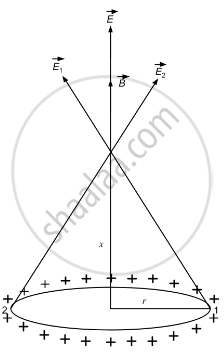
Given:
Magnitude of charges, q = 3.14 × 10⁻⁶ C
Radius of the ring,
\[r = 20 \text{ cm } = 20 \times {10}^{- 2} \] m
Angular velocity of the ring
\[\omega = 60\] rad/s
Time for 1 revolution = \[\frac{2\pi}{60}\]
\[\therefore \text{ Current, i }= \frac{q}{t} = \frac{3 . 14 \times {10}^{- 6} \times 60}{2\pi}\]
\[ = 30 \times {10}^{- 6} A\]
\[ = 30 \times {10}^{- 6} A\]
In the figure, E1 and E2 denotes the electric field at a point on the axis at a distance of 5.00 cm from the centre due to small element 1 and 2 of the ring respectively.
E is the resultant electric field due to the entire ring at a point on the axis at a distance of 5.00 cm from the centre.
The electric field at a point on the axis at a distance x from the centre is given by
E is the resultant electric field due to the entire ring at a point on the axis at a distance of 5.00 cm from the centre.
The electric field at a point on the axis at a distance x from the centre is given by
\[E = \frac{xq}{4\pi \epsilon_0 ( x^2 + r^2 )^\frac{3}{2}}\]
The magnetic field at a point on the axis at a distance x from the centre is given by
\[B = \frac{\mu_0}{2}\frac{i r^2}{( x^2 + r^2 )^{3/2}}\]
\[\frac{E}{B} = \frac{\frac{xq}{4\pi \epsilon_0 ( x^2 + r^2 )^\frac{3}{2}}}{\frac{\mu_0}{2}\frac{i r^2}{( x^2 + r^2 )^{3/2}}}\]
\[ = \frac{9 \times {10}^9 \times 3 . 14 \times {10}^{- 6} \times 2 \times (20 . 6 )^3 \times {10}^{- 6}}{25 \times {10}^{- 4} \times 4\pi \times {10}^{- 14} \times 12}\]
\[ = \frac{9 \times 3 . 14 \times 2 \times (20 . 6 )^3}{25 \times 4\pi \times 12}\]
\[ = 1 . 88 \times {10}^{15} \] m/s
\[\frac{E}{B} = \frac{\frac{xq}{4\pi \epsilon_0 ( x^2 + r^2 )^\frac{3}{2}}}{\frac{\mu_0}{2}\frac{i r^2}{( x^2 + r^2 )^{3/2}}}\]
\[ = \frac{9 \times {10}^9 \times 3 . 14 \times {10}^{- 6} \times 2 \times (20 . 6 )^3 \times {10}^{- 6}}{25 \times {10}^{- 4} \times 4\pi \times {10}^{- 14} \times 12}\]
\[ = \frac{9 \times 3 . 14 \times 2 \times (20 . 6 )^3}{25 \times 4\pi \times 12}\]
\[ = 1 . 88 \times {10}^{15} \] m/s
shaalaa.com
या प्रश्नात किंवा उत्तरात काही त्रुटी आहे का?
