English

Derive the Expression for the Torque on a Rectangular Current Carrying Loop Suspended in a Uniform Magnetic Field. - Physics

Advertisements
Advertisements

Question

Derive the expression for the torque on a rectangular current carrying loop suspended in a uniform magnetic field.

Advertisements

Solution

 Consider a rectangular loop ABCD carrying current I.

Case I - The rectangular loop is placed such that the uniform magnetic field B is in the plane of loop.

No force is exerted by the magnetic field on the arms AD and BC.

Magnetic field exerts a force F1 on arm AB.

F1 = IbB

Magnetic field exerts a force F2 on arm CD.

F2 = IbB = F1

Net force on the loop is zero.

The torque on the loop rotates the loop in anti-clockwise direction.

Torque, τ = `f_1  a/2 + f_2  a/2`

`= IbBa/2 +IbBa/2`

I(ab)B

τ = BIA

If there are ‘n’ such turns the torque will be nIAB

where, b → Breadth of the rectangular coil

a → Length of the rectangular coil

A = ab → Area of the coil

Case II - Plane of the loop is not along the magnetic field, but makes angle with it.
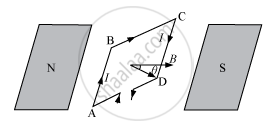
Angle between the field and the normal is θ.

Forces on BC and DA are equal and opposite and they cancel each other as they are collinear.

Force on AB is F1 and force on CD is F2.

F1 = F2 = IbB

Magnitude of torque on the loop as in the figure:
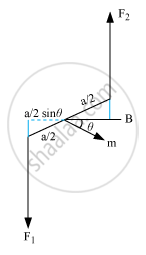
shaalaa.com
  Is there an error in this question or solution?
2012-2013 (March) Delhi Set 2

RELATED QUESTIONS

Two concentric circular coils X and Y of radii 16 cm and 10 cm, respectively, lie in the same vertical plane containing the north to south direction. Coil X has 20 turns and carries a current of 16 A; coil Y has 25 turns and carries a current of 18 A. The sense of the current in X is anticlockwise, and clockwise in Y, for an observer looking at the coils facing west. Give the magnitude and direction of the net magnetic field due to the coils at their centre.


Using Biot-Savart law, deduce the expression for the magnetic field at a point (x) on the axis of a circular current carrying loop of radius R. How is the direction of the magnetic field determined at this point?


A circular loop is kept in that vertical plane which contains the north-south direction. It carries a current that is towards north at the topmost point. Let A be a point on the axis of the circle to the east of it and B a point on this axis to the west of it. The magnetic field due to the loop 


Figure shows a long wire bent at the middle to form a right angle. Show that the magnitudes of the magnetic fields at the point P, Q, R and S are equal and find this magnitude. 


Figure shows a square loop ABCD with edge-length a. The resistance of the wire ABC is r and that of ADC is 2r. Find the magnetic field B at the centre of the loop assuming uniform wires. 


Two circular coils of radii 5.0 cm and 10 cm carry equal currents of 2.0 A. The coils have 50 and 100 turns respectively and are placed in such a way that their planes as well as the centres coincide. Find the magnitude of the magnetic field B at the common centre of the coils if the currents in the coils are (a) in the same sense (b) in the opposite sense. 


Find the magnetic field B due to a semicircular wire of radius 10.0 cm carrying a current of 5.0 A at its centre of curvature.


A circular loop of radius 4.0 cm is placed in a horizontal plane and carries an electric current of 5.0 A in the clockwise direction as seen from above. Find the magnetic field (a) at a point 3.0 cm above the centre of the loop (b) at a point 3.0 cm below the centre of the loop.


Magnetic field at the centre of a circular coil of radius r, through which a current I flows is ______.

Consider a circular current-carrying loop of radius R in the x-y plane with centre at origin. Consider the line intergral

`ℑ(L ) = |int_(-L)^L B.dl|` taken along z-axis.

  1. Show that ℑ(L) monotonically increases with L.
  2. Use an appropriate Amperian loop to show that ℑ(∞) = µ0I, where I is the current in the wire.
  3. Verify directly the above result.
  4. Suppose we replace the circular coil by a square coil of sides R carrying the same current I. What can you say about ℑ(L) and ℑ(∞)?

Share
Notifications

Englishहिंदीमराठी


      Forgot password?
Use app×