Advertisements
Advertisements
Which of the following graphs is correct for a first order reaction?


Concept: undefined >> undefined
State a condition under which a bimolecular reaction is kinetically first order reaction.
Concept: undefined >> undefined
Advertisements
With the help of an example explain what is meant by pseudo first order reaction.
Concept: undefined >> undefined
Extent of adsorption of adsorbate from solution phase increases with ______.
Concept: undefined >> undefined
Which of the following phenomenon is applicable to the process shown in the figure?
Concept: undefined >> undefined
Common impurities present in bauxite are:
(i) \[\ce{CuO}\]
(ii) \[\ce{ZnO}\]
(iii) \[\ce{Fe2O3}\]
(iv) \[\ce{SiO2}\]
Concept: undefined >> undefined
Which of the following elements does not show allotropy?
Concept: undefined >> undefined
Which of the following is correct for P4 molecule of white phosphorus?
(i) It has 6 lone pairs of electrons.
(ii) It has six P–P single bonds.
(iii) It has three P–P single bonds.
(iv) It has four lone pairs of electrons.
Concept: undefined >> undefined
Which of the following statements are correct?
(i) All the three N – O bond lengths in \[\ce{HNO3}\] are equal.
(ii) All P – Cl bond lengths in \[\ce{PCl5}\] molecule in gaseous state are equal.
(iii) \[\ce{P4}\] molecule in white phosphorus have angular strain therefore white phosphorus is very reactive.
(iv) \[\ce{PCl}\] is ionic in solid state in which cation is tetrahedral and anion is octahedral.
Concept: undefined >> undefined
Phosphorus has three allotropic forms — (i) white phosphorus (ii) red phosphorus and (iii) black phosphorus. Write the difference between white and red phosphorus on the basis of their structure and reactivity.
Concept: undefined >> undefined
Identify the optically active compounds from the following:
(i) \[\ce{[Co(en)3]^{3+}}\]
(ii) \[\ce{[trans - [Co(en)2Cl2]^+}\]
(iii) \[\ce{cis - [Co(en)2Cl2]^+}\]
(iv) \[\ce{[Cr(NH3)5Cl]}\]
Concept: undefined >> undefined
Which of the following reactions will yield phenol?
| (i) |  |
| (ii) | 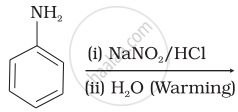 |
| (iii) | 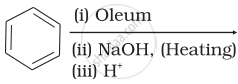 |
| (iv) |  |
Concept: undefined >> undefined
Name the starting material used in the industrial preparation of phenol.
Concept: undefined >> undefined
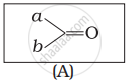
Which of the following is the correct representation for intermediate of nucleophilic addition reaction to the given carbonyl compound (A):
(i) 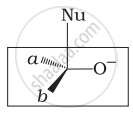
(ii) 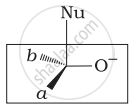
(iii) 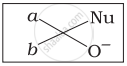
(iv) 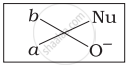
Concept: undefined >> undefined
Write a test to differentiate between pentan-2-one and pentan-3-one.
Concept: undefined >> undefined
Benzaldehyde can be obtained from benzal chloride. Write reactions for obtaining benzalchloride and then benzaldehyde from it.
Concept: undefined >> undefined
Alkenes  and carbonyl compounds
 , both contain a π bond but alkenes show electrophilic addition reactions whereas carbonyl compounds show nucleophilic addition reactions. Explain.
Concept: undefined >> undefined
Carboxylic acids contain carbonyl group but do not show the nucleophilic addition reaction like aldehydes or ketones. Why?
Concept: undefined >> undefined
Identify the compounds A, B and C in the following reaction.
\[\ce{CH3 - Br ->[Mg/ether] (A) ->[(i) CO][(ii) Water] (B) ->[CH3OH/H+][Δ] (C)}\]
Concept: undefined >> undefined
Which of the following should be most volatile?
Concept: undefined >> undefined
