Please select a subject first
Advertisements
Advertisements
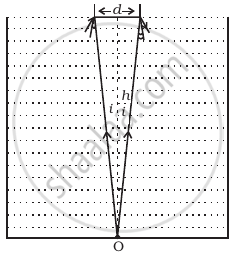
A jar of height h is filled with a transparent liquid of refractive index µ (Figure). At the centre of the jar on the bottom surface is a dot. Find the minimum diameter of a disc, such that when placed on the top surface symmetrically about the centre, the dot is invisible.
Concept: undefined >> undefined
A ray of light passes through a prism of refractive index `sqrt2` as shown in the figure. Find:
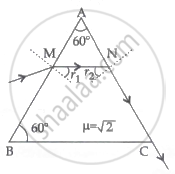
- The angle of incidence (∠r2) at face AC.
- The angle of minimum deviation for this prism.
Concept: undefined >> undefined
Advertisements
- Assertion (A): Propagation of light through an optical fibre is due to total internal reflection taking place at the core-cladding interface.
- Reason (R): Refractive index of the material of the cladding of the optical fibre is greater than that of the core.
Concept: undefined >> undefined
Calculate the distance of an object of height h from a concave mirror of radius of curvature 20 cm, so as to obtain a real image of magnification 2. Find the location of the image also.
Concept: undefined >> undefined
Give two reasons to explain why a reflecting telescope is preferred over a refracting telescope.
Concept: undefined >> undefined
Use the mirror equation to show that an object placed between f and 2f of a concave mirror produces a real image beyond 2f.
Concept: undefined >> undefined
Explain why the maxima at `theta=(n+1/2)lambda/a` become weaker and weaker with increasing n
Concept: undefined >> undefined
For a single slit of width "a", the first minimum of the interference pattern of a monochromatic light of wavelength λ occurs at an angle of λa. At the same angle of λa, we get a maximum for two narrow slits separated by a distance "a". Explain.
Concept: undefined >> undefined
Describe briefly how a diffraction pattern is obtained on a screen due to a single narrow slit illuminated by a monochromatic source of light. Hence obtain the conditions for the angular width of secondary maxima and secondary minima.
Concept: undefined >> undefined
Two wavelengths of sodium light of 590 nm and 596 nm are used in turn to study the diffraction taking place at a single slit of aperture 2 × 10⁻⁶ m. The distance between the slit and the screen is 1·5 m. Calculate the separation between the positions of first maxima of the diffraction pattern obtained in the two cases.
Concept: undefined >> undefined
Use the mirror equation to show that a convex mirror always produces a virtual image independent of the location of the object.
Concept: undefined >> undefined
Use the mirror equation to deduce that the virtual image produced by a convex mirror is always diminished in size and is located between the focus and the pole.
Concept: undefined >> undefined
Use the mirror equation to deduce that an object placed between the pole and focus of a concave mirror produces a virtual and enlarged image.
Concept: undefined >> undefined
Using mirror formula, explain why does a convex mirror always produce a virtual image.
Concept: undefined >> undefined
Use the mirror equation to show that an object placed between f and 2f of a concave mirror forms an image beyond 2f.
Concept: undefined >> undefined
Draw the intensity distribution for the diffraction bands produced due to single slit ?
Concept: undefined >> undefined
Define the term 'limit of resolution'?
Concept: undefined >> undefined
Two wavelengths of sodium light 590 nm and 596 nm are used, in turn to study the diffraction taking place at a single slit of aperture 2 × 10⁻⁴m. The distance between the slit and the screen is 1.5 m. Calculate the separation between the positions of the first maxima of the diffraction pattern obtained in the two cases.
Concept: undefined >> undefined
Two wavelengths of sodium light 590 nm and 596 nm are used, in turn, to study the diffraction taking place due to a single slit of aperture 1 × 10⁻⁴ m. The distance between the slit and the screen is 1.8 m. Calculate the separation between the positions of the first maxima of the diffraction pattern obtained in the two cases.
Concept: undefined >> undefined
Use the mirror equation to show a convex mirror always produces a virtual image independent of the location of the object ?
Concept: undefined >> undefined
