Please select a subject first
Advertisements
Advertisements
Can a plane mirror ever form a real image?
Concept: undefined >> undefined
A point source of light is placed in front of a plane mirror.
Concept: undefined >> undefined
Advertisements
following Figure shows two rays A and B being reflected by a mirror and going as A' and B'. The mirror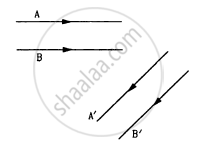
Concept: undefined >> undefined
The rays of different colours fail to converge at a point after going through a converging lens. This defect is called
Concept: undefined >> undefined
Mark the correct options.
Concept: undefined >> undefined
Which of the following (referred to a spherical mirror) do (does) not depend on whether the rays are paraxial or not?
(a) Pole
(b) Focus
(c) Radius of curvature
(d) Principal axis
Concept: undefined >> undefined
A light ray falling at an angle of 45° with the surface of a clean slab of ice of thickness 1.00 m is refracted into it at an angle of 30°. Calculate the time taken by the light rays to cross the slab. Speed of light in vacuum = 3 × 10⁸ m s−1.
Concept: undefined >> undefined
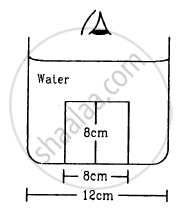
A cylindrical vessel of diameter 12 cm contains 800π cm3 of water. A cylindrical glass piece of diameter 8.0 cm and height 8.0 cm is placed in the vessel. If the bottom of the vessel under the glass piece is seen by the paraxial rays (see figure), locate its image. The index of refraction of glass is 1.50 and that of water is 1.33.
Concept: undefined >> undefined
A small object is placed at the centre of the bottom of a cylindrical vessel of radius 3 cm and height 4 cm filled completely with water. Consider the ray leaving the vessel through a corner. Suppose this ray and the ray along the axis of the vessel are used to trace the image. Find the apparent depth of the image and the ratio of real depth to the apparent depth under the assumptions taken. Refractive index of water = 1.33.
Concept: undefined >> undefined
A light ray is incident at an angle of 45° with the normal to a √2 cm thick plate (μ = 2.0). Find the shift in the path of the light as it emerges out from the plate.
Concept: undefined >> undefined
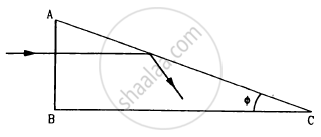
A light ray is incident normally on the face AB of a right-angled prism ABC (μ = 1.50) as shown in figure. What is the largest angle ϕ for which the light ray is totally reflected at the surface AC?
Concept: undefined >> undefined
Find the maximum angle of refraction when a light ray is refracted from glass (μ = 1.50) to air.
Concept: undefined >> undefined
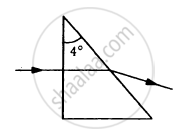
Find the angle of deviation suffered by the light ray shown in figure. The refractive index μ = 1.5 for the prism material.
Concept: undefined >> undefined
A light ray, going through a prism with the angle of prism 60°, is found to deviate by 30°. What limit on the refractive index can be put from these data?
Concept: undefined >> undefined
For paraxial rays, show that the focal length of a spherical mirror is one-half of its radius of curvature.
Concept: undefined >> undefined
Consider the diffraction pattern for a small pinhole. As the size of the hole is increased ______.
- the size decreases.
- the intensity increases.
- the size increases.
- the intensity decreases.
Concept: undefined >> undefined
A polariod (I) is placed in front of a monochromatic source. Another polatiod (II) is placed in front of this polaroid (I) and rotated till no light passes. A third polaroid (III) is now placed in between (I) and (II). In this case, will light emerge from (II). Explain.
Concept: undefined >> undefined

AC = CO = D, S1C = S2C = d << D
A small transparent slab containing material of µ = 1.5 is placed along AS2 (Figure). What will be the distance from O of the principal maxima and of the first minima on either side of the principal maxima obtained in the absence of the glass slab?
Concept: undefined >> undefined
Four identical monochromatic sources A, B, C, D as shown in the (Figure) produce waves of the same wavelength λ and are coherent. Two receiver R1 and R2 are at great but equal distances from B.
- Which of the two receivers picks up the larger signal?
- Which of the two receivers picks up the larger signal when B is turned off?
- Which of the two receivers picks up the larger signal when D is turned off?
- Which of the two receivers can distinguish which of the sources B or D has been turned off?

Concept: undefined >> undefined
Draw the graph showing intensity distribution of fringes with phase angle due to diffraction through a single slit. What is the width of the central maximum in comparison to that of a secondary maximum?
Concept: undefined >> undefined
