English
Karnataka Board PUCPUC Science 2nd PUC Class 12

A polariod (I) is placed in front of a monochromatic source. Another polatiod (II) is placed in front of this polaroid (I) and rotated till no light passes. A third polaroid (III) is now place - Physics

Advertisements
Advertisements

Question

A polariod (I) is placed in front of a monochromatic source. Another polatiod (II) is placed in front of this polaroid (I) and rotated till no light passes. A third polaroid (III) is now placed in between (I) and (II). In this case, will light emerge from (II). Explain.

Short/Brief Note
Advertisements

Solution

A polaroid (I) is placed in front of a monochromatic source. Another polaroid (II) is placed in front of this polaroid (I) when the pass axis of (II) is parallel to (I), light passes through polaroid-II unaffected.
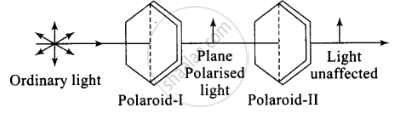
Now polaroid (II) is rotated till no light passes. In this situation, the pass of polaroid (II) is perpendicular to polaroid (I) and then (I) and (II) are set in crossed positions. No light passes through polaroid-II.

Now third polaroid (III) is now placed in between (I) and (II). Only in the special cases when the pass axis of (III) is parallel to (I) or (II), there shall be no light emerging. In all other cases, there shall be light emerging because the pass axis of (II) is no longer perpendicular to the pass axis of (III).

Now polaroid (II) is rotated till no light passes. In this situation, the pass axis of polaroid (II) is perpendicular to polaroid (I) and then (I) and (II) are set in crossed positions. No light passes through polaroid-II.

Now third polaroid (III) is now placed in between (I) and (II). Only in the special cases when the pass axis of (III) is parallel to (I) or (II), there shall be no light emerging. In all other cases, there shall be light emerging because the pass axis of (II) is no longer perpendicular to the pass axis of (III).

shaalaa.com
  Is there an error in this question or solution?
Chapter 10: Wave Optics - MCQ I [Page 65]

APPEARS IN

NCERT Exemplar Physics [English] Class 12
Chapter 10 Wave Optics
MCQ I | Q 10.15 | Page 65

RELATED QUESTIONS

What is 'diffraction of light'


Explain why the maxima at `theta=(n+1/2)lambda/a` become weaker and weaker with increasing n


Explain two types of diffraction of light.


In Fraunhofer diffraction, how is the angular width of the central bright fringe affected when slit separation is increased?


Show graphically the intensity distribution in Fraunhofer's single slit diffraction experiment. Label the axes.


Two wavelengths of sodium light 590 nm and 596 nm are used, in turn, to study the diffraction taking place due to a single slit of aperture 1 × 10⁻⁴ m. The distance between the slit and the screen is 1.8 m. Calculate the separation between the positions of the first maxima of the diffraction pattern obtained in the two cases.


In Fraunhofer diffraction, what kind of a source of light is used and where is it situated?


What should be the order of obstacle or aperture for diffraction of light?


Wavelength of light of frequency 100 Hz is


The penetration of light into the region of geomaterial shadow is called.


Direction of the first secondary maximum in the Fraunhoffer diffraction pattern at a single slit is given by (a is the width of the slit):


Which of the following device is used to study the spectra of light?


AC = CO = D, S1C = S2C = d << D

A small transparent slab containing material of µ = 1.5 is placed along AS2 (Figure). What will be the distance from O of the principal maxima and of the first minima on either side of the principal maxima obtained in the absence of the glass slab?


Four identical monochromatic sources A, B, C, D as shown in the (Figure) produce waves of the same wavelength λ and are coherent. Two receiver R1 and R2 are at great but equal distances from B.

  1. Which of the two receivers picks up the larger signal?
  2. Which of the two receivers picks up the larger signal when B is turned off?
  3. Which of the two receivers picks up the larger signal when D is turned off?
  4. Which of the two receivers can distinguish which of the sources B or D has been turned off?


How can you differentiate whether a pattern is produced by a single slit or double slit?


In a diffraction pattern due to a single slit, how will the angular width of the central maximum change, if the slit width is decreased?

Justify your answer.


Share
Notifications

Englishहिंदीमराठी


      Forgot password?
Use app×