Advertisements
Advertisements
प्रश्न
A polariod (I) is placed in front of a monochromatic source. Another polatiod (II) is placed in front of this polaroid (I) and rotated till no light passes. A third polaroid (III) is now placed in between (I) and (II). In this case, will light emerge from (II). Explain.
Advertisements
उत्तर
A polaroid (I) is placed in front of a monochromatic source. Another polaroid (II) is placed in front of this polaroid (I) when the pass axis of (II) is parallel to (I), light passes through polaroid-II unaffected.
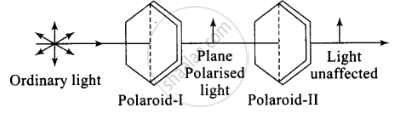
Now polaroid (II) is rotated till no light passes. In this situation, the pass of polaroid (II) is perpendicular to polaroid (I) and then (I) and (II) are set in crossed positions. No light passes through polaroid-II.

Now third polaroid (III) is now placed in between (I) and (II). Only in the special cases when the pass axis of (III) is parallel to (I) or (II), there shall be no light emerging. In all other cases, there shall be light emerging because the pass axis of (II) is no longer perpendicular to the pass axis of (III).

Now polaroid (II) is rotated till no light passes. In this situation, the pass axis of polaroid (II) is perpendicular to polaroid (I) and then (I) and (II) are set in crossed positions. No light passes through polaroid-II.
Now third polaroid (III) is now placed in between (I) and (II). Only in the special cases when the pass axis of (III) is parallel to (I) or (II), there shall be no light emerging. In all other cases, there shall be light emerging because the pass axis of (II) is no longer perpendicular to the pass axis of (III).
APPEARS IN
संबंधित प्रश्न
In a single slit diffraction pattern, the distance between first minima on the right and first minima on the left of central maximum is 4 mm. The screen on which the pattern is displaced, is 2m from the slit and wavelength of light used is 6000Å. Calculate width of the slit and width of the central maximum.
Explain why the maxima at `theta=(n+1/2)lambda/a` become weaker and weaker with increasing n
Explain two types of diffraction of light.
In Fraunhofer diffraction, how is the angular width of the central bright fringe affected when slit separation is increased?
Show graphically the intensity distribution in Fraunhofer's single slit diffraction experiment. Label the axes.
Draw the intensity distribution for the diffraction bands produced due to single slit ?
In Fraunhofer diffraction, what kind of a source of light is used and where is it situated?
The penetration of light into the region of geomaterial shadow is called.
The magnifying power of a telescope in normal adjustment is 24, when the length of the telescope tube 1 meter. The focal length of the eye lens is
Diffraction effects are easy to notice in the case of sound waves than in case of light waves because
Consider the diffraction pattern for a small pinhole. As the size of the hole is increased ______.
- the size decreases.
- the intensity increases.
- the size increases.
- the intensity decreases.
Draw the graph showing intensity distribution of fringes with phase angle due to diffraction through a single slit. What is the width of the central maximum in comparison to that of a secondary maximum?
Write two points of difference between an interference pattern and a diffraction pattern.
In a diffraction pattern due to a single slit, how will the angular width of the central maximum change, if orange light is used in place of green light?
Justify your answer.
In a diffraction pattern due to a single slit, how will the angular width of the central maximum change, if the screen is moved closer to the slit?
Justify your answer.
In a diffraction pattern due to a single slit, how will the angular width of the central maximum change, if the slit width is decreased?
Justify your answer.
Draw a labelled graph showing the variation in intensity of diffracted light with diffracting angle in a single slit Fraunhofer diffraction experiment.
