Please select a subject first
Advertisements
Advertisements
Concept: undefined >> undefined
Concept: undefined >> undefined
Advertisements
Dielectric constant for a metal is ______.
Concept: undefined >> undefined
When air is replaced by a dielectric medium of constant K, the maximum force of attraction between two charges separated by a distance ______.
Concept: undefined >> undefined
In a moving coil galvanometer the deflection (Φ) on the scale by a pointer attached to the spring is ______.
Concept: undefined >> undefined
A moving coil galvanometer can be converted into an ammeter by ______.
Concept: undefined >> undefined
The conversion of a moving coil galvanometer into a voltmeter is done by ______.
Concept: undefined >> undefined
Three capacitors 2µF, 3µF, and 6µF are joined in series with each other. The equivalent capacitance is ____________.
Concept: undefined >> undefined
The coil of a moving coil galvanometer is wound over a metal frame in order to ______.
Concept: undefined >> undefined
The current sensitivity of a galvanometer increase by 20%. If its resistance also increases by 25%, the voltage sensitivity will ______.
Concept: undefined >> undefined
Assertion (A): On Increasing the current sensitivity of a galvanometer by increasing the number of turns may not necessarily increase its voltage sensitivity.
Reason (R): The resistance of the coil of the galvanometer increases on increasing the number of turns.
Select the most appropriate answer from the options given below:
Concept: undefined >> undefined
A capacitor of 4 µ F is connected as shown in the circuit (Figure). The internal resistance of the battery is 0.5 Ω. The amount of charge on the capacitor plates will be ______.
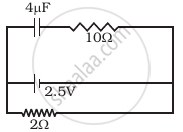
Concept: undefined >> undefined
Consider two conducting spheres of radii R1 and R2 with R1 > R2. If the two are at the same potential, the larger sphere has more charge than the smaller sphere. State whether the charge density of the smaller sphere is more or less than that of the larger one.
Concept: undefined >> undefined
Can the potential function have a maximum or minimum in free space?
Concept: undefined >> undefined
A parallel plate capacitor is filled by a dielectric whose relative permittivity varies with the applied voltage (U) as ε = αU where α = 2V–1. A similar capacitor with no dielectric is charged to U0 = 78V. It is then connected to the uncharged capacitor with the dielectric. Find the final voltage on the capacitors.
Concept: undefined >> undefined
A resistance R is to be measured using a meter bridge. Student chooses the standard resistance S to be 100Ω. He finds the null point at l1 = 2.9 cm. He is told to attempt to improve the accuracy. Which of the following is a useful way?
Concept: undefined >> undefined
The measurement of an unknown resistance R is to be carried out using Wheatstones bridge (figure). Two students perform an experiment in two ways. The first students takes R2 = 10 Ω and R1 = 5 Ω. The other student takes R2 = 1000 Ω and R1 = 500 Ω. In the standard arm, both take R3 = 5 Ω. Both find R = `R_2/R_1 R_3` = 10 Ω within errors.
- The errors of measurement of the two students are the same.
- Errors of measurement do depend on the accuracy with which R2 and R1 can be measured.
- If the student uses large values of R2 and R1, the currents through the arms will be feeble. This will make determination of null point accurately more difficult.
- Wheatstone bridge is a very accurate instrument and has no errors of measurement.
Concept: undefined >> undefined
A multirange voltmeter can be constructed by using a galvanometer circuit as shown in figure. We want to construct a voltmeter that can measure 2V, 20V and 200V using a galvanometer of resistance 10Ω and that produces maximum deflection for current of 1 mA. Find R1, R2 and R3 that have to be used.

Concept: undefined >> undefined
A multirange current meter can be constructed by using a galvanometer circuit as shown in figure. We want a current meter that can measure 10 mA, 100 mA and 1A using a galvanometer of resistance 10 Ω and that prduces maximum deflection for current of 1mA. Find S1, S2 and S3 that have to be used

Concept: undefined >> undefined
A myopic adult has a far point at 0.1 m. His power of accomodation is 4 diopters.
- What power lenses are required to see distant objects?
- What is his near point without glasses?
- What is his near point with glasses? (Take the image distance from the lens of the eye to the retina to be 2 cm.)
Concept: undefined >> undefined
