Please select a subject first
Advertisements
Advertisements
An observer to the left of a solenoid of N turns each of cross section area 'A' observes that a steady current I in it flows in the clockwise direction. Depict the magnetic field lines due to the solenoid specifying its polarity and show that it acts as a bar magnet of magnetic moment m = NIA.
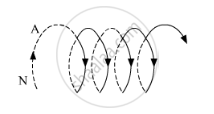
Concept: undefined >> undefined
Derive an expression for the mutual inductance of two long co-axial solenoids of same length wound one over the other,
Concept: undefined >> undefined
Advertisements
An electric dipole of dipole moment`vecp` consists of point charges +q and −q separated by a distance 2a apart. Deduce the expression for the electric field `vecE` due to the dipole at a distance x from the centre of the dipole on its axial line in terms of the dipole moment `vecp`. Hence show that in the limit x>> a, `vecE->2vecp"/"(4piepsilon_0x^3)`
Concept: undefined >> undefined
An electric dipole of length 4 cm, when placed with its axis making an angle of 60° with a uniform electric field, experiences a torque of `4sqrt3`Nm. Calculate the potential energy of the dipole, if it has charge ±8 nC
Concept: undefined >> undefined
A proton and a deuteron are accelerated through the same accelerating potential. Which one of the two has less momentum?
Give reasons to justify your answer.
Concept: undefined >> undefined
Two long coaxial insulated solenoids, S1 and S2 of equal lengths are wound one over the other as shown in the figure. A steady current "I" flow thought the inner solenoid S1 to the other end B, which is connected to the outer solenoid S2 through which the same current "I" flows in the opposite direction so as to come out at end A. If n1 and n2 are the number of turns per unit length, find the magnitude and direction of the net magnetic field at a point (i) inside on the axis and (ii) outside the combined system
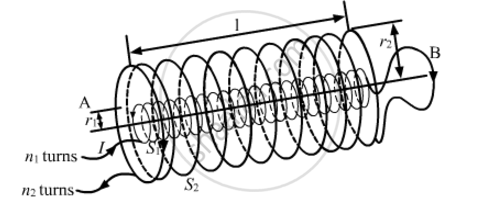
Concept: undefined >> undefined
Define the term self-inductance of a solenoid.
Concept: undefined >> undefined
Write its S.I. unit of (intensity of radiation)
Concept: undefined >> undefined
Obtain the expression for mutual inductance of a pair of long coaxial solenoids each of length l and radii r1 and r2 (r2 >> r1). Total number of turns in the two solenoids are N1 and N2, respectively.
Concept: undefined >> undefined
A system has two charges qA = 2.5 × 10⁻⁷ C and qB = −2.5 × 10⁻⁷ C located at points A: (0, 0, − 15 cm) and B: (0, 0, + 15 cm), respectively. What are the total charge and electric dipole moment of the system?
Concept: undefined >> undefined
Two tiny spheres carrying charges 1.5 μC and 2.5 μC are located 30 cm apart. Find the potential and electric field:
(a) at the mid-point of the line joining the two charges, and
(b) at a point 10 cm from this midpoint in a plane normal to the line and passing through the mid-point.
Concept: undefined >> undefined
Two charged conducting spheres of radii a and b are connected to each other by a wire. What is the ratio of electric fields at the surfaces of the two spheres? Use the result obtained to explain why charge density on the sharp and pointed ends of a conductor is higher than on its flatter portions.
Concept: undefined >> undefined
Two charges −q and +q are located at points (0, 0, −a) and (0, 0, a), respectively.
(a) What is the electrostatic potential at the points?
(b) Obtain the dependence of potential on the distance r of a point from the origin when r/a >> 1.
(c) How much work is done in moving a small test charge from the point (5, 0, 0) to (−7, 0, 0) along the x-axis? Does the answer change if the path of the test charge between the same points is not along the x-axis?
Concept: undefined >> undefined
A closely wound solenoid 80 cm long has 5 layers of windings of 400 turns each. The diameter of the solenoid is 1.8 cm. If the current carried is 8.0 A, estimate the magnitude of B inside the solenoid near its centre.
Concept: undefined >> undefined
A magnetic field of 100 G (1 G = 10−4 T) is required which is uniform in a region of linear dimension about 10 cm and area of cross-section about 10−3 m2. The maximum current-carrying capacity of a given coil of wire is 15 A and the number of turns per unit length that can be wound round a core is at most 1000 turns m−1. Suggest some appropriate design particulars of a solenoid for the required purpose. Assume the core is not ferromagnetic.
Concept: undefined >> undefined
Estimate the distance for which ray optics is good approximation for an aperture of 4 mm and wavelength 400 nm.
Concept: undefined >> undefined
In a single slit diffraction experiment, the width of the slit is made double the original width. How does this affect the size and intensity of the central diffraction band?
Concept: undefined >> undefined
In what way is diffraction from each slit related to the interference pattern in a double-slit experiment?
Concept: undefined >> undefined
Two students are separated by a 7 m partition wall in a room 10 m high. If both light and sound waves can bend around obstacles, how is it that the students are unable to see each other even though they can converse easily?
Concept: undefined >> undefined
Ray optics is based on the assumption that light travels in a straight line. Diffraction effects (observed when light propagates through small apertures/slits or around small obstacles) disprove this assumption. Yet the ray optics assumption is so commonly used in understanding location and several other properties of images in optical instruments. What is the justification?
Concept: undefined >> undefined
