Advertisements
Advertisements
How does the electric flux due to a point charge enclosed by a spherical Gaussian surface get affected when its radius is increased?
Concept: undefined >> undefined
Two cells of emfs 1.5 V and 2.0 V, having internal resistances 0.2 Ω and 0.3 Ω, respectively, are connected in parallel. Calculate the emf and internal resistance of the equivalent cell.
Concept: undefined >> undefined
Advertisements
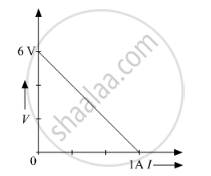
The plot of the variation of potential difference across a combination of three identical cells in series, versus current is shown below. What is the emf and internal resistance of each cell ?
Concept: undefined >> undefined
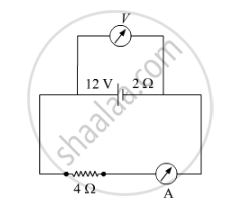
A battery of emf 12 V and internal resistance 2 Ω is connected to a 4 Ω resistor as shown in the figure.
(a) Show that a voltmeter when placed across the cell and across the resistor, in turn, gives the same reading.
(b) To record the voltage and the current in the circuit, why is voltmeter placed in parallel and ammeter in series in the circuit?
Concept: undefined >> undefined
Two identical cells of emf 1.5 V each joined in parallel, supply energy to an external circuit consisting of two resistances of 7 Ω each joined in parallel. A very high resistance voltmeter reads the terminal voltage of cells to be 1.4 V. Calculate the internal resistance of each cell.
Concept: undefined >> undefined
Deduce the expression for the potential energy of a system of two charges q1 and q2 located `vec(r_1)` and `vec(r_2)`, respectively, in an external electric field.
Concept: undefined >> undefined
Define electric flux.
Concept: undefined >> undefined
Write S.I unit of electric flux.
Concept: undefined >> undefined
Find out the outward flux to a point charge +q placed at the centre of a cube of side ‘a’. Why is it found to be independent of the size and shape of the surface enclosing it? Explain.
Concept: undefined >> undefined
Distinguish between emf and terminal voltage of a cell.
Concept: undefined >> undefined
"The outward electric flux due to charge +Q is independent of the shape and size of the surface which encloses is." Give two reasons to justify this statement.
Concept: undefined >> undefined
What is the electric flux through a cube of side 1 cm which encloses an electric dipole?
Concept: undefined >> undefined
A proton and an α-particle have the same de-Broglie wavelength Determine the ratio of their speeds.
Concept: undefined >> undefined
A cell of emf 'E' and internal resistance 'r' is connected across a variable load resistor R. Draw the plots of the terminal voltage V versus (i) R and (ii) the current I.
It is found that when R = 4 Ω, the current is 1 A and when R is increased to 9 Ω, the current reduces to 0.5 A. Find the values of the emf E and internal resistance r.
Concept: undefined >> undefined
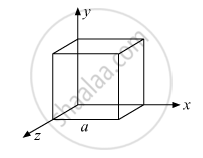
Given the electric field in the region `vecE=2xhati`, find the net electric flux through the cube and the charge enclosed by it.
Concept: undefined >> undefined
Given a uniform electric field `vecE=5xx10^3hati`N/C, find the flux of this field through a square of 10 cm on a side whose plane is parallel to the y-z plane. What would be the flux through the same square if the plane makes a 30° angle with the x-axis ?
Concept: undefined >> undefined
A cell of emf 'E' and internal resistance 'r' is connected across a variable resistor 'R'. Plot a graph showing variation of terminal voltage 'V' of the cell versus the current 'I'. Using the plot, show how the emf of the cell and its internal resistance can be determined.
Concept: undefined >> undefined
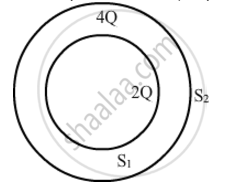
Consider two hollow concentric spheres, S1 and S2, enclosing charges 2Q and 4Q respectively as shown in the figure. (i) Find out the ratio of the electric flux through them. (ii) How will the electric flux through the sphere S1 change if a medium of dielectric constant 'εr' is introduced in the space inside S1 in place of air ? Deduce the necessary expression
Concept: undefined >> undefined
Consider a uniform electric field E = 3 × 10³ `hat i` N/C.
- What is the flux of this field through a square of 10 cm on a side whose plane is parallel to the yz plane?
- What is the flux through the same square if the normal to its plane makes a 60° angle with the x-axis?
Concept: undefined >> undefined
What is the net flux of the uniform electric field of previous question through a cube of side 20 cm oriented so that its faces are parallel to the coordinate planes?
Concept: undefined >> undefined
