Advertisements
Advertisements
State the dependence of angle of deviation on the refractive index of the material of the prism.
Concept: Refraction of Light Through a Rectangular Glass Block
State the dependence of angle of deviation on the wavelength of light
Concept: Refraction of Light Through a Rectangular Glass Block
Write a relationship between the angle of incidence and angle of refractions for a given pair of media.
Concept: Refraction of Light Through a Rectangular Glass Block
Name one factor that affects the lateral displacement of light as it passes through a rectangular glass slab.
Concept: Refraction of Light Through a Rectangular Glass Block
The speed of light in glass is 2 × 10⁵ km/s. What is the refractive index of glass?
Concept: Refraction of Light Through a Rectangular Glass Block
Jatin puts a pencil into a glass container having water and is surprised to see the pencil in a different state.
- What change is observed in the appearance of the pencil?
- Name the phenomenon responsible for the change.
- Draw a ray diagram showing how the eye sees the pencil.
Concept: Apparent Bending of a Stick Under Water
Draw the diagram given below and clearly show the path taken by the emergent ray.
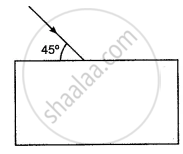
Concept: Refraction of Light Through a Rectangular Glass Block
A ray of light passes from water to air. How does the speed of light change?
Concept: Refraction of Light Through a Rectangular Glass Block
Which colour of light travels fastest in any medium except air?
Concept: Refraction of Light Through a Rectangular Glass Block
Name the factors affecting the critical angle for the pair of media.
Concept: Total Internal Reflection
Name a prism required for obtaining a spectrum of Ultraviolet light.
Concept: Refraction of Light Through a Rectangular Glass Block
Light passes through a rectangular glass slab and through a triangular glass prism. In what way does the direction of the two emergent beams differ and why?
Concept: Refraction of Light Through a Rectangular Glass Block
Why is the ratio of the velocities of light of wavelengths 4000Å and 8000Å in vacuum 1: 1?
Concept: Refraction of Light Through a Rectangular Glass Block
Which of the above wavelengths has a higher frequency?
Concept: Refraction of Light Through a Rectangular Glass Block
State the relation between the critical angle and the absolute refractive index of a medium.
Concept: Total Internal Reflection
Which colour of light has a higher critical angle? Red light or green light.
Concept: Total Internal Reflection
The following diagram shows a 60°, 30°, 90° glass prism of critical angle 42°, Copy the diagram and complete the path of incident ray AB emerging out of the prism marking the angle of incidence on each surface.
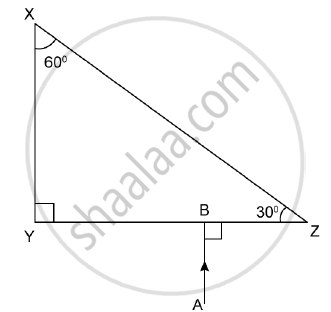
Concept: Refraction of Light Through a Rectangular Glass Block
A ray of light XY passes through a right-angled isosceles prism as shown below
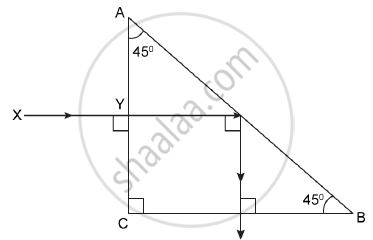
- What is the angle through which the incident ray deviates and emerges out of the prism?
- Name the instrument where this action of the prism is put into use.
- Which prism surface will behave as a mirror?
Concept: Total Internal Reflection in a Prism
Draw the diagram of a right-angled isosceles prism which is used to make an invented image erect.
Concept: Total Internal Reflection
How does the angle of deviation produced by a prism change with increase in the angle of incidence. Draw a curve showing the variation in the angle of deviation with the angle of incidence at a prism surface.
Concept: Refraction of Light Through a Rectangular Glass Block
