Definitions [11]
The collection of all anti-derivatives of a function is called its indefinite integral.
If \[ F'(x) = f(x), \]
then \[ \int f(x)\, dx = F(x) + C \]
Here: f(x) = integrand, dx = variable of integration, C = constant of integration.
A definite integral is connected with finding the area under a curve over a given interval. The chapter introduction presents area as one of the central motivating ideas behind integral calculus.
If the derivative of a function F(x) is f(x), then F(x) is called an antiderivative or integral of f(x). The set of all such antiderivatives is written as:
where C is an arbitrary constant called the constant of integration.
Integration by substitution is a method in which we replace a part of the integral by a new variable to simplify the integration.
General Formula:
If \[x = g(t), \ dx = g'(t) dt\] then \[\int f(x) dx = \int f(g(t))g'(t) dt\]
Proper Rational Function
A rational function \[ \frac{P(x)}{Q(x)} \] is called proper if \[ \deg P(x) < \deg Q(x). \]
Improper Rational Function
It is called improper if \[ \deg P(x) \geq \deg Q(x). \]
An improper rational function must first be reduced to a proper rational function by long division.
A rational function is a function of the form \[ \frac{P(x)}{Q(x)} \] where P(x) and Q(x) are polynomials and Q(x) \neq 0.
Integration by partial fractions is a method used to integrate rational functions, that is, functions of the form
\[\frac{p(x)}{q(x)}\], where both numerator and denominator are polynomials.
A proper rational function can be expressed as a sum of simpler rational functions called partial fractions.
Integration by parts is a method of integration based on the product rule of differentiation.
If u and v are differentiable functions, then \[ \boxed{\int u\, dv = uv - \int v\, du} \]
For a product f(x)g(x), \[ \boxed{\int f(x)g(x)\, dx = f(x)\int g(x)\, dx - \int\left[f'(x)\int g(x)\, dx\right]dx} \]
Integration using trigonometric identities means converting a trigonometric expression into an easier form with the help of standard identities before integrating.
A definite integral represents the value of a function accumulated between two limits.
It can also be interpreted geometrically as the net area between the graph of y = f(x) and the x-axis from x = a to x = b.
If a function f is continuous on an interval, the area function is defined by
This means that A(x) gives the area accumulated from x = a to a variable point x.
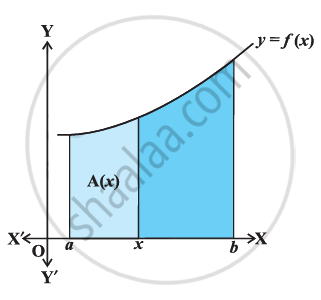
Formulae [2]
| No. | Derivatives | Integrals (Anti-derivatives) |
|---|---|---|
| (i) | \[\frac{d}{dx} \left( \frac{x^{n+1}}{n+1} \right) = x^n\]; | \[\int x^n dx = \frac{x^{n+1}}{n+1} + \text{C}, n \neq -1\] |
| \[\frac{d}{dx} (x) = 1\]; | \[\int dx = x + \text{C}\] | |
| (ii) | \[\frac{d}{dx} (\sin x) = \cos x\]; | \[\int \cos x dx = \sin x + \text{C}\] |
| (iii) | \[\frac{d}{dx} (-\cos x) = \sin x\]; | \[\int \sin x dx = -\cos x + \text{C}\] |
| (iv) | \[\frac{d}{dx} (\tan x) = \sec^2 x\]; | \[\int \sec^2 x dx = \tan x + \text{C}\] |
| (v) | \[\frac{d}{dx} (-\cot x) = \text{cosec}^2 x\]; | \[\int \text{cosec}^2 x dx = -\cot x + \text{C}\] |
| (vi) | \[\frac{d}{dx} (\sec x) = \sec x \tan x\]; | \[\int \sec x \tan x dx = \sec x + \text{C}\] |
| (vii) | \[\frac{d}{dx} (-\text{cosec} x) = \text{cosec} x \cot x\]; | \[\int \text{cosec} x \cot x dx = -\text{cosec} x + \text{C}\] |
| (viii) | \[\frac{d}{dx} (\sin^{-1} x) = \frac{1}{\sqrt{1-x^2}}\]; | \[\int \frac{dx}{\sqrt{1-x^2}} = \sin^{-1} x + \text{C}\] |
| (ix) | \[\frac{d}{dx} (-\cos^{-1} x) = \frac{1}{\sqrt{1-x^2}}\]; | \[\int \frac{dx}{\sqrt{1-x^2}} = -\cos^{-1} x + \text{C}\] |
| (x) | \[\frac{d}{dx} (\tan^{-1} x) = \frac{1}{1+x^2}\]; | \[\int \frac{dx}{1+x^2} = \tan^{-1} x + \text{C}\] |
| (xi) | \[\frac{d}{dx} (e^x) = e^x\]; | \[\int e^x dx = e^x + \text{C}\] |
| (xii) | \[\frac{d}{dx}\left(\log|x|\right)=\frac{1}{x};\] | \[\int\frac{1}{x}dx=\log|x|+\mathrm{C}\] |
| (xiii) | \[\frac{d}{dx} \left( \frac{a^x}{\log a} \right) = a^x\]; | \[\int a^x dx = \frac{a^x}{\log a} + \text{C}\] |
-
\[\int \frac{dx}{x^2 - a^2} = \frac{1}{2a} \log \left| \frac{x - a}{x + a} \right| + C\]
-
\[\int \frac{dx}{a^2 - x^2} = \frac{1}{2a} \log \left| \frac{a + x}{a - x} \right| + C\]
-
\[\int \frac{dx}{x^2 + a^2} = \frac{1}{a} \tan^{-1} \left(\frac{x}{a}\right) + C\]
-
\[\int \frac{dx}{\sqrt{x^2 - a^2}} = \log \left| x + \sqrt{x^2 - a^2} \right| + C\]
-
\[\int \frac{dx}{\sqrt{a^2 - x^2}} = \sin^{-1} \left(\frac{x}{a}\right) + C\]
-
\[\int \frac{dx}{\sqrt{x^2 + a^2}} = \log \left| x + \sqrt{x^2 + a^2} \right| + C\]
Theorems and Laws [3]
Prove that: `int sqrt(a^2 - x^2) * dx = x/2 * sqrt(a^2 - x^2) + a^2/2 * sin^-1(x/a) + c`
Let I = `int sqrt(a^2 - x^2) dx`
= `int sqrt(a^2 - x^2)*1 dx`
= `sqrt(a^2 - x^2)* int 1 dx - int [d/dx (sqrt(a^2 - x^2))* int 1 dx]dx`
= `sqrt(a^2 - x^2)*x - int [1/(2sqrt(a^2 - x^2))*d/dx (a^2 - x^2)*x]dx`
= `sqrt(a^2 - x^2)*x - int 1/(2sqrt(a^2 - x^2))(0 - 2x)*x dx`
= `sqrt(a^2 - x^2)*x - int (-x)/sqrt(a^2 - x^2)*x dx`
= `xsqrt(a^2 - x^2) - int (a^2 - x^2 - a^2)/sqrt(a^2 - x^2)dx`
= `xsqrt(a^2 - x^2) - int sqrt(a^2 - x^2)dx + a^2 int dx/sqrt(a^2 - x^2)`
= `xsqrt(a^2 - x^2) - I + a^2sin^-1(x/a) + c_1`
∴ 2I = `xsqrt(a^2 - x^2) + a^2sin^-1(x/a) + c_1`
∴ I = `x/2 sqrt(a^2 - x^2) + a^2/2 sin^-1(x/a) + c_1/2`
∴ `int sqrt(a^2 - x^2)dx = x/2 sqrt(a^2 - x^2) + a^2/2sin^-1(x/a) + c`, where `c = c_1/2`.
If f is continuous on [a, b] and
If f is continuous on [a, b] and F is any antiderivative of f, then
This is the formula most often used in exams to evaluate definite integrals.
Key Points
- Primitive
Another name for anti-derivative. - Indefinite Integral
The family of all anti-derivatives of a function. - Definite Integral
An integral taken between two fixed limits, commonly used to represent area or total accumulation. - Integral Calculus
The branch of calculus dealing with anti-derivatives, accumulation, and areas under curves.
-
Integration is the inverse process of differentiation.
-
The result of indefinite integration is called the antiderivative or primitive.
-
The indefinite integral is written as: ∫f(x) dx = F(x) + C.
-
The constant C must always be added in indefinite integrals.
| Property | Formula |
| Reverse of differentiation | \[\frac{d}{dx}\left(\int f(x) dx\right) = f(x)\] |
| Same derivative | \[F'(x) = G'(x) \Rightarrow F(x) = G(x) + C\] |
| Sum rule | \[\int (f + g)dx = \int fdx + \int gdx\] |
| Difference rule | \[\int (f - g)dx = \int fdx - \int gdx\] |
| Constant multiple rule | \[\int k f(x)dx = k \int f(x)dx\] |
| General linearity | \[\int (kf \pm lg)dx = k \int fdx \pm l \int gdx\] |
-
Integration by substitution is the reverse process of the chain rule.
-
Choose the substitution so that the integral becomes simpler, not more complicated.
-
Always rewrite both the function and \(dx\) in terms of the new variable.
-
For indefinite integrals, back-substitute and add \(C\).
-
For definite integrals, limits should also be changed if the solution is continued in the new variable.
-
Trigonometric substitution is mainly used for radicals involving \(a^2-x^2\), \(x^2+a^2\), and \(x^2-a^2\).
-
First check whether the rational function is proper or improper.
-
Use long division before decomposition if the fraction is improper.
-
Factorise the denominator completely before choosing partial fractions.
-
For each distinct linear factor, use a constant numerator such as A, B, or C.
-
For a repeated linear factor, include every power separately.
-
For an irreducible quadratic factor, use a linear numerator of the form Bx + C.
-
After decomposition, integrate each term separately using standard formulas.
-
Convert the integrand into a known standard form before integrating.
-
For \[x^2 - a^2\], factorize and use partial fractions.
-
For \[x^2 + a^2\], the answer usually involves \[\tan^{-1}\].
-
For \[\sqrt{a^2 - x^2}\], the answer usually involves \[\sin^{-1}\].
-
For general quadratics, complete the square first.
-
For \[px + q\] in the numerator, relate it to the derivative of the denominator.
-
Always write the constant of integration C in the final answer.
-
Formula:
\[\int u dv = uv - \int v du\] -
Choose u by LIATE
-
For log x and inverse trig, multiply by 1
-
Repeated parts may be needed for \[e^x \sin x\], \[e^x \cos x\].
-
First inspect the pattern in the integrand.
-
Do not integrate complicated trigonometric expressions directly if an identity can simplify them first.
-
After simplification, integrate term by term carefully.
-
Always add the constant of integration, \(C\).
-
Used to find exact accumulated value over a fixed interval.
-
Written as \[\int_{a}^{b} f(x) \, dx\].
-
Evaluated using \[F(b) - F(a)\].
-
Gives a unique numerical value.
-
Represents net area geometrically.
-
The theorem connects differentiation and integration.
-
If \[A(x) = \int_{a}^{x} f(t) \, dt\], then \[A'(x) = f(x)\].
-
If F'(x) = f(x), then \[\int_{a}^{b} f(x) \, dx = F(b) - F(a)\].
-
The result is used to evaluate definite integrals quickly.
-
The function should be continuous on the interval for direct use of the theorem.
-
Look for an inner function and its derivative.
-
Choose substitution carefully.
-
If the integral is continued in the new variable, change the limits accordingly.
-
Integrate in the new variable.
-
Do not add +C in a definite integral.
- Once the limits have been changed to the new variable, there is no need to substitute back to the original variable.
Concepts [15]
- Integration
- Integration as an Inverse Process of Differentiation
- Geometrical Interpretation of Indefinite Integrals
- Properties of Indefinite Integral
- Comparison Between Differentiation and Integration
- Methods of Integration> Integration by Substitution
- Methods of Integration> Integration Using Partial Fraction
- Integrals of Some Particular Functions
- Methods of Integration> Integration by Parts
- Methods of Integration>Integration Using Trigonometric Identities
- Definite Integrals
- Definite Integral as the Limit of a Sum
- Fundamental Theorem of Integral Calculus
- Evaluation of Definite Integrals
- Properties of Definite Integrals
