Definitions [78]
Define molar specific heat capacity.
Molar specific heat capacity is defined as heat energy required to increase the temperature of one mole of a substance by IK or 1°C.
C = `1/μ ((Δ"Q")/(Δ"T"))`
Define specific heat capacity.
Specific heat capacity of a substance is defined as the amount of heat energy required to raise the temperature of 1 kg of a substance by 1 Kelvin or 1°C.
Define thermal conductivity.
The quantity of heat transferred through a unit length of a material in a direction normal to Unit surface area due to a unit temperature difference under steady-state conditions is known as the thermal conductivity of a material.
Define latent heat capacity.
Latent heat capacity of a substance is defined as the amount of heat energy required to change the state of a unit mass of the material.
"Heat is energy in transit. When two bodies at different temperatures are brought in contact, they exchange heat."
OR
The form of energy which is exchanged among various bodies or a system on account of temperature differences is called heat.
-
Units: joule (J), calorie (cal), BTU (British Thermal Unit)
Define one mole.
One mole of any substance is the amount of that substance which contains the Avogadro number (NA) of particles (such as atoms or molecules).
"Temperature is a physical quantity that defines the thermodynamic state of a system."
OR
The degree of hotness or coldness of a body, whose natural flow is from a higher temperature to a lower temperature, is called temperature.
-
SI unit: kelvin (K) | Scalar quantity
An adiabatic wall is an ideal partition that completely prevents heat transfer between two systems. In diagrams, it is shown as a thick, cross-hatched (slanting lines) region.
Thermometry is the branch of physics dealing with temperature measurement. It relies on the principle that certain physical properties of materials change continuously and predictably with temperature.
The temperature at which pure water boils and vapourises into steam at 1 atm pressure is called the steam point or boiling point.
The temperature at which pure water freezes at 1 atm pressure is called the ice point.
When two bodies at different temperatures are brought into contact through a diathermic wall, heat flows from the hotter body to the cooler one. This continues until both reach the same temperature, at which point heat flow stops. This state is called thermal equilibrium.
A diathermic wall is a partition that freely allows heat to flow between two systems. It is shown as a thin dark line in diagrams. A thin copper sheet is a good example.
One kelvin = 1/273.16 of the difference between absolute zero and the triple point of water.
The temperature scale where −273.15°C corresponds to 0 K, i.e., the temperature at which the pressure of a gas would become zero, is called the absolute temperature (0 K).
A hypothetical gas whose molecules have no volume and exert no intermolecular forces; obeys PV = μRT exactly.
The unique temperature & pressure at which solid, liquid, and gas phases of a substance coexist in equilibrium.
OR
The temperature where the solid, liquid, and gas state of a material co-exist in equilibrium, and this occurs only at a unique temperature and pressure, is called the triple point.
The SI absolute temperature scale starting at absolute zero. Written as K (no degree symbol °).
The lowest theoretically possible temperature (0 K = −273.15 °C), where ideal gas molecules have zero kinetic energy.
OR
The lowest attainable temperature, obtained by plotting the relation between pressure of the gas vs its temperature, where all lines for different gases cut the temperature axis at the same point (−273.15°C), is called the absolute zero of temperature.
Extending a graph line beyond the measured data to predict values.
A constant in the ideal gas equation; R = 8.31 J mol⁻¹ K⁻¹.
“The relation between three properties of a gas, i.e., pressure, volume and temperature, is called the ideal gas equation.”
OR
The relation between the three properties of a gas – pressure (P), volume (V), and temperature (T) – expressed as PV = nRT is called the ideal gas equation.
The change in area per unit original surface area of a two-dimensional body (at 0°C) per unit rise in temperature is called the coefficient of superficial expansion.
The increase in length per unit original length of a rod (at 0°C) per unit rise in temperature is called the coefficient of linear expansion.
The increase in the dimensions (length, area, or volume) of a body due to an increase in its temperature is called thermal expansion. Conversely, a decrease in temperature causes contraction.
OR
The increase in the dimensions of a body due to an increase in its temperature is called thermal expansion.
OR
When matter changes its shape, area and volume in response to a change in temperature (i.e., an object expands and becomes larger due to a change in its temperature), this is called thermal expansion.
Answer the following question.
What is thermal stress?
- Consider a metallic rod of length l0 fixed between two rigid supports at T °C.
- If the temperature of rod is increased by ΔT, length of the rod would become, l = l0 (1 + αΔT) Where, α is the coefficient of linear expansion of the material of the rod.
- But the supports prevent the expansion of the rod. As a result, rod exerts stress on the supports. Such stress is termed as thermal stress.
The increase in volume of a body per unit original volume (at 0°C) per unit rise in temperature is called the coefficient of cubical expansion.
The coefficient of linear expansion of a solid is thus defined as the increase in the length per unit original length at 0 °C for a one-degree centigrade rise in temperature.
Linear expansion is the increase in length of a solid due to an increase in temperature. It occurs primarily in one dimension — along the length of the object (e.g., a rod, wire, or rail).
The coefficient of areal expansion of a solid is defined as the increase in the area per unit original area at 0°C for one degree rise in temperature.
Unit: °C⁻¹ or K⁻¹
Dimensions: [L⁰ M⁰ T⁰ K⁻¹]
The increase ΔA in the surface area of a solid, on heating, is called areal expansion or superficial expansion.
When a solid, liquid, or gas is heated, it expands in all three dimensions: length, breadth, and height, resulting in an increase in its overall volume. This phenomenon is called volume expansion (also known as cubical expansion).
The coefficient of cubical expansion of a solid is therefore defined as the increase in volume per unit original volume at 0°C for one degree rise in the temperature.
The amount of heat required to raise the temperature of one mole of a substance through a unit degree Celsius or Kelvin is called molar heat capacity.
The specific heat capacity of a substance is the amount of heat energy required to raise the temperature of unit mass of that substance through 1°C (or 1 K).
OR
Heat capacity of a body when expressed for the unit mass is called the specific heat capacity of the substance of that body.
OR
The amount of heat energy required to raise the temperature of a unit mass of an object by 1 °C is called the specific heat of that object.
OR
The amount of heat per unit mass absorbed or given out by a substance to change its temperature by one unit (one degree), i.e., 1°C or 1 K, is called specific heat capacity.
OR
The quantity of heat required to raise the temperature of a unit mass of a gas by one degree, whose exact value depends upon the mode of heating the gas and can range from zero to infinity or even be negative, is called the specific heat capacity of a gas.
The quantity of heat needed to raise the temperature of the whole body by 1°C (or 1 K) is called heat capacity.
OR
The amount of heat ΔQΔQ supplied to a substance to change its temperature from T to T + ΔT, per unit mass per unit degree change in temperature, is called specific heat:
-
Unit: J kg⁻¹ K⁻¹
Define heat capacity.
The heat capacity of a body is the quantity of heat required to raise its temperature by 1°C. It depends upon the mass and the nature of the body.
Specific heat capacity is defined as the amount of heat per unit mass absorbed or given out by the substance to change its temperature by one unit (one degree) 1 °C or 1K.
The amount of heat per unit mass absorbed or given out by a substance to change its temperature by one unit (one degree), i.e., 1°C or 1 K, is called principal specific heat capacity, denoted by s.
When the amount of substance is specified in terms of moles (μ) instead of mass (m) in kg, the specific heat is called molar specific heat capacity, denoted by C.
The amount of heat required to raise the temperature of 1 mole of a gas through 1°C at constant volume is called molar heat capacity at constant volume, denoted by Cv.
The amount of heat required to raise the temperature of 1 mole of a gas by unity at constant pressure is called molar heat capacity at constant pressure, denoted by Cp.
Heat capacity or thermal capacity of a body is the quantity of heat needed to raise or lower the temperature of the whole body by 1°C (or 1K).
Define thermal capacity.
- Heat capacity or thermal capacity is defined as the amount of heat energy required to raise the temperature of a body by 1°C. It is denoted by ‘C’.
- C = Q/t, where C’ is the heat capacity, ‘Q’ is the quantity of heat required and ‘f’ is rise in temperature.
- SI unit of heat capacity is J/K. It is also expressed in cal/°C, kcal/°C or J/°C.
Define the term heat capacity.
The heat capacity of a body is the amount of heat energy required to raise its temperature by 1°C or 1K.
Calorimetry is the science of measuring heat exchange during physical or chemical processes. The word comes from the Latin calor (heat) + Greek metron (measure).
OR
An experimental technique for the quantitative measurement of heat exchange is called calorimetry.
A calorimeter is a cylindrical vessel which is used to measure the amount of heat gained (or lost) by a body when it is mixed with another body or substance.
Define Triple point.
The triple point of water is that point where water in a solid, liquid and gas state co-exists in equilibrium and this occurs only at a unique temperature and a pressure.
The process of change from one state to another at a constant temperature is called the change of phase.
OR
A transition from one state of matter (solid, liquid, or gas) to another is called change of state.
Define Sublimation.
Sublimation is the process in which a solid changes directly into a gas on heating, without passing through the liquid state.
The temperature at which liquid & solid coexist in thermal equilibrium.
From liquid to solid is called solidification.
Liquid changes to solid by releasing heat.
OR
The change of state from liquid to solid without any change in temperature is called freezing.
Temperature at which solid & liquid coexist in thermal equilibrium.
Solid changes to liquid by absorbing heat.
OR
The change of state from solid to liquid without any rise in temperature is called melting or fusion.
It occurs when vapour loses heat energy. The molecules slow down enough for intermolecular forces to pull them back together.
vapour (gas) → liquid
It occurs when a liquid absorbs enough heat energy at its boiling point. The molecules gain enough energy to overcome intermolecular forces and escape into the gas phase.
liquid → vapour (gas)
OR
The change of state from liquid to vapour (or gas) without change in temperature is called vaporisation.
The temperature at which the liquid and vapour states of a substance coexist in thermal equilibrium. At this temperature, the vapour pressure of the liquid equals the external atmospheric pressure. Adding more heat converts liquid into vapour without raising the temperature.
OR
The temperature at which the liquid and the vapour state of the substance co-exist is called its boiling point.
The temperature and pressure at which all three phases of a substance coexist is called the triple point of a substance.
Critical Temperature (T~c~) is the highest temperature at which a substance can exist in the liquid state. Above this temperature, a substance in the gaseous phase cannot be liquefied by the application of pressure alone, no matter how high that pressure is.
A substance which is in the gaseous phase and is above its critical temperature is called a gas.
A substance which is in the gaseous phase and is below its critical temperature is called a vapour.
The heat energy absorbed (or liberated) in change of phase is not externally manifested by any rise or fall in temperature, it is called the latent heat.
OR
Latent heat is the quantity of heat energy required to change the state of unit mass of a substance from one phase to another, at constant temperature and constant pressure.
OR
The quantity of heat absorbed or given out by unit mass of a substance during change of state of the substance at a constant temperature is called the latent heat of the substance.
The quantity of heat required to convert unit mass of a substance from its solid state to the liquid state, at its melting point, without any change in its temperature, is called its latent heat of fusion (Lf).
OR
The heat energy absorbed at constant temperature during the transformation of solid into liquid is called the latent heat of fusion. The amount of heat energy absorbed at constant temperature by unit mass of a solid to convert into liquid phase is called the specific latent heat of fusion.
The quantity of heat required to convert unit mass of a substance from its liquid state to vapour state, at its boiling point without any change in its temperature is called its latent heat of vapourization (Lv).
Answer the following question.
Define coefficient of thermal conductivity.
The coefficient of thermal conductivity of a material is defined as the quantity of heat that flows in one second between the opposite faces of a cube of side 1 m, the faces being kept at a temperature difference of 1°C (or 1 K).
Solid substances that conduct heat easily are called good conductors of heat.
Substances that do not conduct heat easily are called bad conductors of heat.
Conduction is the process by which heat flows from the hot end to the cold end of a solid body without any net bodily movement of the particles of the body.
OR
The process by which heat flows from the hot end to the cold end of a solid body without any net bodily movement of the particles of the body is called conduction.
Thermal conductivity of a solid is a measure of the ability of the solid to conduct heat through it. Thus, good conductors of heat have higher thermal conductivity than bad conductors.
OR
The measure of how well a material conducts heat — the greater the value of K, the more rapidly it conducts heat — is called thermal conductivity.
-
SI Unit: Js⁻¹ m⁻¹ K⁻¹ or W m⁻¹ K⁻¹
The ratio that measures how effectively a surface emits thermal radiation compared to a perfect black body, where for a perfect radiator e = 1, is called emissivity.
Under steady state condition, the temperature at points within the rod decreases uniformly with distance from the hot end to the cold end. The fall of temperature with distance between the ends of the rod in the direction of flow of heat is called the temperature gradient.
OR
The rate of change of temperature with distance in the direction of flow of heat is called temperature gradient.
The coefficient of thermal conductivity of a material is defined as the quantity of heat that flows in one second between the opposite faces of a cube of side 1 m, the faces being kept at a temperature difference of 1°C (or 1 K).
OR
The quantity of heat that flows in one second between the opposite faces of a cube of side 1 m, the faces being kept at a temperature difference of 1°C (or 1 K), is called the coefficient of thermal conductivity of a material.
The opposition of a body to the flow of heat through it is called thermal resistance.
OR
The ratio \[\frac {T_1−T_2}{P_{cond}}\] is called the thermal resistance (RT) of a material.
Convection is the process by which heat is transmitted through a substance from one point to another due to the actual bodily movement of the heated particles of the substance.
OR
The process by which heat is transmitted through a substance from one point to another due to actual bodily movement of the heated particles of the substance is called convection.
OR
The mode of heat transfer by actual motion of matter (bulk transport of fluid) from the source of heat, which occurs only in fluids, is called convection.
When a hot body is in contact with air under ordinary conditions, the air removes heat from the body by a process called free or natural convection.
The convection process can be accelerated by employing a fan to create a rapid circulation of fresh air. This is called forced convection.
The transfer of heat energy from one place to another via emission of EM energy (in a straight line with the speed of light) without heating the intervening medium is called radiation.
OR
The transfer of heat energy from one place to another via emission of EM energy (in a straight line with the speed of light) without heating the intervening medium is called radiation.
Formulae [22]
\[E_k=\frac{3}{2}k_BT\]
Where:
- Ek = Average kinetic energy of the molecules (in joules)
- kB = Boltzmann constant = 1.380649 × 10⁻²³ J/K
- T = Absolute temperature (in kelvin)
Q = mcΔT
Where:
- Q = Heat absorbed or released (in joules)
- m = Mass of the substance (in kg)
- c = Specific heat capacity (J/kg·K)
- ΔT = Change in temperature (Tfinal−Tinitial)
Master-Conversion-Formula:
\[\frac{T_F-32}{180}=\frac{T_C}{100}\] = \[\frac {T_K−273.15}{100}\]
| Conversion | Formula |
|---|---|
| Celsius → Fahrenheit | TF = \[\frac{9}{5}\] × TC + 32 |
| Fahrenheit → Celsius | TC = \[\frac{5}{9}\] × (TF - 32) |
| Celsius → Kelvin | TK = TC + 273.15) |
| Kelvin → Celsius | TC = TK - 273.15) |
| Thermometric Property | T = 100 × \[\frac{(P_T-P_1)}{(P_2-P_1)}\] |
Master Conversion Formula:
\[\frac {T_C}{100}\] = \[\frac {(T_{F}-32)}{180}\] = \[\frac {(T_{K}-273.15)}{100}\]
\[\frac{P_1V_1}{T_1}=\frac{P_2V_2}{T_2}\]
\[\beta=\frac{\Delta A}{A\cdot\Delta T}=\frac{A_T-A_0}{A_0\left(T-T_0\right)}\]
| Symbol | Meaning |
|---|---|
| A₀ | Area of the plate at initial temperature T₀ |
| Aₜ | Area of the plate at final temperature T |
| ΔA = Aₜ − A₀ | Change in area |
| ΔT = T − T₀ | Rise in temperature |
\[\gamma=\frac{\Delta V}{V\Delta T}=\frac{V_T-V_0}{V_0(T-T_0)}\]
where,
V0 = volume at 0 °C
VT = volume when heated to T °C
T0 = 0 °C is initial temperature
T = final temperature
∆V = VT - V0 = change in volume
∆T = T - T0 = rise in temperature.
\[\gamma_1=\frac{V_2-V_1}{V_1(T_2-T_1)}\]
C = M × c = Q/(nΔT)
Unit: J/mol · K
\[Q=mc\Delta T\]
Write an expression for the heat energy liberated by a hot body.
H = m × c × ΔT
where m is mass, c is specific heat capacity, and ΔT is the change in temperature.
Specific heat capacity c = \[\frac{\text{Heat capacity of body } C'}{\text{Mass of the body } m}\]
or
Specific heat capacity c = \[\frac{Q}{m\times\Delta t}\]
s = \[\frac {ΔQ}{(m · ΔT)}\]
Where,
SI Unit: J · kg⁻¹ · K⁻¹
CGS Unit: erg · g⁻¹ · °C⁻¹
When the amount of substance is measured in moles (μ) instead of kilograms, we use molar specific heat capacity (C):
C = \[\frac {1}{μ}\] · \[\frac {ΔQ}{ΔT}\]
SI Unit: J · mol⁻¹ · K⁻¹
The Heat Equation:
Q = m × c × ΔT
where ΔT = Tfinal − Tinitial
The quantity of heat absorbed or released by a substance depends on three factors:
- Mass (m): More mass requires more heat energy
- Temperature Change (ΔT): A bigger change needs more heat
- Nature of Substance (c): Different materials absorb heat differently
Heat capacity = Q = m × s
- SI Unit: J/K (or equivalently J/°C)
- Dimensional Formula: [ML2T−2K−1]
Q = m × L
where,
Q = Heat energy absorbed or released during phase change
m = Mass of the substance undergoing phase change
L = Specific Latent Heat (characteristic of the substance & process)
SI Units = J kg⁻¹
\[\frac {(T_1-T_2)}{x}\]
where,
- T₁ = Temperature of hot end
- T₂ = Temperature of cold end
- x = Length of the rod
Combining the above four factors:
\[Q\propto\frac{A(T_1-T_2)t}{x}\]
\[{Q=\frac{kA\left(T_1-T_2\right)t}{x}}\] ---(1)
where k is a constant of proportionality called the coefficient of thermal conductivity. Its value depends upon the nature of the material.
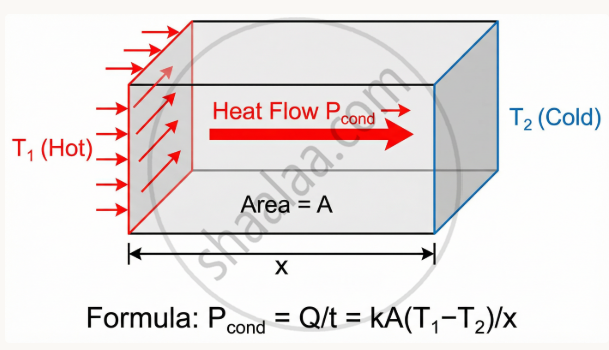
The conduction rate Pcond is the amount of energy transferred per unit time through a slab of area A and thickness x, where the two sides are at temperatures T1 and T2 (T1 > T2):
Pcond = \[\frac {Q}{t}\] = kA\[\frac {(T_1-T_2)}{x}\]
Proportionality Form
\[\frac{dT}{dt}\propto(T-T_0)\]
Introducing the constant of proportionality C:
\[\frac{dT}{dt}=C\left(T-T_0\right)\]
T = Temperature of the body at time t
T0 = Temperature of the surroundings (constant)
C = Constant of proportionality
\[\frac {dT}{dt}\] = Rate of fall of temperature (rate of cooling)
Theorems and Laws [8]
If system A is in thermal equilibrium with system C, and system B is also in thermal equilibrium with system C, then systems A and B are in thermal equilibrium with each other.
When pressure is constant, the ratio of volume to temperature of a gas remains constant.
When temperature is constant, the product of the pressure and volume of a gas remains constant.
When volume is constant, the ratio of pressure to temperature of a gas remains constant.
Statement: When different parts of an isolated system are at different temperatures, heat transfers from the part at higher temperature to the part at lower temperature. The heat lost by the hot object is equal to the heat gained by the cold object, provided no heat is allowed to escape to the surroundings.
(For liquid in calorimeter: m1c1Δθ + mcccΔθ)
Key Points:
- A system is said to be isolated if no exchange of heat occurs between the system and its surroundings.
- Calorimetry literally means measurement of heat.
- Energy supplied by heater = VIt (voltage × current × time).
- This principle is based on the Law of Conservation of Energy.
Statement: In steady-state heat flow by conduction in a bar with ends maintained at different temperatures TC and TD, the heat flow is proportional to the temperature difference and the area of cross-section A, and inversely proportional to the length L.
Also written as:
Where K is the thermal conductivity of the material.
Key Points:
- Gases are poor conductors; liquids have intermediate conductivities; solids are generally good conductors.
- The greater the value of K, the more rapidly the material conducts heat.
Statement: All bodies emit radiant energy depending on their temperature. The heat emitted (H) by a body is given by:
Where:
- σ = Stefan-Boltzmann constant
- e = Emissivity (for perfect radiator, e = 1)
- A = Area of the body
- T = Temperature (in Kelvin)
Key Points:
- Black bodies absorb and emit more radiant energy than bodies of lighter colours.
- Thermal radiation is partially reflected and partially absorbed when it falls on other bodies.
Statement: The rate of loss of heat \[\frac {dT}{dt}\] of the body is directly proportional to the difference of temperature (T − T0) of the body and the surroundings, provided the difference in temperatures is small.
Mathematical Form:
Graphical Representation:
-
Graph of rate of cooling \[\left(\frac{dT}{dt}\right)\] vs (T − T0) → straight line through origin.
-
Graph of temperature T vs time t → exponential decay curve (temperature drops steeply at first, then gradually).
Key Points
- Heat is energy in transit — it transfers between bodies due to a temperature difference.
- Temperature is a physical quantity that defines the thermodynamic state and measures the average kinetic energy of particles.
- When two bodies at different temperatures come in contact, heat flows from the hotter to the cooler body until thermal equilibrium is reached.
- In solids, heating increases particle vibration (kinetic energy); near the melting point, heat weakens bonds without raising the temperature.
- Liquids have weaker bonds than solids but stronger than gases; they have definite volume but no definite shape.
- In gases (ideal), there are no intermolecular forces; particles move freely with no definite shape or volume.
- Interatomic spacing: solids ~10−10 m, gases at NTP ~10−9 m.
- SI unit of heat: Joule (J); CGS unit: Erg; 1 J = 107 erg.
- 1 calorie = 4.184 J.
- Dimensional formula: Heat = [M1L2T−2]; Temperature = [M0L0T0K1].
- Average kinetic energy formula: Ek = \[\frac {3}{2}\]kBT, linking microscopic particle energy to macroscopic temperature.
- Thermal equilibrium occurs when two bodies in contact reach the same temperature and heat flow stops.
- An adiabatic wall blocks heat; a diathermic wall allows it.
- The Zeroth Law of Thermodynamics: If A is in equilibrium with C, and B is in equilibrium with C, then A and B are in equilibrium — this is the scientific basis for thermometers.
- Three temperature scales: Celsius (common), Fahrenheit (USA), and Kelvin (SI unit).
- Thermometric properties (volume, resistance, pressure, EMF) that change predictably with temperature are used to build thermometers.
- The constant-volume gas thermometer is the most accurate; liquid-in-glass thermometers are most common for everyday use.
- Thermocouples are used in research labs and thermistors in digital devices. Temperatures are measured on the following four scales:
Temperatures are measured on the following four scales:
| Scale | LFP | UFP | No. of Divisions |
|---|---|---|---|
| Celsius (°C) | 0°C (melting point of ice) | 100 °C (boiling point of water) | 100 |
| Fahrenheit (°F) | 32 °F (melting point of ice) | 212 °F (boiling point of water) | 180 |
| Kelvin (K) | 273 K (triple point of water = 273.15 K) | 373 K (boiling point of water = 373.15 K) | 100 |
| Rankine (°R) | 0°R | 80 °R | 80 |
- Gases expand linearly with temperature, making them useful for thermometers. This consistent behaviour suggests the existence of a lowest temperature limit.
- Absolute zero (−273.15 °C or 0 K) is the temperature where an ideal gas would have zero pressure. It is the lowest possible temperature.
- The Kelvin scale begins at absolute zero and uses the triple point of water (273.16 K) as a reference point. It is the SI temperature scale.
- The ideal gas equation (PV = μRT) combines all gas laws into a single relationship among pressure, volume, and temperature. It works best for gases at low pressure and high temperature.
- An ideal gas has point-mass molecules, no intermolecular forces, and perfectly elastic collisions.
- The Ideal Gas Equation, PV = nRT, combines all three laws into a single universal relationship.
- The Universal Gas Constant R = 8.314 J mol⁻¹ K⁻¹ is the same for all ideal gases.
- Real gases approximate ideal behaviour at low pressure and high temperature.
- Always use absolute temperature (Kelvin) in gas law calculations. T(K) = T(°C) + 273.15
- Solids have three types of expansion - Linear (1D), Superficial (2D), and Cubical (3D) - with β = 2α and γ = 3α.
- Change in dimensions: ΔL = L0αΔT, ΔA = A0βΔT, ΔV = V0γΔT.
- Liquids have only volume expansion; real expansion = apparent expansion + vessel expansion, i.e., γr = γa + γv.
- Gases have only real expansion as the container expansion is negligible.
- Final quantity after heating: L = L0(1 + αΔT), A = A0(1 + βΔT), V = V0(1 + γΔT).
- Linear expansion = increase in length due to heating
- Master formula: α = (l₂ − l₁) / [l₁ × (T₂ − T₁)]
- α depends on the material — stronger bonds → smaller α
- Unit of α: K⁻¹ or °C⁻¹ (numerically identical)
- For solids, α is very small (~10⁻⁵), so expansion is typically in millimetres
- Real-life: railway gaps, bridge joints, shrink fitting, bimetallic strips, thermometers
- Relationship: α : β : γ = 1 : 2 : 3 (linear : areal : volumetric)
- Areal expansion = increase in surface area of a solid due to heating.
- Working formula: A₂ = A₁[1 + β(T₂ − T₁)]
- Unit of β: °C⁻¹ or K⁻¹
- Key derivation: β = 2α (from expanding a square plate and neglecting α² term)
- Master ratio: α : β : γ = 1 : 2 : 3
- A hole in a metal plate expands on heating — it does NOT shrink.
- Exam shortcut: If given α, multiply by 2 for β. If given γ, divide by 3 for α, then multiply by 2.
- Volume expansion = increase in volume due to heating; relevant for solids, liquids, and gases.
- The formula is ΔV/V = γ · ΔT, where γ is the coefficient of volume expansion (unit: K⁻¹).
- γ = 3α for isotropic solids (α = coefficient of linear expansion).
- Liquids expand much more than solids (γliquid ≫ γsolid); this is why thermometers work.
- When heating a liquid in a container, account for both expansions: γreal = γapparent + γcontainer.
- Water is anomalous: it expands when cooled from 4°C to 0°C — crucial for the survival of aquatic life.
- Heating increases volume → decreases density: ρT ≈ ρ₀(1 − γ · ΔT).
- γ varies with temperature but is treated as constant for most problems.
- Expansion Coefficients: Linear (α), areal (β), and volume (γ) expansion follow the relation α:β:γ = 1:2:3.
- Areal and Volume Relations: β = 2α (surface expansion) and γ = 3α (volume expansion).
- Approximation Rule: Higher powers of α are ignored because α is very small (≈10⁻⁵).
- Anomalous Expansion of Water: Water has maximum density at 4°C, so lakes freeze from the top, protecting aquatic life below.
- Practical Applications: Thermal expansion is used in railway expansion joints, shrink-fitting of wheels, and slack in power lines.
- Heat energy absorbed (Q) depends on mass (m), rise in temperature (Δt), and specific heat capacity (c), i.e., Q ∝ m × Δt × c.
- Heat capacity (C') and specific heat capacity (c) are related by C′ = m × c.
- Specific heat capacity (s) measures how much heat per unit mass is needed to change a substance's temperature by 1°C (or 1 K).
- Formula: ΔQ = m · s · ΔT — applies only when there is no phase change.
- Water has the highest specific heat (4186 J/kg·K) among common substances — this is why it's used in cooling systems and retains heat well.
- Molar specific heat (C) measures heat per mole. For gases, it splits into Cₚ (constant pressure) and Cᵥ (constant volume), with Cₚ > Cᵥ always.
- Specific heat is intrinsic; it depends on the material, not on the amount of substance taken.
- The concept explains everyday phenomena such as coastal climate moderation, engine cooling, cooking times, and therapeutic hot water bags.
- Gases require two heat capacities (cp and cv) because heating at constant pressure involves expansion work.
- always — extra heat at constant pressure goes into PdV work.
- Mayer's Relation: Cp − Cv = R = 8.314 mol-1 K-1.
- and Cp = (\[\frac {f}{2}\] + 1)R where f = degrees of freedom.
- γ = Cp/Cv = 5/3 (monoatomic), 7/5 (diatomic), ~9/7 (triatomic).
- Applications: engine efficiency, refrigeration, speed of sound, and climate.
- Specific heat capacity tells us how "stubborn" a substance is to temperature changes — higher c means it's harder to heat or cool.
- The heat equation Q = m × c × ΔT is the fundamental formula connecting heat energy, mass, specific heat, and temperature change.
- Water has the highest specific heat (4186 J kg⁻¹ K⁻¹) among common substances — this regulates Earth's climate and is why water is used in cooling systems.
- The formula works in both directions: it calculates heat absorbed (temperature rise) or heat released (temperature fall).
- Units matter: always convert mass to kg and ensure ΔT is in °C or K (numerically identical for temperature changes).
- A calorimeter is an insulated device used to measure heat transfer; measurement of specific heat of a substance is carried out using it.
- Principle of Calorimetry: Heat lost by hot body = Heat gained by cold body, which represents the law of conservation of heat energy.
- In the method of mixtures, a heated sample is placed in the calorimeter and the temperature change is measured to calculate specific heat using the formula Q = msΔt.
- Specific heat of a substance depends on the nature of the substance; water is preferred in calorimetry due to its high specific heat, allowing it to absorb large amounts of heat with minimal temperature change.
- For accurate results, the sample must be transferred quickly into the calorimeter and stirred well to ensure uniform heat distribution.
- A change of state occurs when heat exchange causes a substance to transition between solid, liquid, and gas phases.
- Temperature remains constant during a phase change because heat energy changes molecular arrangement (potential energy), not molecular speed (kinetic energy).
- The heating curve has flat plateaus at the melting point (0 °C) and boiling point (100 °C) for water, with rising slopes in between.
- Boiling occurs when a liquid's vapour pressure equals the external atmospheric pressure — it's a bulk phenomenon happening throughout the liquid.
- Increasing pressure raises the boiling point — e.g., in a pressure cooker, water boils at ~120°C because the trapped steam increases internal pressure to ~1.5–2 atm.
- Decreasing pressure lowers the boiling point — e.g., at 2,400 m on a mountain, water boils at ~92°C because atmospheric pressure is lower.
- The flask experiment demonstrates both effects: closing the outlet (↑ pressure → boiling stops) and pouring cold water on the inverted flask (↓ pressure → boiling resumes at ~80°C).
- Cooking at high altitudes is slower because the reduced boiling point means water cannot reach the temperature needed to cook food efficiently.
- Pressure cookers cook faster by raising the boiling point above 100°C through increased internal pressure, providing more thermal energy to food.
- A phase diagram maps all phases of a substance against pressure and temperature
- Three curves — vaporisation (l–v), fusion (l–s), and sublimation (s–v) — divide the diagram into solid, liquid, and vapour regions
- Water's fusion curve has a negative slope because water expands on freezing — this is an anomalous property
- CO₂'s fusion curve has a positive slope — normal behaviour for most substances
- The triple point is the only condition at which all three phases coexist; for water, it is 273.16 K and 6.11 × 10⁻³ Pa
- Critical Temperature (T~c~) is the highest temperature at which a substance can exist as a liquid.
- A substance in the gaseous state above T~c~ is called a gas — it cannot be liquefied by pressure alone.
- A substance in the gaseous state below T~c~ is called a vapour — it can be liquefied by increasing pressure.
- Higher T~c~ indicates stronger intermolecular forces of attraction.
- Both gas and vapour exert pressure; vapour pressure is the pressure in equilibrium with the liquid phase.
- Liquefaction of a true gas requires cooling below T~c~ first, followed by compression.
- Formula: Q = mL. Specific latent heat L has SI unit J kg⁻¹.
- Temperature stays constant during any phase change. Heat energy goes into breaking or forming intermolecular bonds, not into raising kinetic energy.
- Latent Heat of Fusion (water): Lf = 3.33 × 10⁵ J kg⁻¹ = 80 cal/g. Heat needed to melt 1 kg of ice at 0°C.
- Latent Heat of Vaporisation (water): Lv = 22.6 × 10⁵ J kg⁻¹ = 540 cal/g. Heat is needed to convert 1 kg of water to steam at 100°C.
- Lv ≫ Lf because vaporisation requires complete molecular separation and work against atmospheric pressure during expansion.
- All latent heat values depend on atmospheric pressure. Standard values quoted at 1 atm. Increasing pressure raises the boiling point (pressure cooker effect).
- Heat can be transferred in three ways — conduction, convection, and radiation.
- Conduction transfers heat through solids; molecules vibrate but do not move from their positions.
- Convection transfers heat through liquids and gases; molecules physically move from place to place.
- Both conduction and convection require a material medium; radiation does not.
- Radiation travels through electromagnetic waves at a speed of 3×10⁸ ms⁻¹.
- Conduction is the slowest process, convection is rapid, and radiation is the fastest mode of heat transfer.
- The energy received from the Sun is an example of heat transfer by radiation.
- The transfer of heat from the hot part to the cold part of an object is called conduction of heat.
- Conduction takes place through solid substances only — it requires a medium.
- Heat travels by molecular collisions: fast-vibrating molecules pass energy to slower neighbours.
- Copper conducts heat faster than aluminium, which conducts faster than steel.
- Conduction of heat through a substance depends on the property of that substance.
- Good conductors: silver, copper, aluminium, brass — all metals.
- Bad conductors: wood, cloth, air, paper — most non-metals.
- Good conductors of heat are also good conductors of electricity, and bad conductors of heat are also bad conductors of electricity.
- Thermal conductivity is the measure of a solid's ability to conduct heat. Good conductors have higher thermal conductivity.
- When a metal rod is heated at one end, heat flows from the hot end to the cold end by conduction.
- Variable state — the temperature of every section keeps increasing with time.
- Steady state — temperature at each section is constant but different across sections.
- Temperature gradient = (T₁ − T₂) / x — the fall of temperature per unit length in the direction of heat flow.
- Under steady state, heat flow Q depends on A, (T₁ − T₂), t, and 1/x.
- The coefficient k is a material property — it does not depend on the shape or size of the body.
- SI unit of k: W m⁻¹ K⁻¹ (or J s⁻¹ m⁻¹ K⁻¹)
- Dimensions of k: [M1L1T−3K−1]
- The differential form \[\frac {dQ}{dt}\] = -kA\[\frac {dT}{dx}\] applies when temperature varies continuously; the negative sign enforces the hot-to-cold direction of heat flow.
- The lower the thermal conductivity kk, the higher the thermal resistance RT.
- A material with high RT is a poor thermal conductor and a good thermal insulator.
- Thermal resistivity ρT is the reciprocal of thermal conductivity k:
ρT = \[\frac {1}{k}\]
- Metals are good conductors — used for the base of cooking utensils for fast heat transfer to food.
- Wood, ebonite, brick, gunny bag, and air are bad conductors — used wherever heat flow must be restricted.
- Air is one of the worst conductors of heat — its presence in hollow bricks and gunny bag fibres enhances insulation significantly.
- Low thermal conductivity is a disadvantage in glass — it causes cracking due to uneven thermal expansion when heated suddenly.
- Convection occurs only in fluids (liquids and gases) — not in solids.
- In conduction, molecules vibrate but stay in place.
- In convection, molecules physically move from one place to another.
- Heating reduces density → hot fluid rises; cool fluid sinks → a convection current is set up.
- Convection currents transfer heat to the entire mass of the fluid.
- Potassium permanganate makes convection currents visible as magenta-coloured streams.
| Aspect | Heating of Room | Cooling of Transformer |
|---|---|---|
| Medium of convection | Air | Insulating Oil |
| Heat source | Room heater / heat convector | Transformer windings (current flow) |
| Warm fluid motion | Rises upward | Rises toward tank top |
| Cool fluid motion | Sinks from ceiling to floor | Sinks along cooler tank walls |
| Final heat dissipation | To all parts of the room | To surrounding air via tank walls |
| Principle direction | Upward from source | Upward from transformer body |
- When a hot body is in contact with air under ordinary conditions (e.g., air around firewood), the air removes heat by free or natural convection.
- Land and sea breezes are formed as a result of free convection currents in air.
- The convection process can be accelerated by a fan creating rapid circulation of fresh air — this is called 'forced convection'.
- Examples of forced convection: heat convector, air conditioners, and heat radiators in IC engine
- When water is heated from the top, its density decreases, and it stays at the top. Since hot water cannot sink, convection does not occur and the bottom remains cool.
- Radiation is the transfer of heat without a medium — through electromagnetic waves.
- Heat from the Sun reaches us through radiation across the vacuum of space.
- All objects above 0 K emit thermal radiation (electromagnetic waves).
- Radiation is a two-step process: thermal energy → EM waves → thermal energy.
- Black or dark surfaces absorb more heat radiation; absorption also depends on the intrinsic properties of the substance.
- An infrared camera uses the radiation emitted by objects to see at night — useful for military surveillance.
- Copper is an excellent conductor; plastic is a bad conductor (insulator).
- Heat readily conducts through metals (copper and steel) but not through non-metals (wood and plastic).
- A hot body loses heat to its surroundings in the form of heat radiation.
- The rate of cooling is directly proportional to the temperature difference between the body and its surroundings.
- The cooling curve (T vs t) shows rapid initial cooling that gradually slows down.
- Plotting \[\frac {dT}{dt}\] vs (T−T₀) gives a straight line through the origin, confirming Newton's law.
- Mathematically: dT/dt = C(T − T₀), where C is the constant of proportionality.
- The rate of cooling is proportional to — not independent of — the temperature difference. A 4× drop in temperature difference produces a 4× drop in cooling rate.
Concepts [36]
- Understanding Thermal Properties of Matter
- Temperature and Heat
- Measurement of Temperature
- Absolute Zero and Absolute Temperature
- Ideal Gas Equation
- Thermal Expansion
- Linear Expansion
- Areal Expansion
- Volume Expansion
- Relation Between Coefficient of Expansion
- Specific Heat Capacity
- Specific Heat Capacity of Solids and Liquids
- Specific Heat Capacity of Gas
- Heat Equation
- Thermal Capacity
- Calorimetry
- Change of State
- Analysis of Observation>From Point A to B
- Analysis of Observation>From Point B to D
- Evaporation vs Boiling
- Boiling Point and Pressure
- Concept of Desublimation (Deposition)
- Phase Diagram
- Gas and Vapour
- Latent Heat
- Heat Transfer
- Conduction
- Thermal Conductivity
- Coefficient of Thermal Conductivity
- Thermal Resistance
- Applications of Thermal conductivity
- Convection
- Application of Convection
- Free and Forced Convection
- Radiation
- Newton’s Law of Cooling
