Definition: Gravitation
"Every particle of matter in the universe attracts every other particle with a force directly proportional to the product of their masses and inversely proportional to the square of the distance between them. The direction of the force is along the line joining the particles."
or
The force by which the Earth attracts objects towards its centre is called gravitational force.
OR
The force of mutual attraction that any two objects in the universe exert on each other, which is directly proportional to the product of their masses and inversely proportional to the square of the distance between their centres, is called the gravitational force.
Definition: Universal Law of Gravitation
"Every particle of matter attracts every other particle of matter with a force which is directly proportional to the product of their masses and inversely proportional to the square of the distance between them."
Definition: Gravitational Constant
The gravitational constant is the proportionality constant G in Newton's Law of Universal Gravitation, which relates the force of gravitational attraction between two masses and the distance separating them.
Definition: Acceleration Due to Gravity
The gravitational force due to the earth on a body results in its acceleration. This is called acceleration due to gravity and is denoted by ‘g’.
OR
When a body falls towards the Earth under gravity, then the acceleration produced in the body due to gravity is called acceleration due to gravity, which is denoted by g.
Definition: Gravity with Depth
Acceleration due to gravity at depth d is the rate at which an object accelerates toward the Earth when placed at a distance d below the Earth's surface. It is defined as the gravitational force per unit mass acting on a body at that depth.
Definition: Latitude
Latitude is an angle made by the radius vector of any point from the centre of the Earth with the equatorial plane. Obviously it ranges from 0° at the equator to 90° at the poles.
Definition: Weight of an object
"The weight of an object is the force with which the Earth attracts that object."
Definition: Gravitational Potential Energy
The amount of work done in bringing a given body from infinity to that point against the gravitational force is called gravitational potential energy.
OR
The energy possessed by a system of two or more bodies by virtue of their positions and mutual gravitational attraction, which equals the work done against the gravitational force in assembling the system from infinity, is called 'gravitational potential energy'.
U = −\[\frac {Gm_1m_2}{r}\]
Definition: Gravitational Potential
The gravitational potential energy per unit mass at a point is called gravitational potential.
OR
The negative of the work done by the gravitational force in displacing a unit mass from that point to infinity (or equivalently, the work done in bringing a unit mass from infinity to that point without acceleration) is called 'gravitational potential'.
Definition: Potential Energy
"Potential energy is the work done against conservative force (or forces) in achieving a certain position or configuration of a given system."
OR
The energy stored in an object because of its position or state is called potential energy.
OR
The amount of work done against conservative forces which causes a change in P.E. is called potential energy.
Definition: Escape velocity
"The minimum velocity with which a body should be thrown vertically upwards from the surface of the Earth so that it escapes the Earth’s gravitational field is called the escape velocity (vₑ) of the body."
What is meant by the gravitational potential energy?
The gravitational potential energy refers to the potential energy that a body possesses as a result of the Earth's force of attraction to it.
Define the following:
Potential difference
Potential difference: The potential difference between two points may be defined as the work done in moving a unit positive charge from one point to the other.
Define Electric potential.
Electric potential is a measure of work done on the unit's positive charge to bring it to that point against all electrical forces. It is represented as ‘V’.
Definition: Potential Difference
The potential difference (p.d.) between two points is equal to the work done per unit charge in moving a positive test charge from one point to the other.
OR
The work done per unit positive charge in moving a charge from one point to another in an electric field is called the potential difference between those two points.
OR
The potential difference between any two points in the circuit is the amount of energy needed to move one unit of electric charge from one point to the other.
Answer the following question.
Define the binding energy of a satellite.
The minimum energy required by a satellite to escape from Earth’s gravitational influence is the binding energy of the satellite.
Answer the following question in detail.
What is a critical velocity?
The exact horizontal velocity of projection that must be given to a satellite at a certain height so that it can revolve in a circular orbit round the Earth is called the critical velocity or orbital velocity (vc).
Definition: Artificial Satellite
A man-made object that orbits a planet or other celestial body is called an artificial satellite.
Definition: Polar Satellite
A satellite that travels over Earth's poles, passing close to the Earth's surface, with a period of revolution of nearly 85 minutes is called a polar satellite.
Definition: Geosynchronous Satellite
A satellite that orbits the Earth at a height of approximately 36,000 km above the equator with a period of revolution of 24 hours is called a geosynchronous satellite.
Definition: Satellite
The objects that revolve around the Earth are called Earth satellites.
Definition: Critical Velocity
The exact horizontal velocity of projection that must be given to a satellite at a certain height so that it can revolve in a circular orbit around the Earth is called the 'critical velocity' or 'orbital velocity' (vc).
OR
The horizontal velocity of projection that must be given to a satellite at a certain height so that it can revolve in a circular orbit around the Earth is called the critical velocity or orbital velocity (vc).
Definition: Weightlessness
The feeling of weightlessness is the state where "there will not be any feeling of weight," and the weighing machine will record zero.
Definition: Time Period of a Satellite
The time taken by a satellite to complete one full revolution around the Earth is called the Time Period of the satellite.
Definition: Critical Velocity
The limiting velocity up to which flow is streamline and beyond which it changes to turbulent is called critical velocity.
vC = (Re × η)/(ρl)
Definition: Binding Energy of Satellite
"The minimum energy required by a satellite to escape from Earth’s gravitational influence is the binding energy of the satellite."
OR
The energy that must be given to an orbiting satellite to make it escape to infinity (equal to the negative of total energy of the satellite), given by BE=GMm/2rBE=GMm/2r, is called Binding Energy.
Formula: Kepler's Second Law
The area swept by the planet of mass m in a given interval Δt is:
\[\Delta\vec{A}=\frac{1}{2}(\vec{r}\times\vec{v}\Delta t)\]
- \[\vec r\]: Position vector of the planet (distance from Sun).
- \[\vec v\]: Velocity vector of the planet.
- Δt: Time interval.
- \[\vec p\]: Linear momentum (\[\vec p\] = m\[\vec v\])
- \[\vec L\]: Angular momentum (\[\vec L\] = \[\vec r\] × \[\vec p\])
Formula: Kepler's Third Law
Formula: Universal Law of Gravitation
The gravitational force of attraction (F) between two bodies of mass m1 and m2 separated by a distance r is:
\[\mathbf{F} = \mathbf{G}\frac{m_1 m_2}{r^2}\]
- F: Gravitational Force of attraction (in Newtons, N).
- \[m_1, m_2\]: Masses of the two objects (in kilograms, kg).
- r (or d in the first part): Distance between the two objects (in meters, m).
- G: The constant of proportionality, called the Universal gravitational constant.
- Value in SI units: \[G=6.67\times10^{-11}\mathrm{N}\cdot\mathrm{m}^2/\mathrm{kg}^2\]
- Dimensions: \[[G]=[\mathrm{L}^3\mathrm{M}^{-1}\mathrm{T}^{-2}]\]
Formula: Gravitational Force of Attraction
The magnitude of the force of attraction (F) between a big sphere (Mass M) and a neighbouring small sphere (Mass m) separated by distance r is:
The torque (τ) generated by the force of attraction is:
\[\tau = F \cdot L = G \frac{mM}{r^2} L\]
At equilibrium, the gravitational torque equals the restoring torque:
\[G \frac{mM}{r^2} L = K \theta\]
Where:
| G |
Gravitational constant (the value to be calculated). |
| m |
Mass of the small spheres (s1 and s2). |
| M |
Mass of the large spheres (L1 and L2). |
| r |
Initial distance of separation between the centres of the big and the neighbouring small sphere. |
| L |
Length of the light rigid rod. |
| τ |
Gravitational torque. |
| K |
Restoring torque per unit angle of the suspension wire. |
| θ |
Angle of twist of the suspension wire. |
Formula: Acceleration due to gravity
The value of the acceleration due to gravity (g) on the surface of the Earth is given by the formula:
Where:
- g = Acceleration due to gravity (in m/s²).
- G = Newton's Universal Gravitational Constant (≈ 6.67 × 10⁻¹¹ N · m² / kg²).
- M = Mass of the Earth (≈ 6 × 1024 kg).
- R = Radius of the Earth (≈ 6.4 × 10⁶ m).
Formula: Gravity with Altitude
The formulas for acceleration due to gravity (g) are provided below:
On the Earth's Surface:
At height $h$ above the Earth's surface:
\[g_h = g \frac{R^2}{(R+h)^2} \quad \text{or} \quad g_h = g \left(I + \frac{h}{R}\right)^{-2}\]
Simplified Formula for Small Altitudes ($h \ll R$):
\[g_h = g \left(1 - \frac{2h}{R}\right)\]
Definition of Terms:
- g: Acceleration due to gravity on the Earth's surface.
- gh: Acceleration due to gravity at height h above the Earth's surface.
- G: Universal Gravitational Constant.
- M: Mass of the Earth.
- R: Radius of the Earth.
- h: Altitude or height above the Earth's surface.
Formula: Gravity with Depth
gd = g[1 − \[\frac {d}{R}\]]
Where:
- gd = acceleration due to gravity at depth d
- g = acceleration due to gravity at Earth's surface (approximately 9.8 m/s²)
- d = depth below Earth's surface
- R = radius of the Earth (approximately 6,371 km)
Formula: Gravity with Latitude
The effective acceleration due to gravity (g') at a point on the Earth's surface at latitude θ is given by:
\[g' = g - R\omega^2 \cos^2\theta\]
Where:
- g': The effective acceleration due to gravity at latitude θ (m/s²).
- g: The true acceleration due to gravity (without rotational effect) (m/s²).
- R: The radius of the Earth (m).
- ω: The angular velocity of rotation of the Earth (rad / s or s-1).
- θ: The latitude of the point (in degrees or radians).
Formula: Weight of an object
w = mg
where:
- w is the weight of the object.
- m is the mass of the object.
- g is the acceleration due to gravity.
Formula: Potential Energy
Based on the relationship between work and energy, the change in potential energy is given by:
\[\vec F\] · d\[\vec x\] = dU
- \[\vec{F}\]: The force acting on the object (external force applied against the conservative force).
- \[d\vec{x}\]: The small displacement of the object.
- dU: The change (increase) in the potential energy of the system.
Formula: Escape velocity
\[v_e=\sqrt{\frac{2GM}{R}}\]
- ve = Escape velocity (minimum speed needed to escape Earth’s gravity)
- G = Universal gravitational constant (6.674 × 10⁻¹¹ Nm2/kg2)
- M = Mass of the Earth (or celestial body)
- R = Radius of the Earth (or distance from the centre of the mass to the object)
Formula: Gravitational Potential Energy
U(r) = -\[\frac {GMm}{r}\]
Where:
- U(r) = Gravitational potential energy at distance r from Earth's center
- G = Universal gravitational constant (6.67 × 10⁻¹¹ N·m²/kg²)
- M = Mass of Earth (kg)
- m = Mass of the object (kg)
- r = Distance between the centers of mass of Earth and object (m)
- Negative sign = Shows that potential energy is negative (zero at infinity)
Formula: Potential Difference between A and B
\[V_A-V_B=\frac{W}{Q}\]
Formula: Critical velocity
vc = \[\sqrt{\frac{GM}{R+h}}\]
Where:
- vc = critical velocity (m/s)
- G = gravitational constant (6.67 × 10⁻¹¹ N·m²/kg²)
- M = mass of the Earth (kg)
- R = radius of the Earth (km)
- h = height of satellite above Earth's surface (km)
Formula: Newton's Second Law of Motion
According to Newton's second law of motion:
Where:
- F is the net force acting on an object.
- m is the mass of the object.
- a is the acceleration of the object.
For a passenger in a lift, the net force in the downward direction is:
Where:
- F is the net force.
- m is the mass of the passenger.
- g is the gravitational acceleration (gravitational force is mg).
- N is the normal reaction force exerted by the floor (this is the experienced/apparent weight).
Formula: Time Period of Satellite
T = \[2\pi\sqrt{\frac{(R+h)^3}{GM}}\]
Where:
- T = Time period of the satellite (in seconds)
- R = Radius of the Earth
- h = Height of the satellite above Earth's surface
- G = Universal gravitational constant
- M = Mass of the Earth
- (R + h) = r = Radius of the satellite's orbit
Formula: Binding Energy of Satellite
B.E. = −T.E. = \[\frac {GMm}{2r}\]
Formula: Kinetic Energy of Satellite
K.E. = \[\frac {GMm}{2r}\]
Formula: Potential Energy of Satellite
P.E. = -\[\frac {GMm}{r}\]
Formula: Total Energy of Satellite
T.E. = −\[\frac {GMm}{2r}\]
Formula: Binding Energy
Binding Energy = +\[\frac {1}{2}\frac {GMm}{r}\]
Where:
- G = Universal Gravitational Constant
- M = Mass of the Earth
- m = Mass of the satellite
- r = Radius of the orbit (Distance from the center of the Earth)
- Kepler’s first law: The orbit of a planet is an ellipse with the sun at one of the foci.
- Kepler’s second law: The line joining the planet and the sun sweeps equal areas in equal intervals of time.
- Kepler’s third law: The square of the orbital period of revolution of a planet around the Sun is directly proportional to the cube of the mean distance of the planet from the Sun.
Law: Kepler's First Law
Kepler's First Law (Law of Ellipses)
- Each planet moves in an elliptical orbit with the Sun at one focus.
- This means planetary orbits are stretched circles, not perfect circles.
- The ellipse has two foci; the Sun occupies one of these.
Law: Kepler's Second Law
Kepler's Second Law (Law of Equal Areas)
- A line joining the planet and the Sun sweeps out equal areas in equal time intervals.
- When the planet is nearer the Sun (perihelion), it moves faster.
- When the planet is farther from the Sun (aphelion), it moves more slowly.
- This law reflects conservation of angular momentum.
Law: Kepler's Third Law
Kepler's Third Law (Law of Periods)
- The square of the time period of revolution of a planet is proportional to the cube of the semi-major axis of its orbit.
- This means a planet farther from the Sun takes a longer time to complete an orbit.
Law: Universal Law of Gravitation
Statement:
The law which states that every particle of matter attracts every other particle in the universe with a force whose magnitude is directly proportional to the product of masses and inversely proportional to the square of the distance between them is called Newton's Law of Gravitation.
Derivation:
Newton's Universal Law of Gravitation states that every particle of matter attracts every other particle of matter with a force which is the following:
- Directly proportional to the product of their masses: F ∝ m₁ ⋅ m₂
- Inversely proportional to the square of the distance between them: F ∝ \[\frac {1}{r^2}\]
Combining both, the gravitational force is expressed as follows:
F = G\[\frac{m_1m_2}{r^2}\]
where G is the universal gravitational constant, measured by Henry Cavendish using the Cavendish balance, with the value:
G = 6.67 × 10⁻¹¹ Nm2/kg2
Write the answer of the question with reference to laws of gravitation.
State the universal law of gravitation.
The universal law of gravitation states that every object in the universe attracts every other object with a force called the gravitational force. The force acting between two objects is directly proportional to the product of their masses and inversely proportional to the square of the distance between their centres.
F ∝ m M (masses of two bodies m and M)
F ∝ `1/"d"^2` (d is the distance between the two bodies.)
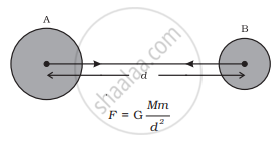
A and B are two bodies, the distance between which is given as d.
F = force with which one body is attracting the other.
G = proportionality constant.
Shell Theorem
Statement:
The Earth can be thought of as many concentric spherical shells. According to the Shell Theorem:
- The gravitational force from outer shells cancels out for an object inside them.
- Only the mass beneath the object (i.e., at radius R − d) contributes to the gravitational force at that depth.
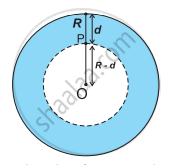
Proof:
Starting with the equation for acceleration due to gravity at the surface:
g = \[\frac {GM}{R^2}\]
If we assume Earth has uniform density ρρ, then:
M = \[\frac {4}{3}\]πR³ρ
Therefore:
g = \[\frac{G\times\frac{4}{3}\pi R^{3}\rho}{R^{2}}=\frac{4}{3}\pi RG\rho\]
At depth d, only the inner sphere of radius (R - d) matters:
M′ = \[\frac{4}{3}\pi(R-d)^3\rho\]
gd = \[\frac{G\times\frac{4}{3}\pi(R-d)^{3}\rho}{(R-d)^{2}}=\frac{4}{3}\pi(R-d)G\rho\]
Dividing the equation at depth d by the equation at the surface:
\[\frac{g_d}{g}=\frac{\frac{4}{3}\pi(R-d)G\rho}{\frac{4}{3}\pi RG\rho}=\frac{R-d}{R}=1-\frac{d}{R}\]
This gives us:
gd = g[1 − \[\frac {d}{R}\]]
Conclusion:
- As depth increases, the value of gd decreases
- The relationship is linear with respect to depth
- At Earth's center (d = R): gd = g[1 − 1] = 0 (no gravitational force)
