ISC (Science)
Academic Year: 2024-2025
Date & Time: 21st March 2025, 2:00 pm
Duration: 3h
Advertisements
Instructions to Candidates
- You are allowed an additional fifteen minutes for only reading the question paper.
- You must NOT start writing during reading time.
- This question paper has 11 printed pages and one blank page.
- It has eighteen questions in all. Answer all questions.
- There are four sections in the paper: A, B, C and D. Internal choices have been provided in one question each in Sections B, C and D.
- Section A consists of one question each carrying one / two mark(s).
- While answering Multiple Choice Questions in Section A, you are required to write only one option as the answer.
- Section B consists of seven questions each carrying two marks.
- Section C consists of seven questions each carrying three marks.
- Section D consists of three questions each carrying five marks.
- Diagrams should be drawn wherever necessary using a pencil only.
- The intended marks for questions are given in brackets [ ].
A sports person quenched his thirst by drinking some tender coconut water. Name the part of the fruit from where the liquid content is derived.
Chapter:
In a particular ecosystem, there were 1000 species at a given time. After 5 years, 200 more species were added. Calculate the growth rate of the population.
Chapter:
Rachel attained puberty at the age of fourteen years. She conceived for the first time at the age of thirty years. How many primary oocytes did she lose till the time of conception?
Chapter:
How many nuclei are present in the central cell of the mature embryo sac of angiosperms before fertilisation?
Chapter:
A woman’s first child suffered from Down syndrome. During her second pregnancy, she wanted to find out whether her second child would be normal or not.
Which method will the gynaecologist adopt to test the genetic abnormality in the embryo?
Chapter:
Derive a name for a restriction endonuclease which was extracted in the 5th order from the RY13 strain of E. coli.
Chapter:
A pistillate flower of a tetraploid angiosperm is pollinated by a pollen grain from a staminate flower of a diploid plant.
What would be the level of the ploidy in the endosperm of seeds thus formed?
Chapter:
Observe the relationship between the first two words/terms and then fill in the fourth word/term.
Lipase: Candida lipolytica :: Taq polymerase: ______
Chapter:
The capacitation of sperms plays a significant role in the process of fertilisation in humans.
Which of the following events are associated with the process of capacitation?
- Large quantity of Ca+2 ions enter the sperm to enhance the permeability of the acrosome.
- Antifertilisin reacts with the fertilisin protein.
- Membrane covering the sperm head and acrosome gets removed.
I and II only
I and III only
II and III only
I, II and III
Chapter:
What is the purpose of the Red Data Book?
To list the endangered species.
To promote sustainable development.
To check the growth of the animal species.
To identify areas for conservation.
Chapter:
Assertion: The eyes of octopus and horse are evidence of convergent evolution.
Reason: Eyes of both the organisms have the same structure and serve the same function.
Both Assertion and Reason are true and Reason is the correct explanation for Assertion.
Both Assertion and Reason are true but Reason is not the correct explanation for Assertion.
Assertion is true and Reason is false.
Both Assertion and Reason are false.
Chapter:
Assertion: In a pond ecosystem, pyramid of biomass shows a sharp decrease in the biomass at higher trophic levels.
Reason: Primary producers convert only 10% of the energy of sunlight into net primary productivity.
Both Assertion and Reason are true and Reason is the correct explanation for Assertion.
Both Assertion and Reason are true but Reason is not the correct explanation for Assertion.
Assertion is true and Reason is false.
Both Assertion and Reason are false.
Chapter:
A forest has a GPP of 20,000 kcal/m2/year, and 40% of this energy is used for respiration. Calculate the amount of energy available as NPP.
Chapter:
Ryan used a synthetic hair dye to colour his hair. Within a day of dyeing, red rashes appeared on his face, causing constant itching.
Chapter:
Name the scientist who is considered the Father of Indian Ecology.
Chapter:
A transformed bacterial cell contains a transgene that can produce one molecule of protein ‘X’ per cell. This bacterium duplicates every 20 minutes. It is cultured in a nutrient medium for 3 hours.
How many molecules of protein ‘X’ will be produced by the end of this culture?
Chapter:
Which drug is extracted from the leaves shown in the image given below?

Chapter:
Advertisements
Give a reason for the following.
The period of lactational amenorrhoea is marked by the absence of menstruation.
Chapter:
The diagram given below shows a segment of DNA that codes for the enzyme pepsin. Anita used strand (b) for making mRNA to translate the enzyme pepsin. Even after repeated attempts, she could not create the enzyme.
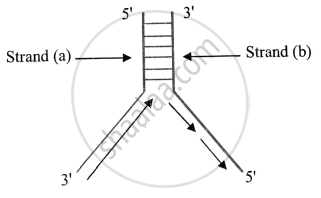
Chapter:
The figure given below shows a tumour. State one characteristic feature of the given type.
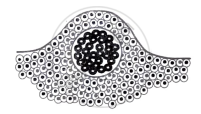
Chapter:
The figure given below shows a tumour. State one characteristic feature of the given type.
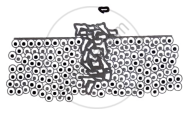
Chapter:
Which trophic level has the most energy in an ecosystem?
Chapter:
What was the main agenda of this historic summit?
Chapter:
Discuss the role of two ovarian hormones in the process of parturition in humans.
Chapter:
|
Akshay Shrivastav, a chemical engineer, launched Navyakosh, a unique biofertiliser. He started his company, LCB Fertilisers, in his backyard during the COVID-19 pandemic induced lockdown. His creation rapidly gained popularity among the farmers. Tejraj Sahu, a farmer from Odisha, was one of those who had used the new biofertiliser, Navyakosh on his paddy field. The harsh sun and unseasonal rains had reduced water holding capacity of Sahu’s field and prompted him to use this biofertiliser. |
- How do you think the use of the biofertiliser, Navyakosh benefitted the paddy field?
- Name the microbe that was used to create the biofertiliser, Navyakosh.
Chapter:
The diagram given below shows a method of screening the transformed bacterial cells.
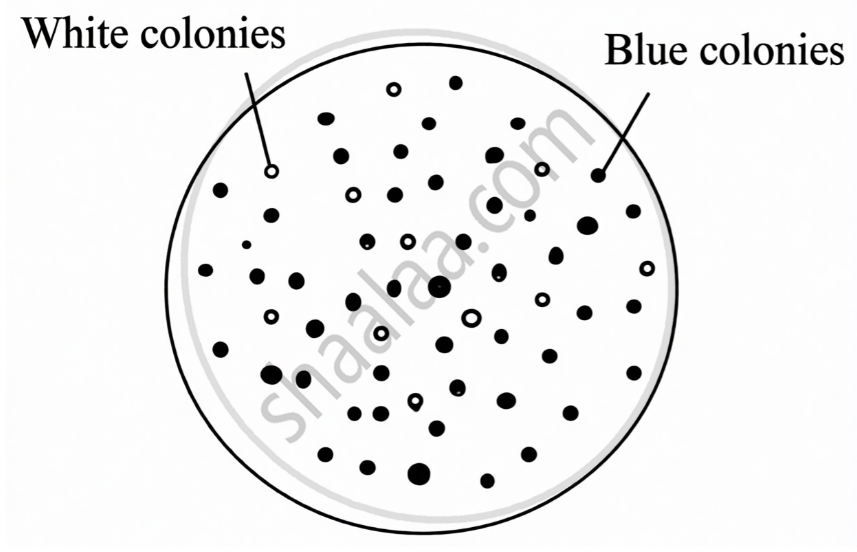
Explain how the differently coloured colonies help in identifying the transformed cells.
Chapter:
As a student of food technology, Leena has planned to produce two dairy-based processed food products that would be completely organic in nature.
Suggest any two food products that Leena can produce.
Chapter:
An organism living at an extremely hot place is likely to have a high GC content in its DNA. Give a reason to explain.
Chapter:
If you are given the exact quantity of G and T, how will you calculate the quantity of A and C in the DNA? Why is this not possible in the RNA molecule?
Chapter:
Michelle, a zookeeper, was collecting data on rabbits. She found that in a population of 1000 rabbits, 360 had long ears (L1), 150 had medium ears (L1), and 490 had short ears (II) at a given time.
Calculate the frequency of rabbits with heterozygous traits.
Chapter:
Michelle, a zookeeper, was collecting data on rabbits. She found that in a population of 1000 rabbits, 360 had long ears (L1), 150 had medium ears (L1), and 490 had short ears (II) at a given time.
Name the principle applied to calculate the frequency of rabbits.
Chapter:
Michelle, a zookeeper, was collecting data on rabbits. She found that in a population of 1000 rabbits, 360 had long ears (L1), 150 had medium ears (L1), and 490 had short ears (II) at a given time.
Michelle also studied the next generation of rabbits and found that their population decreased significantly to 400. Now, there are 336 rabbits with long ears and 64 rabbits with short ears. Give a reason to explain the change in gene frequencies in the new population.
Chapter:
Advertisements
Microbes have been used by humans in household, industrial and agricultural setups. One such use is shown in the diagram given below.
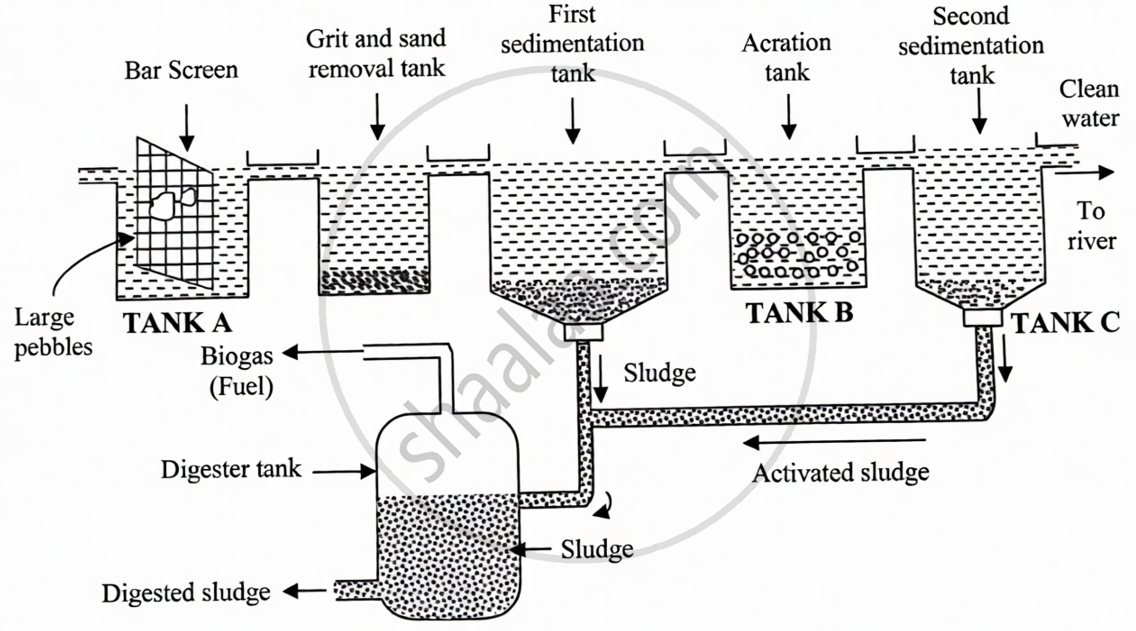
- Tank A represents primary treatment of sewage while Tank B shows its secondary treatment. State one difference between the two kinds of sewage treatment.
- Identify the tank in which flocs are added.
- What is the purpose of using microbes in sewage treatment?
Chapter:
Draw and explain the Logistic population growth curve.
Chapter:
Explain any two types of parasitism with one example each.
Chapter:
Draw a neat and well labelled diagram of T.S. of mammalian testis.
Chapter:
What is the role of restriction endonucleases in rDNA technology?
Chapter:
A biotechnologist was given two restriction endonucleases (RE-A and RE-B) with the following restriction sites:
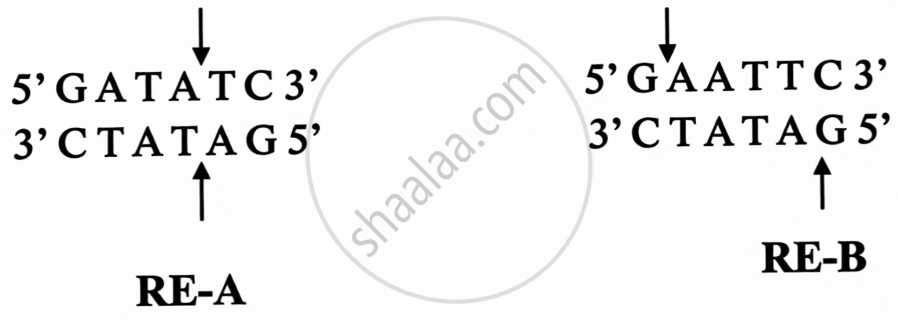
After the action of respective endonucleases, the fragments separated from the restriction sites. Draw the separated fragments on both the sites.
Chapter:
Draw a neat flowchart depicting the life cycle of a retrovirus in the infected human cell.
Chapter:
Discuss any three contrivances for prevention of self-pollination in flowering plants.
Chapter:
Oranges can be produced by processes like Apomixis and Polyembryony. State two differences between these processes.
Chapter:
Mention one example of the following:
Bacterial STD
Chapter:
Mention one example of the following:
Viral STD
Chapter:
Mention one example of the following:
Protozoal STD
Chapter:
State any two artificial methods of contraception which also prevent transmission of STDs.
Chapter:
Explain the rivet Popper hypothesis.
Chapter: [15] Biodiversity and Its Conservation
Briefly discuss the narrowly utilitarian arguments for conserving biodiversity.
Chapter:
Explain the broadly utilitarian argument in favour of conservation of biodiversity.
Chapter:
Consider the information given below about a family and answer the questions that follow.
|
- Draw a single pedigree chart to show the pattern of inheritance in Rafiq’s family.
- What kind of inheritance pattern prevails in Rafiq’s family?
- What are the chances of
- Farah suffering from the same disease?
- Farah being a carrier of the same disease?
Chapter:
Submit Question Paper
Help us maintain new question papers on Shaalaa.com, so we can continue to help studentsonly jpg, png and pdf files
CISCE previous year question papers ISC Class 12 Biology (Theory) with solutions 2024 - 2025
Previous year Question paper for CISCE ISC Class 12 -2025 is solved by experts. Solved question papers gives you the chance to check yourself after your mock test.
By referring the question paper Solutions for Biology (Theory), you can scale your preparation level and work on your weak areas. It will also help the candidates in developing the time-management skills. Practice makes perfect, and there is no better way to practice than to attempt previous year question paper solutions of CISCE ISC Class 12.
How CISCE ISC Class 12 Question Paper solutions Help Students ?
• Question paper solutions for Biology (Theory) will helps students to prepare for exam.
• Question paper with answer will boost students confidence in exam time and also give you an idea About the important questions and topics to be prepared for the board exam.
• For finding solution of question papers no need to refer so multiple sources like textbook or guides.
