Advertisements
Advertisements
Question
You can buy solid air-freshners in shops. Do you think these substance are ionic or covalent? Why?
Advertisements
Solution
These substances are covalent in nature because bonding between covalent substances are not as strong as ionic substances. So, covalent compounds hold together with weak forces and low melting point. This is why, they vapourise easily and give their odours. However, when ionic compounds comes in contact with air, they cannot give an odour by vapourising.
APPEARS IN
RELATED QUESTIONS
What would be the electron dot structure of carbon dioxide which has the formula CO2?
What type of chemical bond is formed between carbon and bromine?
What type of bonds are present in Cl2 molecule? Draw their electron-dot structures.
Give one example of a molecule containing a triple covalent bond.
State one test by which sodium chloride can be distinguished from sugar.
How will you find out which of the water soluble compound A or B is ionic?
Explain why, graphite can be used as a lubricant but diamond cannot.
State one use of diamond which depends on its 'extraordinary brilliance' and one use of graphite which depends on its being 'black and quite soft'.
The organic compound prepared by Wohler from an inorganic compound called ammonium cyanate was:
(a) glucose
(b) urea
(c) uric acid
(d) vinegar
State the type of bonding in the following molecule.
Hydroxyl ion
Draw an electron dot structure of the following molecule. (Without showing the circle) :
Methanol
Explain the following:
Covalent compounds are generally gases or liquids or soft solids.
In the formation of electrovalent compounds, electrons are transferred from one element to another. How are electrons involved in the formation of a covalent compound?
Which of the following is a common characteristic of a covalent compound?
Draw an electron dot diagram to show the formation of the following compound.
Methane
Potassium (Atomic No. 19) and chlorine (Atomic No. 17) react to form a compound. On the basis of electronic concept, explain
(i) oxidation
(ii) reduction
(iii)oxidising agent
(iv)reducing agent
Complete the following activity.
Write the names of the hydrocarbons for the following structural formula.
(isobutylene, cyclohexane, propene, cyclohexene, cyclopentane, benzene, propyne, isobutane, propane)
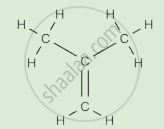 |
Discuss in brief about the properties of coordinate covalent compounds.
Assertion (A): Melting point and boiling point of ethanol are lower than that of sodium chloride.
Reason (R): The forces of attraction between the molecules of ionic compounds are very strong.
