Advertisements
Advertisements
Question
State one test by which sodium chloride can be distinguished from sugar.
Advertisements
Solution
Sodium chloride and sugar can be distinguished by the electrical conductivity test. Sugar, being a covalent compound, does not conduct electricity when dissolved in water but sodium chloride when dissolved in water conducts electricity.
APPEARS IN
RELATED QUESTIONS
Buckminsterfullerene is spherical molecule in which 60 carbon atoms are arranged in interlocking hexagonal and pentagonal rings of carbon atoms.
How many hexagons of carbon atoms are present in one molecule of buckminsterfullerene?
Explain why, diamond is hard while graphite is soft (though both are made of carbon atoms).
Explain why, graphite can be used as a lubricant but diamond cannot.
Explain why, diamond can be used in rock drilling equipment but graphite cannot.
The molecules having triple bond in them are:
(a) oxygen and ethyne
(b) carbon dioxide and ammonia
(c) methane and ethene
(d) nitrogen and ethyne
One of the following contains a double bond as well as single bonds. This is:
(a) CO2
(b) O2
(c) C2H4
(d) C2H2
An element A has 4 valence electrons in its atom whereas element B has only one valence electron in its atom. The compound formed by A and B does not conduct electricity. What is the nature of chemical bond in the compound formed? Give its electron-dot structure.
What happens when methane (natural gas) burns in air? Write the chemical equation of the reaction involved.
Explain the following:
polar covalent compounds electricity.
State the type of bonding in the following molecule.
Methane
Explain the following term with example.
Alkane
Explain the following term with example.
Unsaturated hydrocarbon
The carbon compound is used in daily life is ______.
Explain the following:
Polar covalent compounds conduct electricity?
Write a short note.
Characteristics of carbon
Complete the following activity.
Write the names of the hydrocarbons for the following structural formula.
(isobutylene, cyclohexane, propene, cyclohexene, cyclopentane, benzene, propyne, isobutane, propane)
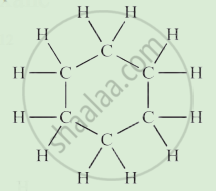 |
Identify the incorrect statement and correct them.
- Like covalent compounds, coordinate compounds also contain charged particles (ions). So they are good conductors of electricity.
- Ionic bond is a weak bond when compared to Hydrogen bond.
- Ionic or electrovalent bonds are formed by mutual sharing of electrons between atoms.
- Loss of electrons is called Oxidation and gain of electron is called Reduction.
- The electrons which are not involved in bonding are called valence electrons.
Acetic acid was added to a solid X kept in a test tube. A colourless, odourless gas Y was evolved. The gas was passed through lime water, which turned milky. It was concluded that ______.
Mineral acids are stronger acids than carboxylic acids because
- mineral acids are completely ionised
- carboxylic acids are completely ionised
- mineral acids are partially ionised
- carboxylic acids are partially ionised
Show the covalent bond formation in nitrogen molecule.
