Advertisements
Advertisements
Question
Write the order of the differential equation of the family of circles touching X-axis at the origin.
Advertisements
Solution
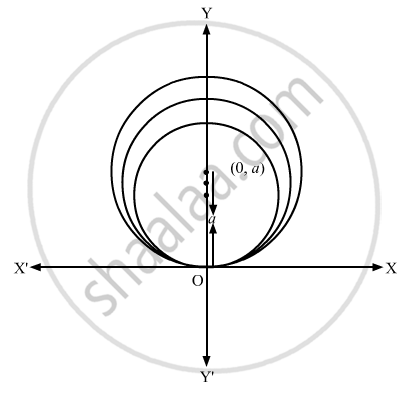
The equation of the family of circles touching x-axis at the origin is \[\left( x - 0 \right)^2 + \left( y - a \right)^2 = a^2 \]
\[ x^2 + y^2 - 2ay = 0 . . . . . \left( 1 \right)\]
Here, a is the parameter .
Since this equation contains only one arbitary constant, we differentiate it only once .
Differentiating with respect to x, we get
\[2x + 2y\frac{dy}{dx} - 2a\frac{dy}{dx} = 0\]
\[a = \frac{x + y\left( \frac{dy}{dx} \right)}{\frac{dy}{dx}} . . . . . \left( 2 \right)\]
Putting the value of a from (2) in (1), we get
\[ x^2 + y^2 = 2y\left\{ \frac{x + y\left( \frac{dy}{dx} \right)}{\frac{dy}{dx}} \right\}\]
\[\left( x^2 - y^2 \right)\frac{dy}{dx} = 2xy\]
So, this is the required differential equation .
Here, order of the differential equation is 1 .
APPEARS IN
RELATED QUESTIONS
Order and degree of the differential equation `[1+(dy/dx)^3]^(7/3)=7(d^2y)/(dx^2)` are respectively
(A) 2, 3
(B) 3, 2
(C) 7, 2
(D) 3, 7
Determine the order and degree (if defined) of the differential equation:
`((ds)/(dt))^4 + 3s (d^2s)/(dt^2) = 0`
Determine the order and degree (if defined) of the differential equation:
`(d^2y)/(dx^2)^2 + cos(dy/dx) = 0`
Determine the order and degree (if defined) of the differential equation:
( y′′′) + (y″)3 + (y′)4 + y5 = 0
Determine the order and degree (if defined) of the differential equation:
y″ + (y′)2 + 2y = 0
The degree of the differential equation `((d^2y)/(dx^2))^3 + ((dy)/(dx))^2 + sin ((dy)/(dx)) + 1 = 0` is ______.
For the differential equation given below, indicate its order and degree (if defined).
`(d^2y)/dx^2 + 5x(dy/dx)^2 - 6y = log x`
For the given below, verify that the given function (implicit or explicit) is a solution to the corresponding differential equation.
`y = e^x (acos x + b sin x) : (d^2y)/(dx^2) - 2 dy/dx + 2y = 0`
Write the degree of the differential equation
\[\frac{d^2 y}{d x^2} + x \left( \frac{dy}{dx} \right)^2 = 2 x^2 \log \left( \frac{d^2 y}{d x^2} \right)\]
Write the order of the differential equation of all non-horizontal lines in a plane.
Determine the order and degree (if defined) of the following differential equation:-
y"' + 2y" + y' = 0
Determine the order and degree (if defined) of the following differential equation:-
y"' + y2 + ey' = 0
In the following verify that the given functions (explicit or implicit) is a solution of the corresponding differential equation:-
y = cos x + C y' + sin x = 0
Write the order and degree of the differential equation `((d^4"y")/(d"x"^4))^2 = [ "x" + ((d"y")/(d"x"))^2]^3`.
Determine the order and degree of the following differential equation:
`(("d"^2"y")/"dx"^2)^2 + cos ("dy"/"dx") = 0`
Determine the order and degree of the following differential equations.
`dy/dx = 7 (d^2y)/dx^2`
State whether the following statement is true or false:
Order and degree of a differential equation are always positive integers.
Find the order and degree of the following differential equation:
`[ (d^3y)/dx^3 + x]^(3/2) = (d^2y)/dx^2`
Find the order and degree of the following differential equation:
`x+ dy/dx = 1 + (dy/dx)^2`
Select and write the correct alternative from the given option for the question
The order and degree of `(("d"y)/("d"x))^3 - ("d"^3y)/("d"x^3) + y"e"^x` = 0 are respectively
State the degree of differential equation `e^((dy)/(dx)) + (dy)/(dx)` = x
The order and degree of `((dy)/(dx))^3 - (d^3y)/(dx^3) + ye^x` = 0 are ______.
Order of highest derivative occurring in the differential equation is called the degree of the differential equation
The degree of the differential equation `1/2 ("d"^3"y")/"dx"^3 = {1 + (("d"^2"y")/"dx"^2)}^(5/3)` is ______.
The order and degree of `(("n + 1")/"n")("d"^4"y")/"dx"^4 = ["n" + (("d"^2"y")/"dx"^2)^4]^(3//5)` are respectively.
If m and n are the order and degree of the differential equation `((d^3y)/(dx^3))^6+5((d^3y)/(dx^3))^4/((d^4y)/(dx^4))+(d^4y)/(dx^4)=x^3-1,` then ______.
The degree of the differential equation `("d"^2y)/("d"x^2) + 3("dy"/"dx")^2 = x^2 log(("d"^2y)/("d"x^2))` is ______.
The degree of the differential equation `("d"^2y)/("d"x^2) + (("d"y)/("d"x))^3 + 6y^5` = 0 is ______.
The degree of the differential equation `("d"^2y)/("d"x^2) + "e"^((dy)/(dx))` = 0 is ______.
The degree of the differential equation `sqrt(1 + (("d"y)/("d"x))^2)` = x is ______.
Polio drops are delivered to 50 K children in a district. The rate at which polio drops are given is directly proportional to the number of children who have not been administered the drops. By the end of 2nd week half the children have been given the polio drops. How many will have been given the drops by the end of 3rd week can be estimated using the solution to the differential equation `"dy"/"dx" = "k"(50 - "y")` where x denotes the number of weeks and y the number of children who have been given the drops.
State the order of the above given differential equation.
The order and the degree of the differential equation `(1 + 3 dy/dx)^2 = 4 (d^3y)/(dx^3)` respectively are ______.
Find the order and degree of the differential equation
`sqrt(1 + 1/(dy/dx)^2) = ((d^2y)/(dx^2))^(3/2)`
Find the order and degree of the differential equation `(d^2y)/(dx^2) = root(3)(1 - (dy/dx)^4`
What is the fundamental condition required for the degree of a differential equation to be defined?
Based on the differential equation \[\left(\frac{d^{3}y}{dx^{3}}\right)^{2} + 5\frac{dy}{dx} = \sin(x)\], what is the degree?
