Advertisements
Advertisements
प्रश्न
Write the order of the differential equation of the family of circles touching X-axis at the origin.
Advertisements
उत्तर
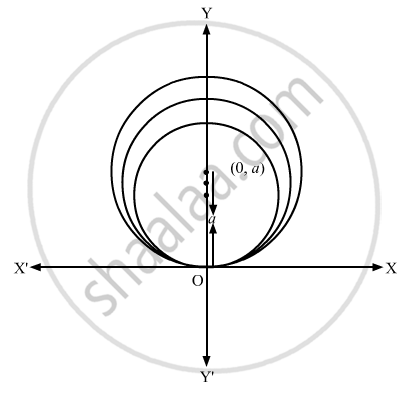
The equation of the family of circles touching x-axis at the origin is \[\left( x - 0 \right)^2 + \left( y - a \right)^2 = a^2 \]
\[ x^2 + y^2 - 2ay = 0 . . . . . \left( 1 \right)\]
Here, a is the parameter .
Since this equation contains only one arbitary constant, we differentiate it only once .
Differentiating with respect to x, we get
\[2x + 2y\frac{dy}{dx} - 2a\frac{dy}{dx} = 0\]
\[a = \frac{x + y\left( \frac{dy}{dx} \right)}{\frac{dy}{dx}} . . . . . \left( 2 \right)\]
Putting the value of a from (2) in (1), we get
\[ x^2 + y^2 = 2y\left\{ \frac{x + y\left( \frac{dy}{dx} \right)}{\frac{dy}{dx}} \right\}\]
\[\left( x^2 - y^2 \right)\frac{dy}{dx} = 2xy\]
So, this is the required differential equation .
Here, order of the differential equation is 1 .
APPEARS IN
संबंधित प्रश्न
Determine the order and degree (if defined) of the differential equation:
y′′′ + 2y″ + y′ = 0
For the given below, verify that the given function (implicit or explicit) is a solution to the corresponding differential equation.
`x^2 = 2y^2 log y : (x^2 + y^2) dy/dx - xy = 0`
Write the degree of the differential equation
\[a^2 \frac{d^2 y}{d x^2} = \left\{ 1 + \left( \frac{dy}{dx} \right)^2 \right\}^{1/4}\]
Write the order of the differential equation of all non-horizontal lines in a plane.
Write the degree of the differential equation \[\left( 1 + \frac{dy}{dx} \right)^3 = \left( \frac{d^2 y}{d x^2} \right)^2\]
If p and q are the order and degree of the differential equation \[y\frac{dy}{dx} + x^3 \frac{d^2 y}{d x^2} + xy\] = cos x, then
Write the order and degree of the differential equation `((d^4"y")/(d"x"^4))^2 = [ "x" + ((d"y")/(d"x"))^2]^3`.
Determine the order and degree of the following differential equation:
`[1 + (dy/dx)^2]^(3/2) = 8(d^2y)/dx^2`
Determine the order and degree of the following differential equation:
`(("d"^3"y")/"dx"^3)^2 = root(5)(1 + "dy"/"dx")`
Determine the order and degree of the following differential equations.
`(d^2x)/(dt^2)+((dx)/(dt))^2 + 8=0`
Determine the order and degree of the following differential equations.
`((d^2y)/(dx^2))^2 + ((dy)/(dx))^2 =a^x `
Choose the correct alternative.
The order and degree of `(dy/dx)^3 - (d^3y)/dx^3 + ye^x = 0` are respectively.
State whether the following is True or False:
The power of the highest ordered derivative when all the derivatives are made free from negative and / or fractional indices if any is called order of the differential equation.
Select and write the correct alternative from the given option for the question
The order and degree of `(1 + (("d"y)/("d"x))^3)^(2/3) = 8 ("d"^3y)/("d"x^3)` are respectively
Order of highest derivative occurring in the differential equation is called the ______ of the differential equation
Order and degree of differential equation are always ______ integers
The order and degree of the differential equation `[1 + 1/("dy"/"dx")^2]^(5/3) = 5 ("d"^2y)/"dx"^2` are respectively.
The order of the differential equation of all circles whose radius is 4, is ______.
The differential equation `x((d^2y)/dx^2)^3 + ((d^3y)/dx^3)^2y = x^2` is of ______
The order and degree of the differential equation `("d"^2"y")/"dx"^2 + (("d"^3"y")/"dx"^3) + x^(1/5) = 0` are respectively.
Order of the differential equation representing the family of ellipses having centre at origin and foci on x-axis is two.
The degree of the differential equation `[1 + (("d"y)/("d"x))^2]^(3/2) = ("d"^2y)/("d"x^2)` is ______.
The order and degree of the differential equation `(("d"^3y)/("d"x^3))^2 - 3 ("d"^2y)/("d"x^2) + 2(("d"y)/("d"x))^4` = y4 are ______.
The degree of the differential equation `("d"^2y)/("d"x^2) + "e"^((dy)/(dx))` = 0 is ______.
The degree of the differential equation `sqrt(1 + (("d"y)/("d"x))^2)` = x is ______.
The order and degree of the differential equation `sqrt(dy/dx) - 4 dy/dx - 7x` = 0 are ______.
The sum of the order and the degree of the differential equation `d/dx[(dy/dx)^3]` is ______.
The order and the degree of the differential equation `(1 + 3 dy/dx)^2 = 4 (d^3y)/(dx^3)` respectively are ______.
Find the order and degree of the differential equation
`sqrt(1 + 1/(dy/dx)^2) = ((d^2y)/(dx^2))^(3/2)`
The order and degree of the differential equation `sqrt((dy)/(dx)) - 4 (dy)/(dx) - 7x = 0` are respectively ______.
What is the degree of the differential equation \[\frac{dy}{dx} - \cos x = 0\]?
For the differential equation \[y''' + y^{2} + e^{y'} = 0\], what is the order?
What is the fundamental condition required for the degree of a differential equation to be defined?
In the differential equation \[\frac{d^{2}y}{dx^{2}} + \left(\frac{dy}{dx}\right)^{3} - y = 0\], what are the order and degree respectively?
What is the key difference between order and degree of a differential equation?
