Advertisements
Advertisements
Question
Wilfred Owen paints a horrific picture of a nightmarish memory on the battlefield. How does Duke et Decorum Est become Owen's condemnation and bitter response to war?
Advertisements
Solution
Dulce et Decorum Est is a poem Wilfred Owen wrote following his own experiences fighting in the trenches in northern France in World War One. Dulce et Decorum Est Pro Patria Mori, which is a line taken from the Latin Odes of the Roman poet Horace, means It is sweet and proper to die for one's country. In his poem, Wilfred Owen takes the opposite stance. He is in effect saying - It is anything but sweet and proper to die for one's country - in a hideous war that took the lives of over 17 million people. A poem that still resonates today, with brutal language and imagery, written by a young soldier recovering from his wounds, brave enough to return to the battlefield. The poet explains that It's just another day on the battlefields of World War I. As our speaker lets us know right away, however, "normal" isn't a word that has any meaning for the soldiers anymore. They're all mentally and physically ravaged by the exertions of battle.
And then it gets worse. Just as the men are heading home for the night, gas shells drop beside them. The soldiers scramble for their gas masks in a frantic attempt to save their own lives. Unfortunately, they don't all get to their masks in time. Our speaker watches as a member of his crew chokes and staggers in the toxic fumes, unable to save him from an excruciating certain death. Now fast-forward. It's some time after the battle, but our speaker just can't get the sight of his dying comrade out of his head. The soldier's image is everywhere: in the speaker's thoughts, in his dreams, in his poetry. Worst of all, our speaker can't do anything to help the dying soldier.
Bitterly, the speaker finally addresses the people at home who rally around the youth of England and urge them to fight for personal glory and national honor. He wonders how they can continue to call for war. If they could only witness the physical agony war creates – or even experience the emotional trauma that the speaker's going through now – the speaker thinks they might change their views. In the speaker's mind, there's nothing glorious or honorable about death. Or, for that matter, the war itself.
APPEARS IN
RELATED QUESTIONS
Explain what is imagery in a poem. Flow has Angelou used it in the poem?
What makes Margot different from the other children? Why does this cause the other children dislike Margot?
Fill in the blank with an appropriate word :
Sheila's grandmother found it difficult to climb __________ the steep staircase.
(A) Some of the cakes had been eaten by the boys before the party began.
(B) The boys…………………………
Discuss the following statement in groups of four.
“The landscape is an inner one, a spiritual and conceptual space.”
Discuss in groups of four.
Laws are never respected not enforced in India.
Identify the words in the advertisement that gave away the fact that it was placed by John Garrideb.
Look at these sentences.
- Deserts are the driest places on earth.
- Gerbils spend the hottest part of the day in cool underground burrows.
Now form pairs. Ask questions using a suitable form of the word in brackets. Try to answer the questions too.
Do you know
1. Which animal is the _______________________ (tall)?
2. Which animal runs the _______________________ (fast)?
3. Which place on earth is the _______________________ (hot) or the _______________________ (cold)?
4. Which animal is the _______________________ (large)?
5. Which is the ————————————— (tall) mountain in the world?
6. Which is the _______________________ (rainy) place on earth?
7. Which is the ________________________ (old) living animal?
Can you add some questions of your own?
Give reasons, for us being reluctant to make friends with some strangers, but being comfortable with some, even after meeting them for the first time.
The pride of any city is its skyline.
Write 5 lines about the place where you reside and what makes you feel proud of it.
Describe the climax scene in your own words. Write your comments on it.
Prepare a News Report in brief on this Art Festival.
Among your classmates, one is unable to walk properly, the second one can’t hear properly and the third one can’t see this beautiful world. All of them are facing lots of difficulties in life. Compose a dialogue among them, about the problems and difficulties faced by them. You can take help of the following dialogue to expand your ideas.
| Student 1: | Do you know, how many problems I have to face when I decide to go anywhere? |
| Student 2: | I can’t hear anything. |
| Student 3: | So, sad! You both can’t walk or hear but my problem is more serious than yours. You know, I can’t see this beautiful world. |
(Now continue in your notebook.)
Prepare a set of 10-12 questions that you would ask at an interview of a person who has strongly acted against social injustice and has achieved success inspite of a long struggle against so many odds in his/her life. Write them down in your notebook.
Answer the following questions in a paragraph about 80 -100 words
It is said, “The choices made by one, shape one’s destiny”. Ponder on the thought and write a paragraph.
Look at the picture and write a story.
|
If you cut down trees Your children will pay the fees |

Arrange the picture in order by writing the numbers 1,2,3 and 4 in the given boxes and write this familiar story in about 100 words.
Make use of the words given below.
| thirsty, village, pitcher, disappointment, pebbles, water level |
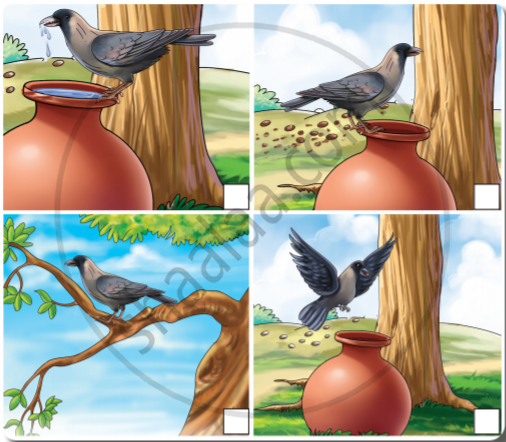
One hot day, a thirsty crow _____________________________________________________________
__________________________________________________________________________________________
Now complete the following suitably.
He was cleaning out his cupboard when _______
Punctuate the following sentence.
when I went fishing I caught an old shoe a plastic bag and a bad cold.
Which country would you like to visit when you grow up?
Make a project by drawing or pasting.
- a map of that country, its national flag
- stamps of the country, its currency
- some famous monuments or landmarks
What did Bob share with the cop about their friendship?
Bob’s life in the West was not a bed of roses. Give reasons.
Compare and contrast the character of Jimmy Wells and Bob with suitable references from the story to support your view.
He was called on Saturday to ______.
Write a dialogue between a student and teacher on 'Importance of Yoga'.
Think of an occasion when you did not like the decision/actions of your family members but realised later on that they were right. Write about it in 5-8 lines.
Write a short note on your mother tongue and the attempts you make to study it well.
Describe the event that led the narrator, Shankar, to suggest digging the ground under the Deodar tree in the short story, Fritz. Write your answer in a short paragraph of about 100-150 words.
