Advertisements
Advertisements
प्रश्न
Wilfred Owen paints a horrific picture of a nightmarish memory on the battlefield. How does Duke et Decorum Est become Owen's condemnation and bitter response to war?
Advertisements
उत्तर
Dulce et Decorum Est is a poem Wilfred Owen wrote following his own experiences fighting in the trenches in northern France in World War One. Dulce et Decorum Est Pro Patria Mori, which is a line taken from the Latin Odes of the Roman poet Horace, means It is sweet and proper to die for one's country. In his poem, Wilfred Owen takes the opposite stance. He is in effect saying - It is anything but sweet and proper to die for one's country - in a hideous war that took the lives of over 17 million people. A poem that still resonates today, with brutal language and imagery, written by a young soldier recovering from his wounds, brave enough to return to the battlefield. The poet explains that It's just another day on the battlefields of World War I. As our speaker lets us know right away, however, "normal" isn't a word that has any meaning for the soldiers anymore. They're all mentally and physically ravaged by the exertions of battle.
And then it gets worse. Just as the men are heading home for the night, gas shells drop beside them. The soldiers scramble for their gas masks in a frantic attempt to save their own lives. Unfortunately, they don't all get to their masks in time. Our speaker watches as a member of his crew chokes and staggers in the toxic fumes, unable to save him from an excruciating certain death. Now fast-forward. It's some time after the battle, but our speaker just can't get the sight of his dying comrade out of his head. The soldier's image is everywhere: in the speaker's thoughts, in his dreams, in his poetry. Worst of all, our speaker can't do anything to help the dying soldier.
Bitterly, the speaker finally addresses the people at home who rally around the youth of England and urge them to fight for personal glory and national honor. He wonders how they can continue to call for war. If they could only witness the physical agony war creates – or even experience the emotional trauma that the speaker's going through now – the speaker thinks they might change their views. In the speaker's mind, there's nothing glorious or honorable about death. Or, for that matter, the war itself.
APPEARS IN
संबंधित प्रश्न
In the following items, sentence A is complete, while sentence B is not. Complete sentence B, making it as similar as possible to sentence A. Write sentence B.
(A) He is so old that be cannot remember events of the past.
(B) He is too ............................................................................
In the following items, sentence A is complete, while sentence B is not. Complete sentence B, making it as similar as possible to sentence A. Write sentence B.
(A) His attitude towards his parents has always puzzled the
(B) I have ..................................................................................
What-is meant by,’ rainbow tinted circles of light? What kind of literary figure is it?
Later, too, the old man uses the expression famous victory? Why?
Explain and discuss the themes in the poem.
But a BIRD that stalks down his narrow cage
Can seldom see through his bars of rage
His wings are clipped and his feet are tied
So he opens his throat to sing.
Read the above lines and answer the question that follow.
Why does the caged bird sing?
What is the primary purpose of “Hearts and Hands” by O. Henry?
Below is a topic for essay writing. Follow the steps listed above to write on this topic.
Himalayan Quake 2005
What was John Garrideb's objective in inventing the story of Alexander Hamilton Garrideb and his legacy?
Describe the cycle of events in Satyajit's life that brought him back to where he began.
Different arms and ammunitions are mentioned in the excerpt. Find their names.
Write two lines from this poem which you find most humorous. Justify your choice.
Have you ever eaten any fruit/vegetable picking it straight from the tree or field? Write about that experience in 3-5 lines.
What is the name of her diary?
It is very late at night and your father hasn’t returned from the office. ______
You are waiting to board a train in a railway station. The train is delayed by an hour. Write a paragraph about the crowded scene in the railway station based on your observation.
| vendors | tea vendors | shops | families | piles of luggage |
| porters | trolley | scroll board | announcement | ticket counter queue |

Do you want to try to write your own paragraph now?
Write a paragraph on Palm tree.

- ______
- ______
- ______
- ______
- ______
Work in groups of four. See the picture of a shipwreck at the bottom of the ocean.
Suppose you went deep-sea diving. What would you find? Think of all the words that come to your mind, then build a paragraph. Share your story with other groups.

Who said these words and to whom?
| Who said | To whom | |
| “Wake up, dear! Wake up fast!” | ||
| “Ma, who woke me up today?” | ||
| “Why do you sleep at nine every night?” |
Now complete the following sentences, choosing the right word.
The golden ______ was very ______ to him. (dear, deer)
Complete the following stories by using an appropriate word from the box given below –
| my, his, he, your |
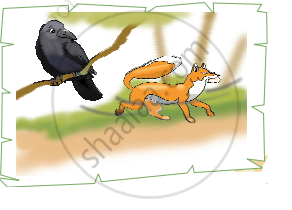
Sitting on a tree a crow was enjoying a piece of bread. A hungry fox wanted to have that bread. said very sweetly, “Dear brother, I've heard that ______ voice is very sweet. Please sing a song for me.” The foolish crow opened ______ beak and the piece of bread fell down. The fox picked it up in ______ mouth and ran away.
Make naming words by adding ness, ity, ty at the end of the words given below. One has been done for you.
| public | publicity |
| forgive | |
| kind | |
| polite | |
| moral | |
| stupid | stupidity |
| blind | |
| cruel | |
| swift | |
| solid |
Find one story of bravery about a child. You can search for the story by talking to older people or watching a TV programme or from a film.
- Write down the story. Also, mention its source.
- Narrate the story to the class.
- Which story did you like the best? Write down your reasons.
Summarising is to briefly sum up the various points given in the notes made from the original passage. It is a retrieval of information from the notes made. Hence, while writing it, one need not go back to the original passage but refer only to the notes made. A first draft will help us to write a fair summary.
Woman 5 was not aware of what was happening. Why?
‘Just one more installment and BABY’S REALLY OURS!’ This tells us that the couple
Think of an occasion when you did not like the decision/actions of your family members but realised later on that they were right. Write about it in 5-8 lines.
If you want to become a tourist guide at the following places, which languages will you need to learn?
- Ajanta
- Belgavi
- Delhi
- Tarkarli
Prepare an attractive tourist leaflet for your native place, in English as well as in your mother tongue.
What strategies do you use when you study on your own?
