Advertisements
Advertisements
Question
Why does compound (A) given below not form an oxime?

(A)
Advertisements
Solution
Glucose pentaacetate (structure A) does not have a free –OH group at C, and therefore, cannot be converted to the open chain form to give a free –CHO group and hence it does not form the oxime.
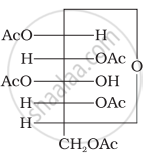
(Structure A)
APPEARS IN
RELATED QUESTIONS
Differentiable between the following:
Amylose and Amylopectin
Write the reactions involved when D-glucose is treated with the following reagent:
H2N-OH
Write the reaction involved when D-glucose is treated with the following reagent:
(CH3CO)2O
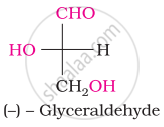
Choose the appropriate answer(s) for the below representation from the options given

What is the most abundant organic compound on earth?
Glucose is found to exist in two different α and β crystalline forms. These forms can be obtained by:
(i) The α form of glucose is obtained by crystallisation from a concentrated solution of glucose at 303 K.
(ii) The β form of glucose is obtained by crystallisation from a concentrated solution of glucose at 303 K.
(iii) The β form is obtained by crystallisation from hot and saturated aqueous solution at 371 K.
(iv) The α form is obtained by crystallisation from hot and saturated aqueous solution at 371 K.
The reaction of glucose with red P + HI is called ____________.
Which is the least stable form of glucose?
A solution of D-glucose in water rotates the plane polarised light ____________.
Choose the correct relationship for glucose and fructose:
Which one is correct?
In the following reaction, identify A and B:
\[\begin{array}{cc}
\ce{C6H12O6 ->[Acetic anhydride] A}\\
\downarrow \text{Conc. nitric acid}\phantom{...}\\
\ce{B}\phantom{.................}\end{array}\]
Three structures are given below in which two glucose units are linked. Which of these linkages between glucose units are between C1 and C4 and which linkages are between C1 and C6?
| (I) |  |
| (II) |  |
| (III) |  |
Assertion: D (+) – Glucose is dextrorotatory in nature.
Reason: ‘D’ represents its dextrorotatory nature.
What happens when D-glucose is treated with the following reagent?
HI
Glucose with excess of phenyl hydrazine forms ______.
When D-glucose reacts with HI, it forms ______.
Give a reason for the following observations:
Penta-acetate of glucose does not react with hydroxylamine.
