Advertisements
Advertisements
Question
Who does the speaker claim to represent?
Advertisements
Solution
The speaker wishes to represent some of the cardinal principles enunciated by those who offered to graduates in the past. He remarks that his speech would bear the layman’s point of view to the findings of experts in various fields of education. He promises to annotate the speeches of great educationists for the benefit of the graduates.
APPEARS IN
RELATED QUESTIONS
Nuclear Family or Joint Family
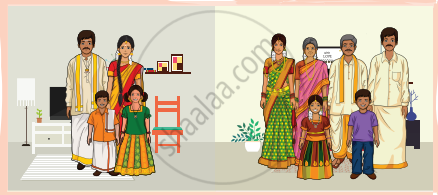
Based on the visuals given above, give five words/phrases each, to describe these two family types.
| Nuclear family | Joint family | ||
What is your favourite sport? Do you play any sport?
Regardless of the challenges faced, some women have achieved great success in the field of sports. Here is a list of Indian women celebrities who are accomplished in the field of sports and games. Match their names with the sports or games they are associated with, by drawing lines. One has been done for you as an example.
| Names of personalities | Sports / Games | |
| PV Sindhu | golf | |
| Geeta Phogat | weightlifting | |
| Koneru Humpy | swimming | |
| Karnam Malleshwari | badminton | |
| Anjali Bhagwat | cricket | |
| Sania Mirza | hockey | tennis |
| Dipika Pallikal | archery | |
| Bula Choudhury | athletics | |
| P.T. Usha | wrestling | |
| Saba Anjum Karim | chess | |
| Akanksha Singh | shooting | |
| Mithali Raj | basketball | |
| Sharmila Nicollet | squash | |
| Deepika Kumari | tennis |
How forgetful are you?
Discuss and share your views with the class on the following.
Is forgetfulness a result of carelessness or preoccupation?
How do psychologists interpret forgetfulness?
What is common about the ‘angler’ and the ‘poet’?
When does human memory work with less than its usual capacity?
We found a ______of biscuits in the old man’s shirt ______. (pocket/packet)
Describe the activity that was going on in the sale-room at King Street.
How had the author managed the auction without getting involved in the deal?
What did the falling of the hammer indicate?
The narrator would not forget two things about his friend. What are they?
Why did the narrator visit Christie’s?
What was the narrator’s financial condition?
The narrator could not pretend to have made a mistake in bidding. Why?
Narrate the circumstances that led to the narrator getting into a tight corner, by his own folly
Explain how the narrator got out of the tight corner that he was in.
Work in pairs. Look at the mind map below and add a few other features of democracy you can think of. Share your answers with the class.
- e.g. sharing and caring
Given below is a list of items or features you find in a good school. Study the list and classify the items as individual and common.
textbooks – uniform – smart classroom – laboratory – competent teachers – library – mid-day meals – blackboard – stationery – playground – sports equipment washrooms
| Individual | Common |
| e.g. textbooks | playground |
Who provides these common facilities? Tick the appropriate source.
- Parents
- Educational institutions
- The Department of Education
- Social Service Organizations
- Other agencies
Discuss this aspect with your partner and share your views on how students can give back to society.
How does the speaker highlight the importance of giving back to the society?
Describe the fluttery cascade of things tumbling from the bag.
How did Bryson free himself from the crash position?
How would staying away from liquid mischief benefit Bryson?
Can a clumsy person train himself/ herself to overcome shortcomings? How could this be done?
