Advertisements
Advertisements
Question
What were the strange instruments the nurse carried to the surgery? How did the waiting patients interpret her act?
Advertisements
Solution
The nurse carried pliers, hammer and hacksaw to the Dentists’s room. The patients thought the dentist was using those tools to extract bad tooth from patient one. Lady 1 couldn’t resist going to the surgical room as to know what was exactly happening to Joe who was the first patient. Woman restrained her all the time. Unable to bear the groans, two men left the waiting room. They were getting late for work.
APPEARS IN
RELATED QUESTIONS
How was the great victory a personal tragedy for Kaspar?
Do you agree with his justification of the war? Why/ why not?
Why is the poet so much against watching television? Give two reasons.
What is the encaged bird fearful of ?
Can the poem be taken as interpretation of human fickleness?
What kind of atheletes were they?
Choose two of the passages (a) to (c) and answer briefly the questions that follow:
Benedick: I can see yet without spectacles, and I see no such matter. There's her cousin, she were not possessed with a fury, exceeds her as much in beauty as the first of May doth the last of December. But I hope you have no intent to turn husband, have you?
Claudio: I would scarce trust myself though I had sworn the contrary if I Hero would be my wife.
(i) Whom is Benedick referring to in the above lines?
(ii) Benedick says: 'I see no such matter.' What does he mean by it?
(iii) Explain the lines:
"There's her cousin, she was not possessed with a fury, exceeds her as much in beauty as the first of May doth the last of December".
(iv) What does the comparison of Beatrice with May suggest about Benedick?
(v) What does Claudio mean by 'sworn the contrary'?
(vi) Give the meaning of the following words as they are used in the context of the passage: possessed; fury; intent
(A) Ramesh said, "Rajiv, please bring your physics book to school tomorrow."
(B) Ramesh………………………….
Read the extract given below and answer the questions that follow:
Mabel: [Utterly surprised] Ronny! Do they want me in Court?
Dancy: No.
Mabel: What is it, then? Why are you back?
Dancy: Spun.
Mabel: [Blank] Spun? What do you mean? What’s spun?
Dancy: The case. They’ve found out through those notes.
Mabel: Oh [Staring at his face] Who?
(i) Where are Mabel and Dancy at this time? What was Mabel doing just before this conversation?
(ii) Why did Mabel say, “Do they want me in court?” Explain the meaning of spun in the extract?
(iii) What ‘notes’ is Dancy talking about now?. How does Mabel react immediately after the extract”:
(iv) Dancy leaves a note for his best friend towards the end of the play. What is the name of his best friend? What is written in the note?
(v) What does Dancy do at the end? Why does he do that? What is your opinion of Mabel and Dancy?
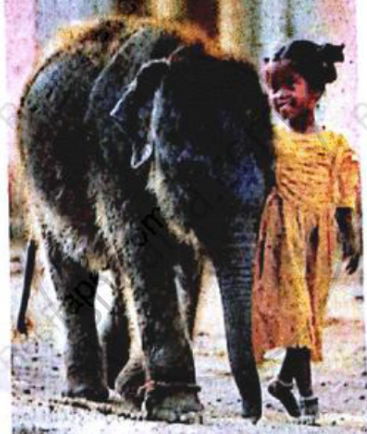
Study the picture given below. Write a story or a description or an account of what it suggests to you. Your composition may be about the subject of the picture or you may take suggestions from it; however, there must be a clear connection between the picture and your composition.
He drew a beautiful diagram________ the board.
List the advances in technology that have improved forensic analysis.
To what is the bird’s movement compared? What is the basis for the comparison?
How did Holmes guess that John Garrideb would go to 136, Little Ryder Street? Did he expect to find what he ultimately did before he went there?
Multiple Choice Question:
What does ‘We’ here refer to?
State whether the following statement is true or false. Correct the false statement.
There is nothing wrong with being grateful to great men.
The poet is prompted to call the sower an ‘august personality’ which means one who has reached the highest position in his workplace.
Explain this using the following point.
Hard work
Pick out the examples of alliteration from the poem and write them down.
Discuss with your partner and match the following expressions given in column A with their interpretations in column 'B'.
| Sr.No. | A | B |
| 1. | While Chief Baron Ear sat to balance the laws. | (a) Eyes are refrained from using spectacles. |
| 2. | They are made with the straddle as wide as the ridge of the Nose is. | (b) The responsibility of giving a verdict rested on the shoulders of the hearing organ. |
| 3. | That whenever the Nose put his Spectacles on, by daylight or candlelight Eyes should be shut! | (c) Spectacles are meant for none other than the nose. |
| 4. | So his lordship decreed with a grave solemn tone, decisive and clear, without one if or but. | (d) The judge delivered a firm verdict without any doubt. |
Write the appreciation of the poem.
- About the poem/poet/title
- Theme
- Poetic devices, language, style
- Special features/novelties/focusing elements
- Values, message
- Your opinion about the poem.
Read the following note from a school girl’s diary:
|
Miss Fernandes is our new class teacher. She is slim and fit even at the age of 50. With her grey hair, spectacles, and plain formal clothes, she looks so strict! But we discovered that her classes can be great fun. We begin each class with a simple two-minute game or activity. Today we had to write as many words beginning with 'a' as we could, within 60 seconds. I wrote 50! I got a pot on my back for making 'the best effort'! I feel on top of the world. |
Write diary entries for the interesting or important events that take place in your school. Write at least 3 entries.
Write an article for the following.
The service provided by the conservancy workers in your city is very poor. You find all the street corners dumped with garbage thrown by the residents of the locality. It causes a menace for the public at large. You are Ramya/Rajan of Class X, studying in TM Model School, Dharmapuri. Write an article in about 150-200 words to the editor of The Indian Express, about this and suggest ways by which the situation could be improved.
Read the acrostic poem on ‘Friend’. Write an acrostic poem like this on ‘Tree’.
| Friend | Tree |
|
Friends always love each other |
T |
|
Respect each Other |
R |
|
Interact with each other |
E |
|
Enjoy playing with each Other |
E |
|
Never hurt your friends |
|
|
Do everything together |
Write a short paragraph on 'summer' using the hints given.
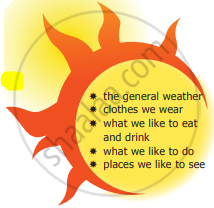
you can begin like this
I live in Chennai. The weather is...
Now complete the following, in the same way, using the words easy or strong.
The dog is ______
The horse is ______
The elephant is ______
Make groups of ten and present one of the following activities in class.
| skit | song | dance | painting a chart for class | make paper bags from old newspaper |
Describe the photographer.
"That which we obtain too easily, we esteem too lightly. It is dearness only which gives everything its value."- Thomas Paine
Do we value only what we struggle for? Plan your response, and then write an essay to explain your views on this issue. Be sure to support your position with specific points and examples. (You may use examples from your reading, observations, and inputs from subjects such as History, Science and literature)
Write a dialogue between a student and teacher on 'Importance of Yoga'.
What might success mean to the following people? Think about it and write.
A businessman
