Advertisements
Advertisements
Question
Now complete the following, in the same way, using the words easy or strong.
The dog is ______
The horse is ______
The elephant is ______
Advertisements
Solution
The dog is strong
The horse is stronger
The elephant is strongest.
APPEARS IN
RELATED QUESTIONS
Explain:
Thus I entered, and thus I go!
In triumphs, people have dropped down dead.
Write a composition (350 - 400 words) on the following:
Write an original short story that begins with the words : “The day started off well enough, whoever thought it would ……….”
Discuss the following in pairs or in small groups.
‘It was worth a wound—it was worth many wounds—to know the depth of loyalty and love that lay behind that cold mask’— how does this comment throw light on the kind of relationship between Holmes and Watson?
Look at these sentences.
|
|
| ‘Would’ tells us what the author used to do, or what used to happen. | ‘Could’ tells us what the author was usually able to do, or grandfather is now not able to do. |
Choose would and could to replace the italicised words in the following sentences.
Choose would and could to replace the italicised words in the following sentences.
Grandfather says, in the old days,
1. elephants were able to fly in the sky, like clouds. They were also able to change their shapes. They used to fly behind clouds and frighten them. People used to look up at the sky in wonder.
2. because there was no electricity, he used to get up with the sun, and he used to go to bed with the sun, like the birds.
3. like the owl, he was able to see quite well in the dark. He was able to tell who was coming by listening to their footsteps.
Discuss with your partner and choose the correct alternative.
A democratic country is governed by, its - __________________.
State whether the following statement is true or false. Correct the false statement.
Hero-worship leads to dictatorship.
Write an appreciation of the poem considering the following points:
- About the poem, poet, and title.
- Theme/summary/gist of the poem.
- Poetic style/language, poetic devices used in the poem.
- Special features/novelties/focusing elements.
- Message/values/morals in the poem.
- Your opinion about the poem.
The poet has observed the sower closely. Express in your own words the reverence the poet has for the sower.
Given below is a list of words used to develop a CV or a Resume. Prepare a CV/Resume of your own.
Personal Information
- Name
- Address
- Date of birth
- Telephone / E-mail
- Nationality
- Marital status
Work Experience
- Experience/ Occupation / Position
- Employer / Employment History
- Internships
- Activities and responsibilities
Education
- Education and Training
- Primary school
- Secondary school
- Other qualification
Personal Skills and Competencies
- Competencies / Personal Competencies / Personal Skills/ Computer skills Mother tongue/ Other languages / Foreign languages
Discuss the following and write about the following in your own words in 5-6 lines.
What opinion do you form about Mathilde’s husband from her story?
Rewrite the play in the form of a short story.
There are many legends about the ‘nine gems’ in Akbar’s Court. These are popular tales and they may not have a historical basis. Can you name some of the nine gems and the stories associated with them?
Who said these words and to whom?
| Who said | To whom | |
| “Wake up, dear! Wake up fast!” | ||
| “Ma, who woke me up today?” | ||
| “Why do you sleep at nine every night?” |
See the picture Travel Time below. Answer the questions that follow.
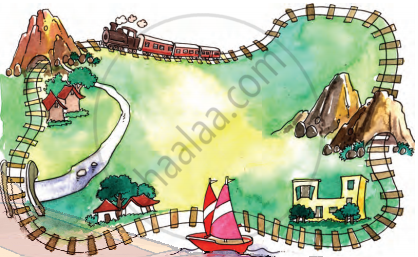
- Where did you go for an excursion/holiday?
- With whom did you go?
- What did you take with you?
- What was the first thing you saw when you reached your destination?
- What did you like best about the place?
- How long did you stay there?
- What did you miss about home?
Study the pie-chart carefully and answer the questions that follow.
Percentage of people who speak each language as their first language.

- Which language is spoken by most people?
- What are the Indian languages that rank among the top five spoken languages?
- Which are the languages that are spoken by less than three percent of people?
- With the help of the questions and answers, draw your own conclusions from the pie chart. Then, write a paragraph on the popular spoken languages.
Write conversation on the following situation.
Between two friends about the importance of reading newspapers
Jill said that they owned the steering wheel of a car, one of the tyres, two of the cylinders and leg of the sofa. What does this convey?
Identify the list in which Abou Ben Adhem's name appeared right at the top.
Using the given informal letter as a model, write a letter on any one of the topics given below.
Write letter to your father asking permission to go on a educational tour.
Write points and counter points on the following topic:
You must memorise the rules of grammar
