Advertisements
Advertisements
Question
Given below is the diagram of a cell as seen under the microscope after having been placed in a solution:

(i) What is the technical term used for the state/condition of the cell given above?
(ii) Give the technical term for the solution in which the cell was placed.
(iii) Name the parts numbered 1 to 4.
(iv) Is the cell given above a plant cell or an animal cell ? Give two reasons in support of your answer as evident from the diagram.
(v) What would you do to bring this cell back to its original condition?
Advertisements
Solution
(i) Plasmolysis
(ii) Hypertonic solution
(iii) (1) Nucleus, (2) Sugar drops, (3) Small vacuole, (4) Large vacuole.
(iv) Plant cell (1) Presence of cell wall, (2) Presence of large vacuole.
(v) It has to be placed in a hypotonic solution.
APPEARS IN
RELATED QUESTIONS
The figure given below is a diagrammatic representation of a part of the cross section of the root in the root hair zone. Study the same and then answer the questions that follow

(i) Name the parts indicated by the guidelines 1 to 4.
(ii) Which is the process that enables the passage of water from the soil into the root hair?
(iii) Name the pressure that is responsible for the movement of water in the direction indicated by the arrows. Define it.
(iv) Due to an excess of this pressure sometimes drops of water are found along the leaf margins of some plants especially in the early mornings. What is the phenomenon called?
(v) Draw a well labelled diagram of the root hair cell as it would appear if an excess of fertiliser is added to the soil close to it.
How does movement and absorption of water take place through the roots?
Which one of the following is a characteristic NOT related with the suitability of the roots for absorbing water?
Study the experimental setup in the figure and then answer the question that follow.
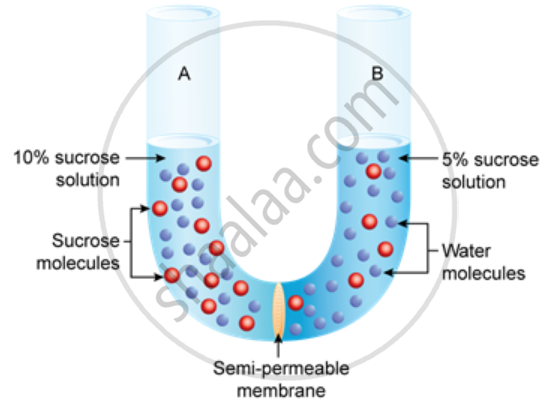
What is meant by 'semipermeable membrane'?
Root hairs become flaccid, when fertilizers are added to the moist soil around it. Explain.
Fill in the Blank
Leaves get wilted if _________ is removed from the plant.
A thin strip of epidermal cells of a leaf was observed in a drop of water. They all looked turgid and normal.
(a) Draw a diagram of such a cell.
(b) Draw a diagram of a cell if this strip is transferred to a strong concentrated solution of sugar. What is term used for the effect on the cells ?
Multiple Choice Question:
In soil, water available for absorption by root is ______.
Multiple Choice Question:
The most widely accepted theory for ascent of sap is ______.
In soil which of the following type of water is available for absorption by plant roots?
