Advertisements
Advertisements
Questions
Define perfect competition.
Define a perfect market.
Define a perfectly competitive market.
Advertisements
Solution
Perfect competition is a form of market in which there are a large number of buyers and sellers and a homogeneous product is sold at a uniform price.
APPEARS IN
RELATED QUESTIONS
Define Discriminating Monopoly.
Which two forms of market earn normal profit in the long run?
Explain three features of Perfect competitive market.
How is Perfect competitive market is different from a monopoly market?
Justify the following statement with any two valid arguments. 'In a perfect competition market structure, an individual firm does not have any role in determining price’.
Selling costs are absent in perfect competition market.
Firm A hires the services of Rohit Sharma to act as the Brand ambassador for its products X. Identify the nature of market for commodity X.
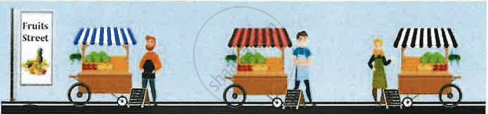
“While shopping for fruits in the local market you see many seller selling fruits”. In this context answer the following:
- What is the type of market referred to?
- State and draw the type of demand curve faced by the market above.
- Differentiate between the market indicated above and monopoly on the basis of:
- No. of sellers
- Market price
- Entry and exit of firms in the market
Following is not the feature of perfect competition:
Differentiated products is a characteristic of ______.
Marginal revenue of a firm is constant throughout under:
Indian Railways is an example of ______.
A monopolist is price maker:
Observe the relationship of the first pair of words and complete the second pair.
Single seller in the market : Monopoly
Single buyer in the market : ______
The seller in a monopoly market is a price maker.
Which of these feature's is found in both a perfectly competitive market and a monopolistically competitive market?
Pick the option which does not belong to the group.
The monopolist's downward sloping demand curve means that it can increase sales only by changing a lower price.
Imperfect knowledge is a characteristic feature of:
Which one of the following is NOT found in a perfectly competition market?
A holiday resort in a remote village is very popular among the tourists. Since the connectivity is very poor with the outer world, the owner employs the local villagers for the functioning of the resort.
This is a case of:
Which of the following is the least competitive market?
Match the following:
| Column I | Column II | ||
| A. | Monopoly | (i) | Availability of close substitutes |
| B. | Oligopoly | (ii) | Absence of close substitutes |
| C. | Perfect competition | (iii) | Few large sellers |
| D. | Monopolistic competition | (iv) | Homogeneous products |
Match the following:
| Column I | Column II | ||
| A. | Demand curve under perfect competition | (i) | Indeterminate demand curve |
| B. | Demand curve under monopoly | (ii) | Downward sloping but less elastic |
| C. | Demand curve under monopolistic competition | (iii) | Horizontal straight line |
| D. | Demand curve under oligopoly | (iv) | Elastic demand curve |
Read the following statements carefully and choose the correct alternative:
Assertion (A): Buyers are ready to pay different prices for the product produced by different firms under perfect competition.
Reason (R): The products offered for sale in the perfect market are homogeneous.
Read the following statements carefully and choose the correct alternative:
Assertion (A): Under Perfect Competition, each firm faces a perfectly elastic demand curve.
Reason (R): Firm is a price maker under perfect competition.
Mention two features of monopoly.
Producers in a monopoly are price makers. Briefly explain.
There are no substitute goods in a monopoly market. Give a reason to support your answer.
Give three points of difference between perfect competition and monopoly.
Define monopolistic competition.
Define oligopoly.
Define monopsony.
Give two characteristics of perfect competition.
Define product differentiation.
To which market is product differentiation relevant?
What are selling costs?
State the advantage of monopolistic competition over monopoly.
Highlight the importance of selling costs in a monopolistically compatible market.
Identify the market form of the following:
Goods sold are homogeneous.
Identify the market form of the following:
Motor car market in India.
Identify the market form for the following:
Railways in India.
Identify the market form for the following:
Telecom industry in India.
State the market form of the following commodity.
Railways
State the market form of the following commodity.
Automobiles
State the market form of the following commodity.
Shampoos
State the market form of the following commodity.
Fighter Aircrafts
Identify the market form for the item given below:
A single seller
Identify the market form for the item given below:
Homogeneous goods
Name the market in which there is a single buyer and many sellers.
Give an example of monopoly.
Give an example of price discrimination.
Explain the main characteristics of a monopoly.
Which type of market structure is the following? Give reason.
Trucks
Which type of market structure is the following? Give reason.
Scooters
Which type of market structure is the following? Give reason.
Mobile phone services
Which type of market structure is the following? Give reason.
Jeans
Which type of market structure is the following? Give reason.
Ball-pen
Product differentiation is practised in monopolistic competition? Give reasons.
To which market is price discrimination relevant?
Give two examples of a monopolistically competitive market.
Why can a monopolist charge different prices in different markets?
What do you mean by homogeneous products?
Which market form has the least number of producers?
What induces new firms to enter an industry?
What is the effect on price when a perfectly competitive firm tries to sell more?
What is the effect on price when a monopoly firm tries to sell more?
What is the difference between collusive and non-collusive oligopoly?
Elaborate the price discrimination feature of monopoly.
Identify the market form from the following.
Price discrimination
Identify the market form from the following.
Perfect knowledge
Mention one feature of a monopoly market.
Name the characteristic which makes monopolistic competition different from perfect competition.
What is a price making firm?
Why an individual firm under perfect competition cannot influence the market price?
Why are selling costs incurred?
