Advertisements
Advertisements
Question
Indian Railways is an example of ______.
Options
Monopolistic competition
Perfect competition
Monopoly
Oligopoly
Advertisements
Solution
Indian Railways is an example of Monopoly.
Explanation:
Indian Railways is an example of a monopoly because it is India's sole provider of railway transportation services, which is government-controlled. There are no direct competitors in the rail transport business; hence, Indian Railways has complete control over price and services.
RELATED QUESTIONS
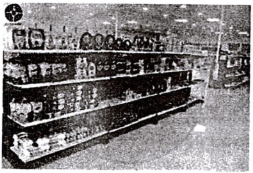
The image above shows a departmental store of a market structure.
- Identify the form of market as observed from the above image.
- Discuss the features of this market form with respect to:
- Type of product
- Entry and exit of firms
- Selling cost
Explain three features of Perfect competitive market.
Selling costs are absent in perfect competition market.
Match the following and select the correct option.
| Column I | Column II | ||
| (i) | Perfectly elastic demand | (A) | Oligopoly |
| (ii) | Less elastic demand | (B) | Monopolistic competition |
| (iii) | More elastic demand | (C) | Perfect competition |
| (iv) | Indeterminate demand | (D) | Monopoly |
"The price of a product under perfect competition is determined by an individual seller."
Observe the relationship of the first pair of words and complete the second pair.
Single seller in the market : Monopoly
Single buyer in the market : ______
Read the given statements carefully and select the correct option.
- The number of sellers under oligopoly are small.
- In monopolistically competitive markets, buyers and sellers have perfect knowledge about the market conditions.
Which of the following market types has the fewest number of firms?
The market structure which is characterised by a single producer of a commodity and when there are not close substitutes for that commodity:
A holiday resort in a remote village is very popular among the tourists. Since the connectivity is very poor with the outer world, the owner employs the local villagers for the functioning of the resort.
This is a case of:
Which of the following is the least competitive market?
Match the following:
| Column I | Column II | ||
| A. | Monopoly | (i) | Availability of close substitutes |
| B. | Oligopoly | (ii) | Absence of close substitutes |
| C. | Perfect competition | (iii) | Few large sellers |
| D. | Monopolistic competition | (iv) | Homogeneous products |
Read the following statements carefully and choose the correct alternative:
Assertion (A): Under Perfect Competition, each firm faces a perfectly elastic demand curve.
Reason (R): Firm is a price maker under perfect competition.
Define monopolistic competition.
Identify the market form of the following:
Market for toilet soaps in India.
Identify the market form for the item given below:
A single buyer
Give an example of monopoly.
Which market form has the least number of producers?
Name the market which has characteristics both of monopoly and perfect competition.
In which type of market are firms interdependent and a few large firms dominate?
