Advertisements
Advertisements
Questions
Explain the main characteristics of a monopoly.
Explain three main features of monopoly.
Explain in detail the features of a monopoly.
Advertisements
Solution
- Single seller/firm/industry: In a monopoly, there exists only one seller or a group of individuals owning a single firm.
- Price maker: Since a monopolistic firm is the only firm in the market, it has total freedom to fix the price level that can maximize its profit. Therefore, it can be said that a monopolistic firm is a price maker.
- Perfect knowledge: It is assumed that a monopolist has perfect knowledge about the different conditions prevailing in the market. He is well informed about the types of demand prevailing in different market segments and determines the price of his product accordingly.
- Price discrimination: A monopolist enjoys the freedom to engage in price discrimination. In other words, it can sell the same product to different buyers at different prices at different time periods.
- Complete control over market supply: Being a single seller, a monopolist has sole control over the production. The supply of output rests on the monopolist’s decision.
- Possibility of supernormal profits: A monopolist firm has complete control over his decisions regarding price and output. The decision is taken into consideration the profit motive. At times a higher price is charged and at times supply is restricted to earn greater profits.
- Firm is the industry: As the monopoly firm is the single firm in the market, there is no distinction between the firm and the industry.
Notes
Students should refer to the answer according to the question.
APPEARS IN
RELATED QUESTIONS
Identify the market having a single buyer and many sellers from the following:
Non-price competition is ______.
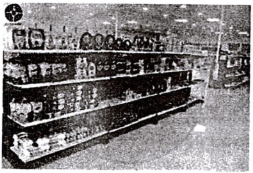
The image above shows a departmental store of a market structure.
- Identify the form of market as observed from the above image.
- Discuss the features of this market form with respect to:
- Type of product
- Entry and exit of firms
- Selling cost
Explain three features of Perfect competitive market.
Justify the following statement with any two valid arguments. 'In a perfect competition market structure, an individual firm does not have any role in determining price’.
Selling costs are absent in perfect competition market.
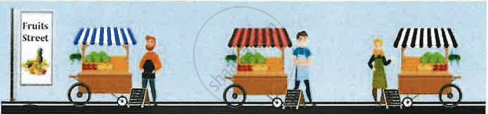
“While shopping for fruits in the local market you see many seller selling fruits”. In this context answer the following:
- What is the type of market referred to?
- State and draw the type of demand curve faced by the market above.
- Differentiate between the market indicated above and monopoly on the basis of:
- No. of sellers
- Market price
- Entry and exit of firms in the market
Following is the feature of perfect competition:
Following is not the feature of perfect competition:
Marginal revenue of a firm is constant throughout under:
A seller cannot influence the market price under:
Indian Railways is an example of ______.
A monopolist is price maker:
Indian Oil Corporation Limited is an example of a/an ______.
"The price of a product under perfect competition is determined by an individual seller."
A market where homogeneous products are sold with no control over price by an individual firm or a buyer is ______.
Observe the relationship of the first pair of words and complete the second pair.
Single seller in the market : Monopoly
Single buyer in the market : ______
The seller in a monopoly market is a price maker.
Which among the following is a feature of monopsony market?
Which of the following statements are true?
- Monopolistically competitive markets have high selling costs.
- Monopolistically competitive markets sell homogeneous goods.
- Any firm can start a business in a monopolistically competitive market.
The monopolist's downward sloping demand curve means that it can increase sales only by changing a lower price.
Imperfect knowledge is a characteristic feature of:
Identify the market form for seller A on the basis of the following information:
| Units of output sold | Price offered by seller A in ₹ |
| 30 | 10 |
| 40 | 10 |
| 50 | 10 |
Match the following:
| Column I | Column II | ||
| A. | Demand curve under perfect competition | (i) | Indeterminate demand curve |
| B. | Demand curve under monopoly | (ii) | Downward sloping but less elastic |
| C. | Demand curve under monopolistic competition | (iii) | Horizontal straight line |
| D. | Demand curve under oligopoly | (iv) | Elastic demand curve |
Read the following statements carefully and choose the correct alternative:
Assertion (A): Under Perfect Competition, each firm faces a perfectly elastic demand curve.
Reason (R): Firm is a price maker under perfect competition.
Define perfect competition.
What is meant by pure competition?
Producers in a monopoly are price makers. Briefly explain.
Give three points of difference between perfect competition and monopoly.
Define monopsony.
Give an example of monopsony.
Give two characteristics of perfect competition.
State two important characteristics of monopoly.
Identify the market form of the following:
The Government of India is the sole buyer of fighter aircrafts.
Identify the market form of the following:
Goods sold are homogeneous.
Identify the market form of the following:
Motor car market in India.
State the market form of the following commodity.
Railways
State the market form of the following commodity.
Automobiles
State the market form of the following commodity.
Fighter Aircrafts
Identify the market form for the item given below:
A single buyer
Name the market in which there is a single buyer and many sellers. Give an example.
Give an example of price discrimination.
Explain any four features of perfect competition.
Discuss any four differences between monopoly and monopolistic competition.
Which type of market structure is the following? Give reason.
Scooters
Which type of market structure is the following? Give reason.
Lipstick
Which type of market structure is the following? Give reason.
Soft drinks
Product differentiation is practised in monopolistic competition? Give reasons.
What do you mean by homogeneous products?
What induces new firms to enter an industry?
What is meant by barriers to entry?
What is the effect on price when a perfectly competitive firm tries to sell more?
Name the market which has characteristics both of monopoly and perfect competition.
Identify the market form from the following.
Firm is a price maker.
Identify the market form from the following.
Price discrimination
Identify the market form from the following:
A few large sellers
There are a large number of buyers and sellers under a ______ market.
Why are selling costs incurred?
In which type of market are firms interdependent and a few large firms dominate?
