Advertisements
Advertisements
Question
What are selling costs?
Advertisements
Solution 1
Selling costs refer to the expenditure incurred by a firm to promote the sale of its product.
Solution 2
Selling costs are expenses incurred by firms to promote the sale of their product and persuade buyers to prefer their brand over rivals. They include advertising, sales promotion, free samples, publicity, discounts, personal selling, and after-sales service. Under monopolistic competition, where products are similar but differentiated, selling costs play a key role in increasing demand.
APPEARS IN
RELATED QUESTIONS
Explain three features of Perfect competitive market.
How is Perfect competitive market is different from a monopoly market?
What is the shape of the demand curve faced by any monopoly firm? Support your answer with a diagram.
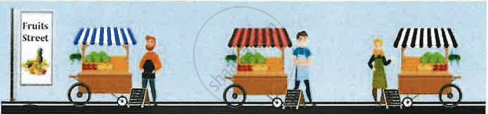
“While shopping for fruits in the local market you see many seller selling fruits”. In this context answer the following:
- What is the type of market referred to?
- State and draw the type of demand curve faced by the market above.
- Differentiate between the market indicated above and monopoly on the basis of:
- No. of sellers
- Market price
- Entry and exit of firms in the market
Indian Railways is an example of ______.
Match the following and select the correct option:
| Column I | Column II | ||
| (i) | Perfect competition | (A) | Differentiated Products |
| (ii) | Monopoly | (B) | Few large firms |
| (iii) | Monopolistic Competition | (C) | Single seller |
| (iv) | Oligopoly | (D) | Homogeneous products |
Indian Oil Corporation Limited is an example of a/an ______.
There is no difference between perfect competition and pure competition.
Pick the option which does not belong to the group.
Read the given statements carefully and select the correct option.
- The number of sellers under oligopoly are small.
- In monopolistically competitive markets, buyers and sellers have perfect knowledge about the market conditions.
Which one of the following is NOT found in a perfectly competition market?
Which of the following is the least competitive market?
Match the following:
| Column I | Column II | ||
| A. | Monopoly | (i) | Availability of close substitutes |
| B. | Oligopoly | (ii) | Absence of close substitutes |
| C. | Perfect competition | (iii) | Few large sellers |
| D. | Monopolistic competition | (iv) | Homogeneous products |
Read the following statements carefully and choose the correct alternative:
Assertion (A): Price discrimination is possible under monopoly.
Reason (R): A monopolist can charge different prices in different markets because different sets of consumers - rich and poor - have different price elasticity of demand for the monopolist's product.
Read the following statements carefully and choose the correct alternative:
Assertion (A): Under Perfect Competition, each firm faces a perfectly elastic demand curve.
Reason (R): Firm is a price maker under perfect competition.
Define monopolistic competition.
Give an example of oligopoly.
Define monopsony.
Define product differentiation.
To which market is product differentiation relevant?
Highlight the importance of selling costs in a monopolistically compatible market.
Identify the market form of the following:
The Government of India is the sole buyer of fighter aircrafts.
State the market form of the following commodity.
Fighter Aircrafts
Identify the market form for the item given below:
A single seller
Identify the market form for the item given below:
Product differentiation
Give an example of price discrimination.
Explain any four features of perfect competition.
Discuss any four differences between monopoly and monopolistic competition.
Which type of market structure is the following? Give reason.
Lipstick
Which type of market structure is the following? Give reason.
Ball-pen
Which market form has the least number of producers?
What induces new firms to enter an industry?
What is meant by barriers to entry?
What is the difference between perfect and imperfect oligopoly?
What does perfectly elastic demand curve faced by a competitive firm indicate?
Elaborate the price discrimination feature of monopoly.
There is inverse relation between price and demand for the product of a firm under ______.
Which of the following is an example of a perfectly competitive market?
