Advertisements
Advertisements
Question
What do you understand by the following statement:
The specific heat capacity of lead is 130 J kg−1K−1.
Advertisements
Solution
The specific heat capacity of lead is 130 J kg−1K−1 means that 130 joules of heat energy are required to raise the temperature of 1 kg of lead by 1 kelvin (1 K).
RELATED QUESTIONS
What property of water makes it an effective coolant?
During the phase change does the average kinetic energy of the molecules of the substance increase?
Water property of water makes it an effective coolant?
Give one example where high specific heat capacity of water is used as cooling.
Explain, why temperature in hot summer, falls sharply after a sharp shower?
A substance is in the form of a solid at 0°C. The amount of heat added to this substance and the temperature of the substance are plotted on the following graph:
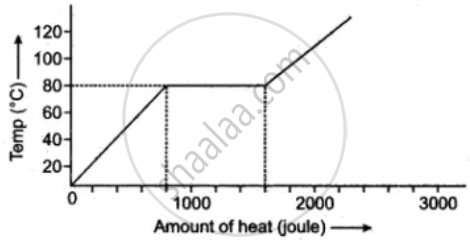
If the specific heat capacity of the solid substance is 500 J/kg °G, find from the graph, the mass of the substance.
A vessel of negligible heat*capacity contains 40g of ice in it at 0°C, 8g of steam at 100°C is passed into the ice to melt it. Find the final temperature of the contents of the vessel.
(Specific latent heat of vaporization of steam = 2268 J/g, specific latent heat of fusion of ice = 336 J/f and specific heat capacity of water = 4.2 J/g°C)
Express the change in internal energy in terms of molar specific heat capacity.
At same temperature and pressure of an ideal gas, ____________.
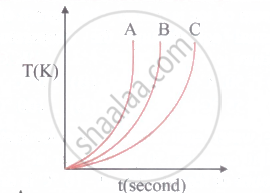
Which of the following substances (A, B and C) has the highest specific heat?