Advertisements
Advertisements
प्रश्न
What do you understand by the following statement:
The specific heat capacity of lead is 130 J kg−1K−1.
Advertisements
उत्तर
The specific heat capacity of lead is 130 J kg−1K−1 means that 130 joules of heat energy are required to raise the temperature of 1 kg of lead by 1 kelvin (1 K).
संबंधित प्रश्न
What do you mean by the following statement?
The specific heat capacity of copper is 0. 4 Jg-1 K-1?
Equal heat is given to two objects A and B of mass 1 g. Temperature of A increases by 3°C and B by 5°C. Which object has more specific heat? And by what factor?
In Regnault's apparatus for measuring specific heat capacity of a solid, there is an inlet and an outlet in the steam chamber. The inlet is near the top and the outlet is near the bottom. Why is it better than the opposite choice where the inlet is near the bottom and the outlet is near the top?
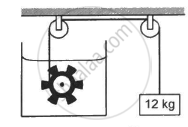
Figure shows a paddle wheel coupled to a mass of 12 kg through fixed frictionless pulleys. The paddle is immersed in a liquid of heat capacity 4200 J K−1 kept in an adiabatic container. Consider a time interval in which the 12 kg block falls slowly through 70 cm. (a) How much heat is given to the liquid? (b) How much work is done on the liquid? (c) Calculate the rise in the temperature of the liquid neglecting the heat capacity of the container and the paddle.
What are other units of heat? Name and define them.
Explain, why do sandy soils, get heated up quickly as compared to wet soils?
A vessel of negligible heat*capacity contains 40g of ice in it at 0°C, 8g of steam at 100°C is passed into the ice to melt it. Find the final temperature of the contents of the vessel.
(Specific latent heat of vaporization of steam = 2268 J/g, specific latent heat of fusion of ice = 336 J/f and specific heat capacity of water = 4.2 J/g°C)
Calculate the ratio of two specific heats of polyatomic gas molecules.
If 'Cp' and 'Cv' are molar specific heats of an ideal gas at constant pressure and volume respectively. If 'λ' is the ratio of two specific heats and 'R' is universal gas constant then 'Cp' is equal to ______.
Why is water used as a coolant in radiators of a car?
