Advertisements
Advertisements
प्रश्न
What do you understand by the following statement:
The specific heat capacity of lead is 130 J kg−1K−1.
Advertisements
उत्तर
The specific heat capacity of lead is 130 J kg−1K−1 means that 130 joules of heat energy are required to raise the temperature of 1 kg of lead by 1 kelvin (1 K).
संबंधित प्रश्न
State two factors upon which the heat absorbed by a body depends.
Why do the farmers fill their fields with water on a cold winter night?
The global warming has resulted:
(a) the increase in yield of crops
(b) the decrease in sea levels
(c) the decrease in human deaths
(d) the increase in sea levels
Describe a method to determine the specific heat capacity of a solid (say, a piece of copper).
Discuss how high specific heat capacity of water helps in formation of land and sea breeze.
A. hot solid of mass 60 g at 100°C is placed in 150 g of water at 20° C. The final steady temperature recorded is 25°C. Calculate the specific heat capacity of the solid. [Specific heat capacity of water = 4200 J kg-1 °C-1]
How much heat energy is necessary to raise the temperature of 5 kg of water from 20°C to 100°C?
From the options given below the specific heat of _______ is maximum.
The diagram below shows a cooling curve for 200 g of water. The heat is extracted at the rate of 100 Js-1. Answer the questions that follow:
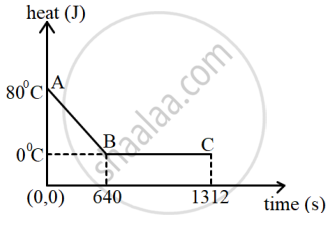
- Calculate specific heat capacity of water.
- Heat released in the region BC.
J/Kg °C is the unit of specific heat capacity.
