Advertisements
Advertisements
Question
What property of water makes it an effective coolant?
Advertisements
Solution
The high specific heat capacity of water makes it an effective coolant.
RELATED QUESTIONS
What amount of heat must be supplied to 2.0 x 10⁻² kg of nitrogen (at room temperature) to raise its temperature by 45 °C at constant pressure? (Molecular mass of N2 = 28; R = 8.3 J mol-1 K-1.)
You have a choice of three metals A, B, and C, of specific heat capacities 900 Jkg-1 °C-1, 380 Jkg-1 °C-1 and 460 Jkg-1 °C-1 respectively, to make a calorimeter. Which material will you select? Justify your answer.
Heat supplied to a solid change it into liquid. What is this change in the phase called?
The temperature of 170 g of water at 50°C is lowered to 5°C by adding a certain amount of ice to it. Find the mass of ice added.
Given: Specific heat capacity of water = 4200 J kg-1 °C-1 and specific latent heat of ice = 336000 J kg-1.
Without green house effect, the average temperature of earth’s surface would have been:
(a) – 18℃
(b) 33℃
(c) 0℃
(d) 15℃
A substance is heated at a constant rate from a low temperature to a high temperature. A graph of temperature against time is shown in the figure. Which part or parts of the graph correspond(s) to the substance existing in two states?
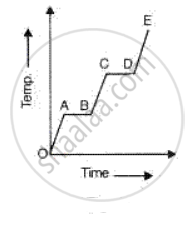
(b) 2000 J of heat energy is required to raise the temperature of 4 kg of a
metal by 3°c. Which expression gives the specific heat capacity of the metal?
Ice-cream at 0°C feels colder than water at 0°C. Give reason for this observation.
An electric immersion heater is rated 1250 W. Calculate the time in which it will heat 20 kg of water at 5°C to 65°C.
Water has the lowest specific heat capacity.
