Advertisements
Advertisements
Question
Derive an expression for finding out the specific heat capacity of a body (solid) from the readings of an experiment given below:
(i) Mass of empty calorimeter (with stirrer) = m1 gm
(ii) Mass of the metal piece = M gm
(iii) Mass of colorimeter and water = m2 gm
(iv) Initial temperature and water = t1°C
(v) Temperature of hot solid (metal piece) = t2 °C
(vi) Final temperature of the mixture = t°C
(vii) Specific heat of calorimeter = 0.4 J gm / °C
Advertisements
Solution
Lets J gm / °C be the specific heat of the solid
(i) Fall in temperature of hot solid = (t2 - t) °C
(ii) Rise in the temperature of calorimeter as well as water = (t - t2) °C
(iii) Heat taken up by calorimeter = m1 × 0.4 × (t - t1) °C
(iv) Heat taken up by water = (m2 - m1) × 4.2 × (t - t1)°C
(v) Heat given out by hot soild = M × s × (t2 - t)°C
Now, heat given out by hot solid = Heat taken up by calorimeter + Heat taken up by water
or Ms (t2 - t) = m1 × 0.4 (t - t1) + (m2 - m1) × (4.2 × (t - t1))
From this heat equation, 's' can b e calculated where all other values are known.
RELATED QUESTIONS
What property of water makes it an effective coolant?
Water property of water makes it an effective coolant?
Name three fossil fuels that emit carbon dioxide into the atmosphere ?
How will climate changes affect the various animal species?
What impact will climate changes have on the crops of food?
A substance is in the form of a solid at 0°C. The amount of heat added to this substance and the temperature of the substance are plotted on the following graph:
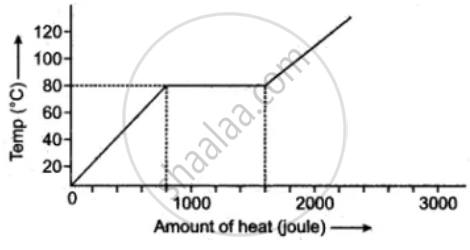
If the specific heat capacity of the solid substance is 500 J/kg °G, find from the graph, the mass of the substance.
How much heat energy is necessary to raise the temperature of 5 kg of water from 20°C to 100°C?
All metals have the same specific heat capacity.
Read the passage and answer the questions based on it.
If heat is exchanged between a hot and cold object, the temperature of the cold object goes on increasing due to gain of energy and the temperature of the hot object goes on decreasing due to loss of energy. The change in temperature continues till the temperatures of both objects attain the same value. In this process, the cold object gains heat energy and the hot object loses heat energy. If the system of both the objects is isolated from the environment by keeping it inside a heat-resistant box then no energy can flow from inside the box or come into the box. In this situation, we get the following principle.
Heat energy lost by the hot object = Heat energy gained by the cold object. This is called the ‘Principle of heat exchange’.
- Where does heat transfer take place?
- In such a situation which principle of heat do you perceive?
- How can this principle be explained in short?
- Measuring the property of which substance this principle is used?
On supplying 100 µC of charge to a conductor, its potential rises by 5 V then capacity of the conductor is ______.
