Advertisements
Advertisements
Question
Using crystal field theory, draw energy level diagram, write electronic configuration of the central metal atom/ion and determine the magnetic moment value in the following:
\[\ce{[CoF6]^{3-}, [Co(H2O)6]^{2+}, [Co(Cn)6]^{3-}}\]
Advertisements
Solution
(1) \[\ce{[CoF6]^{3-}}\]: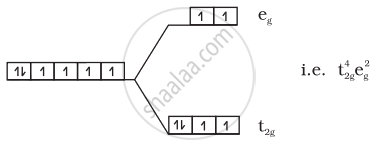
\[\ce{Co^{3+} = 3d^6}\]
Number of unpaired electrons = 4
Magnetic moment = `sqrt(n(n + 2)) = sqrt(4(4 + 2))` = 4.9 BM
(ii) \[\ce{[Co(H2O)6]^{2+}}\]:
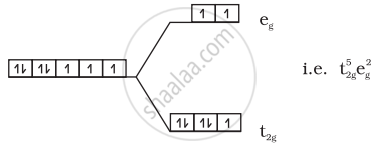
\[\ce{Co^{2+} = 3d^7}\]
Number of unpaired electrons = 3
Magnetic moment = `sqrt(3(3 + 2))` = 3.87 BM
(iii) \[\ce{[Co(CN)6]^{3-}}\]:
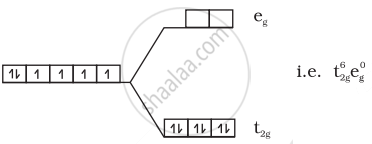
\[\ce{Co^{3+} = 3d^6}\]
No unpaired electrons so diamagnetic.
APPEARS IN
RELATED QUESTIONS
On the basis of crystal field theory, write the electronic configuration for d4 ion if ∆0 < P.
How are the following conversions carried out?
Benzoic acid into metanitrobenzoic acid.
Why are low spin tetrahedral complexes rarely observed?
Draw the structures of the following :
(1) XeF6
(2) IF7
Complete and balance the following reactions:
\[\ce{P4 + H2SO4 ->}\] ______ + ______ + ______
The colour of the coordination compounds depends on the crystal field splitting. What will be the correct order of absorption of wavelength of light in the visible region, for the complexes, \[\ce{[Co(NH3)6]^{3+}}\], \[\ce{[Co(CN)6]^{3-}}\], \[\ce{[Co(H2O)6]^{3+}}\]
The CFSE for octahedral \[\ce{[CoCl6]^{4-}}\] is 18,000 cm–1. The CFSE for tetrahedral \[\ce{[CoCl4]^{2-}}\] will be ______.
Atomic number of \[\ce{Mn, Fe, Co}\] and Ni are 25, 26, 27 and 28 respectively. Which of the following outer orbital octahedral complexes have same number of unpaired electrons?
(i) \[\ce{[MnCl6]^{3-}}\]
(ii) \[\ce{[FeF6]^{3-}}\]
(iii) \[\ce{[CoF6]^{3-}}\]
(iv) \[\ce{[Ni(NH3)6]^{2+}}\]
The CFSE for octahedral [CoCl6]−4 is 18,000 cm−1. What will be the CFSE for tetrahedral [CoCl3]−2?
In a coordination entity, the electronic configuration of the central metal ion is t2g3 eg1
Draw the crystal field splitting diagram for the above complex.
Considering crystal field theory, strong-field ligands such as CN–:
The magnitude of CFSE depends upon ______
The correct order of intensity of colors of the compounds is ______.
Consider that d6 metal ion (M2+) forms a complex with aqua ligands and the spin only magnetic moment of the complex is 4.90 BM. The geometry and the crystal field stabilization energy of the complex are ______.
On the basis of crystal field theory, write the electronic configuration for the d5 ion with a weak ligand for which Δ0 < P.
Read the passage carefully and answer the questions that follow.
|
Crystal field splitting by various ligands Metal complexes show different colours due to d-d transitions. The complex absorbs light of specific wavelength to promote the electron from t2g to eg level. The colour of the complex is due to the transmitted light, which is complementary of the colour absorbed. The wave number of light absorbed by different complexes of Cr ion are given below:
|
Answer the following questions:
(a) Out of ligands "A", "B", "C" and "D", which ligand causes maximum crystal field splitting? Why?
OR
Which of the two, “A” or “D” will be a weak field ligand? Why?
(b) Which of the complexes will be violet in colour? [CrA6]3- or [CrB6]3+ and why?
(Given: If 560 - 570 nm of light is absorbed, the colour of the complex observed is violet.)
(c) If the ligands attached to Cr3+ ion in the complexes given in the table above are water, cyanide ion, chloride ion, and ammonia (not in this order).
Identify the ligand, write the formula and IUPAC name of the following:
- [CrA6]3-
- [CrC6]3+
