Advertisements
Advertisements
Question
Write the electronic configuration of Fe(III) on the basis of crystal field theory when it forms an octahedral complex in the presence of (i) strong field, and (ii) weak field ligand. (Atomic no.of Fe=26)
Advertisements
Solution
`"Fe"= ["Ar"]3"d"^6 4"s"^2`
`"Fe"^{3+} = ["Ar"]3"d"^6 4"s"^2`
`"Fe"^(+3) = ["AR"] 3"d"^5 4"s"^0`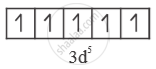
In octahedral crystal field.
(i) Strong field ligand - Electrons will be paired.
No. of unpaired e- = 1
Paramagnetic
`μ = sqrt(n(n+2) = sqrt(1(3) = sqrt3 B.M`
(ii) Weak field ligand
- Electrons follow Hund’s rule 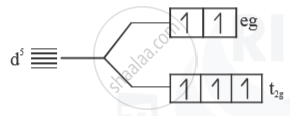
No. of unpaired = 5
Paramagnetic
`μ =sqrt(5(5+2))= sqrt(35) B.M.`
APPEARS IN
RELATED QUESTIONS
On the basis of crystal field theory, write the electronic configuration for d4 ion if ∆0 < P.
The hexaquo manganese(II) ion contains five unpaired electrons, while the hexacyanoion contains only one unpaired electron. Explain using Crystal Field Theory.
Why are low spin tetrahedral complexes rarely observed?
Complete and balance the following reactions:
\[\ce{P4 + H2SO4 ->}\] ______ + ______ + ______
Give the electronic configuration of the following complexes on the basis of Crystal Field Splitting theory.
\[\ce{[CoF6]^{3-}, [Fe(CN)6]^{4-} and [Cu(NH3)6]^{2+}}\].
Arrange following complex ions in increasing order of crystal field splitting energy (∆O):
\[\ce{[Cr(Cl)6]^{3-}, [Cr(CN)6]^{3-}, [Cr(NH3)6]^{3+}}\].
[Ni(H2O)6]2+ (aq) is green in colour whereas [Ni(H2O)4 (en)]2+ (aq)is blue in colour, give reason in support of your answer.
The correct order of increasing crystal field strength in following series:
Crystal field stabilising energy for high spind4 octahedral complex is:-
Using crystal field theory, write the electronic configuration of d5 ion, if Δ0 > P.
