English
Karnataka Board PUCPUC Science 2nd PUC Class 12

Using crystal field theory, draw energy level diagram, write electronic configuration of the central metal atom/ion and determine the magnetic moment value in the following: [FeFX6]X3−,[Fe(HX - Chemistry

Advertisements
Advertisements

Question

Using crystal field theory, draw energy level diagram, write electronic configuration of the central metal atom/ion and determine the magnetic moment value in the following:

\[\ce{[FeF6]^{3-}, [Fe(H2O)6]^{2+}, [Fe(CN)6]^{4-}}\]

Long Answer
Advertisements

Solution

(1) \[\ce{FeF^{3-}6}\]:
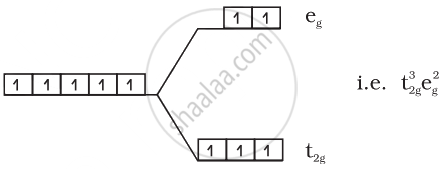
\[\ce{Fe^{3+} = 3d^5}\]

Number of unpaired electrons = 5

Magnetic moment = `sqrt(5(5 + 2))` = 5.92 BM

(2) \[\ce{[Fe(H2O)6]^{2+}}\]:
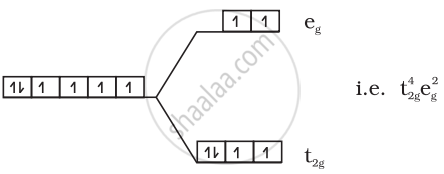
\[\ce{Fe^{2+} = 3d^6}\]

Number of unpaired electrons = 4

Magnetic moment = `sqrt(4(4 + 2))` = 4.9 BM

(3) \[\ce{[Fe(CN)6]^{4-}}\]:

\[\ce{Fe^{2+} = 3d^6}\]

Since CN is a strong field ligand all the electrons get paired.
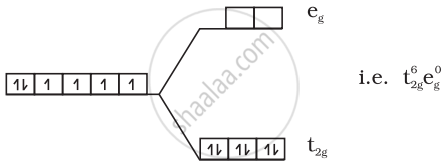
No unpaired electrons so diamagnetic.

shaalaa.com
  Is there an error in this question or solution?
Chapter 9: Coordination Compounds - Exercises [Page 127]

APPEARS IN

NCERT Exemplar Chemistry [English] Class 12
Chapter 9 Coordination Compounds
Exercises | Q VI. 46. (ii) | Page 127

RELATED QUESTIONS

On the basis of crystal field theory, write the electronic configuration for d4 ion if Δ0 > P.


The hexaquo manganese (II) ion contains five unpaired electrons, while the hexacyanoion contains only one unpaired electron. Explain using Crystal Field Theory.


How does the magnitude of Δ0 decide the actual configuration of d orbitals in a coordination entity?


Why are low spin tetrahedral complexes rarely observed?


The colour of the coordination compounds depends on the crystal field splitting. What will be the correct order of absorption of wavelength of light in the visible region, for the complexes, \[\ce{[Co(NH3)6]^{3+}}\], \[\ce{[Co(CN)6]^{3-}}\], \[\ce{[Co(H2O)6]^{3+}}\]


Atomic number of \[\ce{Mn}\], \[\ce{Fe}\] and \[\ce{Co}\] are 25, 26 and 27 respectively. Which of the following inner orbital octahedral complex ions are diamagnetic?

(i) \[\ce{[Co(NH3)6]^{3+}}\]

(ii) \[\ce{[Mn(CN)6]^{3-}}\] 

(iii) \[\ce{[Fe(CN)6]^{4-}}\]

(iv) \[\ce{[Fe(CN)6]^{3-}}\]


An aqueous pink solution of cobalt (II) chloride changes to deep blue on addition of excess of HCl. This is because:

(i) \[\ce{[Co(H2O)6]^{2+}}\] is transformed into \[\ce{[CoCl6]}^{4-}\]

(ii) \[\ce{[Co(H2O)6]^{2+}}\] is transformed into \[\ce{[CoCl4]}^{2-}\]

(iii) tetrahedral complexes have smaller crystal field splitting than octahedral complexes.

(iv) tetrahedral complexes have larger crystal field splitting than octahedral complex.


Arrange following complex ions in increasing order of crystal field splitting energy (∆O):

\[\ce{[Cr(Cl)6]^{3-}, [Cr(CN)6]^{3-}, [Cr(NH3)6]^{3+}}\].


\[\ce{CuSO4 . 5H2O}\] is blue in colour while \[\ce{CuSO4}\] is colourless. Why?


Match the complex ions given in Column I with the hybridisation and number of unpaired electrons given in Column II and assign the correct code:

Column I (Complex ion) Column II (Hybridisation, number of unpaired electrons)
A. \[\ce{[Cr(H2O)6]^{3+}}\] 1. dsp2, 1
B. \[\ce{[Co(CN)4]^{2-}}\] 2. sp3d2, 5
C. \[\ce{[Ni(NH3)6]^{2+}}\] 3. d2sp3, 3
D. \[\ce{[MnF6]^{4-}}\] 4. sp3, 4
  5. sp3d2, 2

Using crystal field theory, draw energy level diagram, write electronic configuration of the central metal atom/ion and determine the magnetic moment value in the following:

\[\ce{[CoF6]^{3-}, [Co(H2O)6]^{2+}, [Co(Cn)6]^{3-}}\]


The correct order of increasing crystal field strength in following series:


What is the spectrochemical series?


The correct order of intensity of colors of the compounds is ______.


Consider that d6 metal ion (M2+) forms a complex with aqua ligands and the spin only magnetic moment of the complex is 4.90 BM. The geometry and the crystal field stabilization energy of the complex are ______.


Read the passage carefully and answer the questions that follow.

Crystal field splitting by various ligands

Metal complexes show different colours due to d-d transitions. The complex absorbs light of specific wavelength to promote the electron from t2g to eg level. The colour of the complex is due to the transmitted light, which is complementary of the colour absorbed.

The wave number of light absorbed by different complexes of Cr ion are given below:

Complex Wavenumber of light absorbed (cm-1) Energy of light absorbed (kJ/mol)
[CrA6]3- 13,640 163
[CrB6]3+ 17,830 213
[CrC6]3+ 21,680 259
[CrD6]3- 26,280 314

Answer the following questions:

(a) Out of ligands "A", "B", "C" and "D", which ligand causes maximum crystal field splitting? Why?

OR

Which of the two, “A” or “D” will be a weak field ligand? Why?

(b) Which of the complexes will be violet in colour? [CrA6]3- or [CrB6]3+ and why?
(Given: If 560 - 570 nm of light is absorbed, the colour of the complex observed is violet.)

(c) If the ligands attached to Cr3+ ion in the complexes given in the table above are water, cyanide ion, chloride ion, and ammonia (not in this order).

Identify the ligand, write the formula and IUPAC name of the following:

  1. [CrA6]3-
  2. [CrC6]3+

On the basis of Crystal Field Theory, write the electronic configuration of d4 ion if Δ0 > P.


Share
Notifications

Englishहिंदीमराठी


      Forgot password?
Use app×