Advertisements
Advertisements
Question
The sum of three consecutive numbers is 156. Find the number which is a multiple of 13 out of these numbers.
Advertisements
Solution
Let three consecutive numbers be x, (x + 1) and (x + 2).
According to the question,
x + (x + 1) + (x + 2) = 156 ...[Given]
⇒ 3x + 3 = 156
⇒ 3x = 156 – 3 = 153
∴ `x = 153 xx 1/3 = 51`
Thus, we get the numbers 51, 51 + 1 and 51 + 2, i.e. 51, 52 and 53. Out of these, only 52 is a multiple of 13.
APPEARS IN
RELATED QUESTIONS
Three consecutive integers are such that when they are taken in increasing order and multiplied by 2, 3 and 4 respectively, they add up to 74. Find these numbers.
Baichung’s father is 26 years younger than Baichung’s grandfather and 29 years older than Baichung. The sum of the ages of all the three is 135 years. What is the age of each one of them?
Fifteen years from now Ravi’s age will be four times his present age. What is Ravi’s present age?
Lakshmi is a cashier in a bank. She has currency notes of denominations Rs 100, Rs 50 and Rs 10, respectively. The ratio of the number of these notes is 2:3:5. The total cash with Lakshmi is Rs 4, 00,000. How many notes of each denomination does she have?
I have a total of Rs 300 in coins of denomination Re 1, Rs 2 and Rs 5. The number of Rs 2 coins is 3 times the number of Rs 5 coins. The total number of coins is 160. How many coins of each denomination are with me?
The difference between two whole numbers is 66. The ratio of the two numbers is 2: 5. What are the two numbers?
3 years ago, the age of a boy was y years. His age 2 years ago was (y – 2) years.
Shikha’s present age is p years. Reemu’s present age is 4 times the present age of Shikha. After 5 years Reemu’s age will be 15p years.
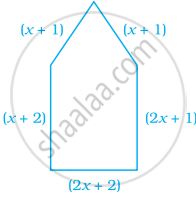
For what value of x is the perimeter of shape 77 cm?