Advertisements
Advertisements
Question
The sum of three consecutive multiples of 7 is 357. Find the smallest multiple.
Options
112
126
119
116
Advertisements
Solution
112
Explanation:
Let the three consecutive multiples of 7 be 7x, (7x + 7), (7x + 14) where x is a natural number.
According to the question,
7x + (7x + 7) + (7x + 14) = 357
⇒ 21x + 21 = 357
⇒ 21(x + 1) = 357
⇒ `(21(x + 1))/21 = 357/21` ...[Dividing both sides by 21]
⇒ x + 1 = 17
⇒ x = 17 – 1 ...[Transposing 1 to RHS]
⇒ x = 16
Hence, the smallest multiple of 7 is 7 × 16, i.e. 112.
APPEARS IN
RELATED QUESTIONS
Three consecutive integers add up to 51. What are these integers?
The number of boys and girls in a class are in the ratio 7:5. The number of boys is 8 more than the number of girls. What is the total class strength?
Baichung’s father is 26 years younger than Baichung’s grandfather and 29 years older than Baichung. The sum of the ages of all the three is 135 years. What is the age of each one of them?
Sum of two numbers is 74. One of the numbers is 10 more than the other. What are the numbers?
Arpita’s present age is thrice of Shilpa. If Shilpa’s age three years ago was x. Then Arpita’s present age is ______.
Shikha’s present age is p years. Reemu’s present age is 4 times the present age of Shikha. After 5 years Reemu’s age will be 15p years.
Two equal sides of a triangle are each 4 m less than three times the third side. Find the dimensions of the triangle, if its perimeter is 55 m.
The perimeter of a rectangle is 240 cm. If its length is increased by 10% and its breadth is decreased by 20%, we get the same perimeter. Find the length and breadth of the rectangle.
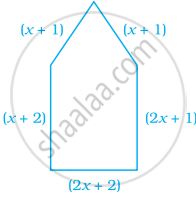
For what value of x is the perimeter of shape 77 cm?
On dividing Rs. 200 between A and B such that twice of A’s share is less than 3 times B’s share by 200, B’s share is?
