Advertisements
Advertisements
Question
The set of all points where the function f(x) = x + |x| is differentiable, is ______.
Options
(0, ∞)
(–∞, 0)
(–∞, 0) ∪ (0, ∞)
(–∞, ∞)
Advertisements
Solution 1
The set of all points where the function f(x) = x + |x| is differentiable, is (–∞, 0) ∪ (0, ∞).
Explanation:
f(x) = x + |x| = `{{:(2x",", x ≥ 0),(0",", x < 0):}`
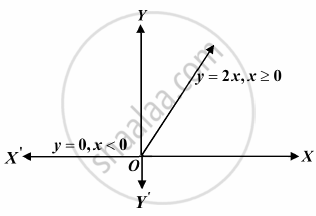
There is a sharp corner at x = 0, so f(x) is not differentiable at x = 0.
Solution 2
The set of all points where the function f(x) = x + |x| is differentiable, is (–∞, 0) ∪ (0, ∞).
Explanation:
Lf' (0) = 0 and Rf' (0) = 2 ; so, the function is not differentiable at x = 0
For x ≥ 0, f(x) = 2x (linear function) and when x < 0, f(x) = 0 (constant function)
Hence f(x) is differentiable when x ∈ (–∞, 0) ∪ (0, ∞).
APPEARS IN
RELATED QUESTIONS
Differentiate the function with respect to x.
`cos (sqrtx)`
Prove that the function f given by f(x) = |x − 1|, x ∈ R is not differentiable at x = 1.
Differentiate the function with respect to x:
`sin^(–1)(xsqrtx), 0 ≤ x ≤ 1`
If f(x) = |x|3, show that f"(x) exists for all real x and find it.
Let f(x) = x|x|, for all x ∈ R. Discuss the derivability of f(x) at x = 0
If y = tan(x + y), find `("d"y)/("d"x)`
If y = tanx + secx, prove that `("d"^2y)/("d"x^2) = cosx/(1 - sinx)^2`
|sinx| is a differentiable function for every value of x.
(sin x)cosx
(x + 1)2(x + 2)3(x + 3)4
`cos^-1 ((sinx + cosx)/sqrt(2)), (-pi)/4 < x < pi/4`
`tan^-1 (secx + tanx), - pi/2 < x < pi/2`
`tan^-1 (("a"cosx - "b"sinx)/("b"cosx - "a"sinx)), - pi/2 < x < pi/2` and `"a"/"b" tan x > -1`
`sec^-1 (1/(4x^3 - 3x)), 0 < x < 1/sqrt(2)`
If xm . yn = (x + y)m+n, prove that `("d"^2"y")/("dx"^2)` = 0
For the curve `sqrt(x) + sqrt(y)` = 1, `"dy"/"dx"` at `(1/4, 1/4)` is ______.
If k be an integer, then `lim_("x" -> "k") ("x" - ["x"])` ____________.
If `y = (x + sqrt(1 + x^2))^n`, then `(1 + x^2) (d^2y)/(dx^2) + x (dy)/(dx)` is
The rate of increase of bacteria in a certain culture is proportional to the number present. If it doubles in 5 hours then in 25 hours, its number would be
Let f: R→R and f be a differentiable function such that f(x + 2y) = f(x) + 4f(y) + 2y(2x – 1) ∀ x, y ∈ R and f’(0) = 1, then f(3) + f’(3) is ______.
If f(x) = `{{:((sin(p + 1)x + sinx)/x,",", x < 0),(q,",", x = 0),((sqrt(x + x^2) - sqrt(x))/(x^(3//2)),",", x > 0):}`
is continuous at x = 0, then the ordered pair (p, q) is equal to ______.
Let S = {t ∈ R : f(x) = |x – π| (e|x| – 1)sin |x| is not differentiable at t}. Then the set S is equal to ______.
If f(x) = `{{:(ax + b; 0 < x ≤ 1),(2x^2 - x; 1 < x < 2):}` is a differentiable function in (0, 2), then find the values of a and b.
Prove that the greatest integer function defined by f(x) = [x], 0 < x < 3 is not differentiable at x = 1 and x = 2.
What is \[\frac{d}{dx}(\sin x)\]?
What is \[\frac{d}{dx}(\tan x)\]?
Why is \[|x|\] not differentiable at \[x=0\]?
