Advertisements
Advertisements
प्रश्न
The set of all points where the function f(x) = x + |x| is differentiable, is ______.
पर्याय
(0, ∞)
(–∞, 0)
(–∞, 0) ∪ (0, ∞)
(–∞, ∞)
Advertisements
उत्तर १
The set of all points where the function f(x) = x + |x| is differentiable, is (–∞, 0) ∪ (0, ∞).
Explanation:
f(x) = x + |x| = `{{:(2x",", x ≥ 0),(0",", x < 0):}`
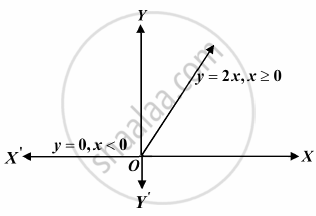
There is a sharp corner at x = 0, so f(x) is not differentiable at x = 0.
उत्तर २
The set of all points where the function f(x) = x + |x| is differentiable, is (–∞, 0) ∪ (0, ∞).
Explanation:
Lf' (0) = 0 and Rf' (0) = 2 ; so, the function is not differentiable at x = 0
For x ≥ 0, f(x) = 2x (linear function) and when x < 0, f(x) = 0 (constant function)
Hence f(x) is differentiable when x ∈ (–∞, 0) ∪ (0, ∞).
APPEARS IN
संबंधित प्रश्न
Differentiate the function with respect to x:
(3x2 – 9x + 5)9
Find `dy/dx`, if y = 12 (1 – cos t), x = 10 (t – sin t), `-pi/2 < t < pi/2`.
If y = `[(f(x), g(x), h(x)),(l, m,n),(a,b,c)]`, prove that `dy/dx = |(f'(x), g'(x), h'(x)),(l,m, n),(a,b,c)|`.
If sin y = xsin(a + y) prove that `(dy)/(dx) = sin^2(a + y)/sin a`
`"If y" = (sec^-1 "x")^2 , "x" > 0 "show that" "x"^2 ("x"^2 - 1) (d^2"y")/(d"x"^2) + (2"x"^3 - "x") (d"y")/(d"x") - 2 = 0`
If f(x) = x + 1, find `d/dx (fof) (x)`
If y = tan(x + y), find `("d"y)/("d"x)`
If y = tanx + secx, prove that `("d"^2y)/("d"x^2) = cosx/(1 - sinx)^2`
Let f(x)= |cosx|. Then, ______.
If u = `sin^-1 ((2x)/(1 + x^2))` and v = `tan^-1 ((2x)/(1 - x^2))`, then `"du"/"dv"` is ______.
cos |x| is differentiable everywhere.
(x + 1)2(x + 2)3(x + 3)4
`cos^-1 ((sinx + cosx)/sqrt(2)), (-pi)/4 < x < pi/4`
`tan^-1 (("a"cosx - "b"sinx)/("b"cosx - "a"sinx)), - pi/2 < x < pi/2` and `"a"/"b" tan x > -1`
`sec^-1 (1/(4x^3 - 3x)), 0 < x < 1/sqrt(2)`
`tan^-1 ((sqrt(1 + x^2) + sqrt(1 - x^2))/(sqrt(1 + x^2) - sqrt(1 - x^2))), -1 < x < 1, x ≠ 0`
The differential coefficient of `"tan"^-1 ((sqrt(1 + "x") - sqrt (1 - "x"))/(sqrt (1+ "x") + sqrt (1 - "x")))` is ____________.
Let S = {t ∈ R : f(x) = |x – π| (e|x| – 1)sin |x| is not differentiable at t}. Then the set S is equal to ______.
If f(x) = `{{:(ax + b; 0 < x ≤ 1),(2x^2 - x; 1 < x < 2):}` is a differentiable function in (0, 2), then find the values of a and b.
The function f(x) = x | x |, x ∈ R is differentiable ______.
Prove that the greatest integer function defined by f(x) = [x], 0 < x < 3 is not differentiable at x = 1 and x = 2.
For \[v\ne0\], what is the derivative of \[\frac{u}{v}\]?
What is \[\frac{d}{dx}(\sin x)\]?
What is \[\frac{d}{dx}(\tan x)\]?
Which limit is the right-hand derivative at \[x=c\]?
When is a function differentiable on an open interval \[(a,b)\]?
Which statement correctly describes the converse of “differentiability implies continuity”?
