Advertisements
Advertisements
प्रश्न
The set of all points where the function f(x) = x + |x| is differentiable, is ______.
विकल्प
(0, ∞)
(–∞, 0)
(–∞, 0) ∪ (0, ∞)
(–∞, ∞)
Advertisements
उत्तर १
The set of all points where the function f(x) = x + |x| is differentiable, is (–∞, 0) ∪ (0, ∞).
Explanation:
f(x) = x + |x| = `{{:(2x",", x ≥ 0),(0",", x < 0):}`
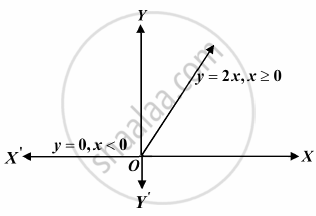
There is a sharp corner at x = 0, so f(x) is not differentiable at x = 0.
उत्तर २
The set of all points where the function f(x) = x + |x| is differentiable, is (–∞, 0) ∪ (0, ∞).
Explanation:
Lf' (0) = 0 and Rf' (0) = 2 ; so, the function is not differentiable at x = 0
For x ≥ 0, f(x) = 2x (linear function) and when x < 0, f(x) = 0 (constant function)
Hence f(x) is differentiable when x ∈ (–∞, 0) ∪ (0, ∞).
APPEARS IN
संबंधित प्रश्न
Differentiate the function with respect to x.
sin (ax + b)
Differentiate the function with respect to x.
`sec(tan (sqrtx))`
Differentiate the function with respect to x.
`2sqrt(cot(x^2))`
Differentiate the function with respect to x:
`(cos^(-1) x/2)/sqrt(2x+7)`, −2 < x < 2
Does there exist a function which is continuos everywhere but not differentiable at exactly two points? Justify your answer?
Discuss the continuity and differentiability of the
`"If y" = (sec^-1 "x")^2 , "x" > 0 "show that" "x"^2 ("x"^2 - 1) (d^2"y")/(d"x"^2) + (2"x"^3 - "x") (d"y")/(d"x") - 2 = 0`
If f(x) = x + 1, find `d/dx (fof) (x)`
`cos(tan sqrt(x + 1))`
(x + 1)2(x + 2)3(x + 3)4
`tan^-1 (("a"cosx - "b"sinx)/("b"cosx - "a"sinx)), - pi/2 < x < pi/2` and `"a"/"b" tan x > -1`
If `"f"("x") = ("sin" ("e"^("x"-2) - 1))/("log" ("x" - 1)), "x" ne 2 and "f" ("x") = "k"` for x = 2, then value of k for which f is continuous is ____________.
Let c, k ∈ R. If f(x) = (c + 1)x2 + (1 – c2)x + 2k and f(x + y) = f(x) + f(y) – xy, for all x, y ∈ R, then the value of |2(f(1) + f(2) + f(3) + ... + f(20))| is equal to ______.
Let S = {t ∈ R : f(x) = |x – π| (e|x| – 1)sin |x| is not differentiable at t}. Then the set S is equal to ______.
If f(x) = `{{:(x^2"," if x ≥ 1),(x"," if x < 1):}`, then show that f is not differentiable at x = 1.
The function f(x) = x | x |, x ∈ R is differentiable ______.
If \[u\] and \[v\] are differentiable functions, what is \[(uv)'\]?
What is \[\frac{d}{dx}(x^n)\]?
What is \[\frac{d}{dx}(\cos x)\]?
What is \[\frac{d}{dx}(\tan x)\]?
Which limit is the right-hand derivative at \[x=c\]?
What is the practical condition for differentiability at a point?
For differentiability on a closed interval \[[a,b]\], which derivative is considered at \[a\]?
If \[f\] is differentiable at \[c\], which limit equals \[f'(c)\]?
Which conclusion establishes that \[f\] is continuous at \[x=c\]?
Which statement correctly describes the converse of “differentiability implies continuity”?
When does a derivative exist?
What does differentiability at a point mean?
