Advertisements
Advertisements
Question
The recognition sequence of restriction enzymes is generally ______ nucleotide long.
Options
2 to 4
4 to 8
8 to 10
14 to 18
Advertisements
Solution
The recognition sequence of restriction enzymes is generally 4 to 8 nucleotides long.
Explanation:
The sequences recognized by restriction enzymes are 4 to 8 nucleotides long and characterized by a particular type of internal symmetry. Consider the specific sequence recognized by the enzyme EcoRI.
RELATED QUESTIONS
Explain the work carried out by Cohen and Boyer that contributed immensely in biotechnology.
How has the development of bioreactor helped in biotechnology?
Explain the properties of a good or ideal cloning vector for rDNA technology.
What is the role of Taq-polymerase in PCR technology?
Bt-cotton shows adverse effect on the population of which butterfly?
Study the following statements regarding separation of DNA using agarose gel electrophoresis.
- Large fragments of DNA molecules move faster than small DNA fragments and thus separate faster.
- DNA being negatively charged migrates to cathode.
The main reason for the presence of both a leading and a lagging strand during DNA replication is, ______
Identify the desirable characteristics for a plasmid used in rDNA technology from the following.
- Ability to multiply and express outside the host in a bioreactor.
- A highly active promoter.
- A site at which replication can be initiated.
- One or more identifiable marker genes.
- One or more unique restriction sites.
Suneeta is planning an experiment to clone a gene in a vector. So, she has to choose a good cloning vector.
Which one of the vectors shown below should she choose? Justify your answer by giving two reasons.
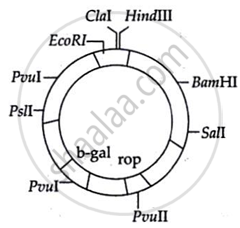 |
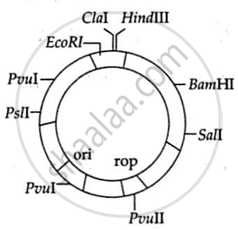 |
 |
| Vector A | Vector B | Vector C |
What is the function of DNA ligase in the creation of recombinant DNA?
